Anthropic’s official entry into the drug discovery sector marks a pivotal moment in the evolution of generative artificial intelligence. The company, widely recognized for its Claude model and its commitment to 'Constitutional AI,' is no longer just aiming to master human language; it is now seeking to decode the language of life itself: proteins, molecules, and complex biological systems.
Anthropic’s Strategy and the New Frontier
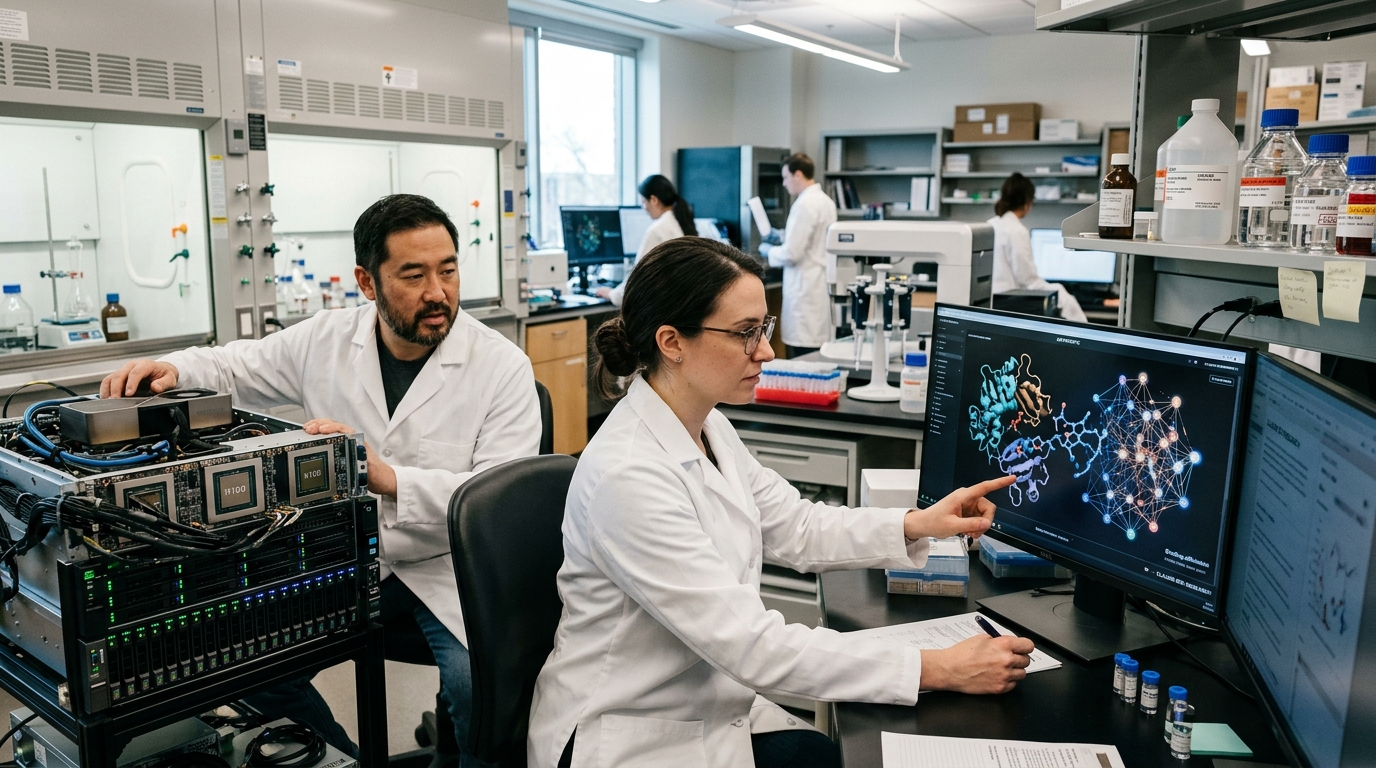
While industry observers expected this move, its timing and specific approach carry significant weight. As Google DeepMind dominates with AlphaFold 3 and Nvidia provides the foundational infrastructure via BioNeMo, Anthropic promises a unique synthesis: combining the reasoning capabilities of Large Language Models (LLMs) with specialized biological datasets. The program aims to drastically reduce the time needed to identify promising drug candidates—a process that traditionally spans over a decade and costs billions of dollars.
Anthropic has already initiated collaborations with leading scientists and pharmaceutical giants, focusing on areas where computational power can yield the highest impact, such as oncology and rare genetic disorders. Claude’s ability to parse vast amounts of scientific literature and propose novel molecular structures gives the company a strategic edge in the early stages of lead optimization.
The Competitive Landscape of Bio-AI
The market for AI in biotechnology is projected to skyrocket. Google DeepMind has set a high bar, having mapped nearly all known proteins. Microsoft, meanwhile, is investing heavily in models that simulate cellular processes. Anthropic’s differentiator lies in safety and interpretability. In an industry where precision is a matter of life and death, an AI model’s ability to explain the rationale behind a specific drug lead is invaluable.
- Google DeepMind: Focused on structural biology and protein folding prediction.
- Nvidia: Providing the hardware and software platforms for training specialized bio-models.
- Anthropic: Integrating linguistic reasoning with biological analysis under a safety-first framework.
The Biosecurity Paradox
One of the most compelling aspects of Anthropic’s entry into this field is its historical stance on AI risks. CEO Dario Amodei has repeatedly warned that AI could potentially assist in the creation of biological weapons. With this new program, the company must walk a tightrope: advancing medical innovation while ensuring these tools are not misappropriated for harmful purposes. Anthropic asserts that its safety protocols are the most rigorous in the industry, ensuring that the model filters out dangerous biological instructions.
"The challenge is not just finding the next cure, but ensuring that the knowledge generated remains secure," internal company sources suggest.
The Economic Imperative and the Path Ahead
For investors, this move represents a clear effort by Anthropic to diversify its revenue streams beyond consumer subscriptions and cloud services. The pharmaceutical industry holds massive capital and is desperately seeking ways to improve R&D (Research and Development) efficiency. If Anthropic can prove that Claude can reduce the failure rate in clinical trials by even 10%, the company's valuation could see exponential growth.
In conclusion, Anthropic’s foray into drug discovery is more than a business expansion; it is a declaration that AI is transitioning from digital creativity to physical intervention. The battle for the future of healthcare will be fought within the lines of code that attempt to understand our DNA.