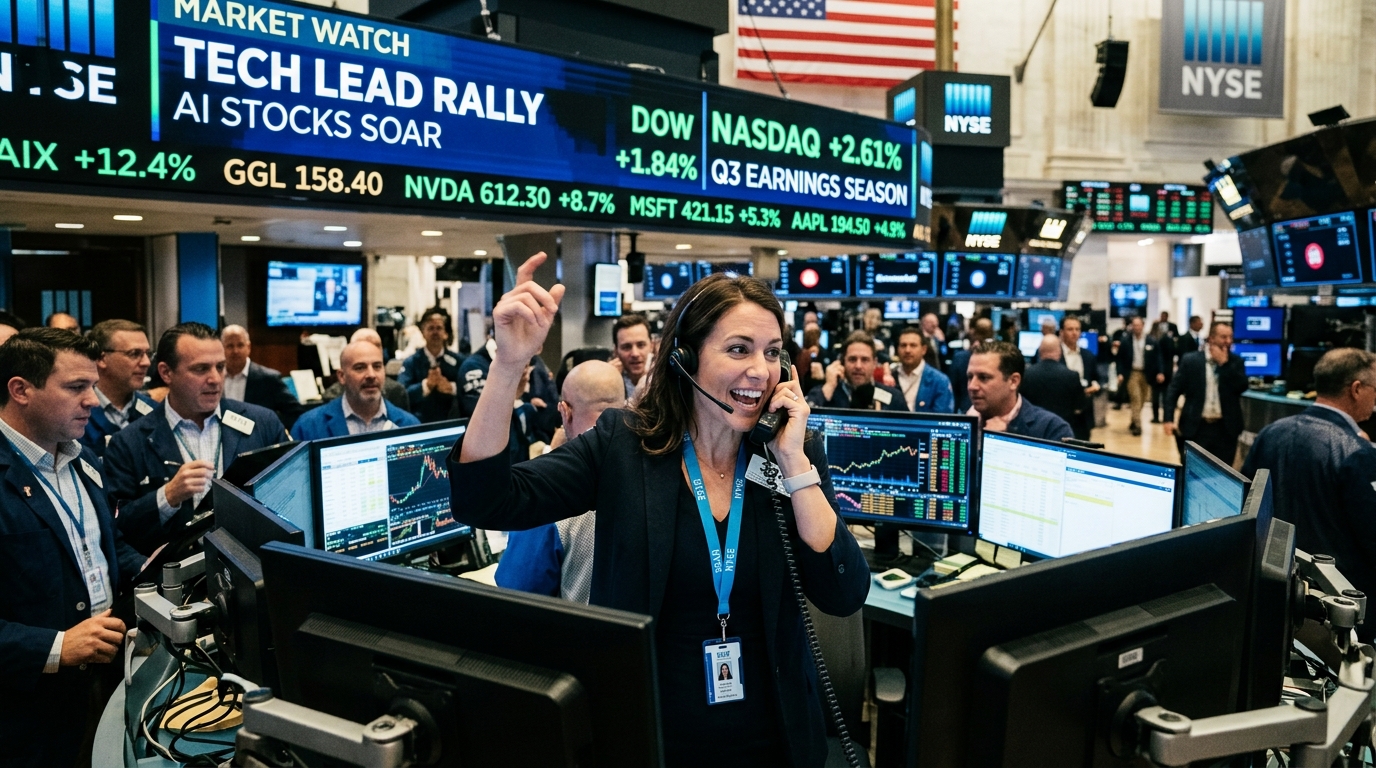
As the curtain falls on the first half of 2026, Wall Street finds itself in a state of euphoria that many analysts considered unthinkable two years ago. The start of the third quarter sees the S&P 500 and Nasdaq at all-time highs, with Artificial Intelligence (AI) no longer a mere promise for the future, but the primary engine of profitability for the world's largest corporations. The momentum built in 2024 and 2025 has now solidified, turning the technology sector into a safe haven for investors seeking growth in an environment of shifting interest rates.
The Shift from Infrastructure to Applications
If 2024 was the year of semiconductors and 2025 the year of large language models, 2026 is being characterized as the year of "Generative Implementation." Investors are no longer satisfied solely with chip sales from Nvidia or AMD. Attention has shifted to software and service providers that have successfully integrated AI into daily corporate workflows. "AI Agents" have become the new standard, automating complex processes from customer service to supply chain management.
Wall Street is closely monitoring profit margins. While infrastructure spending remains at record levels, the market is rewarding those who prove that AI can reduce operating costs. According to recent reports, S&P 500 companies that were early adopters of AI solutions report a productivity increase of 15% on average, justifying their premium stock prices.
The Role of Nvidia and Semiconductors
Despite the emergence of software, Nvidia remains the undisputed sovereign of the rally. With the release of its new "Rubin" architecture, the company has managed to maintain its lead over competitors, offering solutions that are not only faster but also significantly more energy-efficient. The data center energy crisis, which threatened growth in 2025, seems to be mitigated by new cooling technologies and more efficient processors.
- Nvidia's market capitalization is now approaching levels that make it the most valuable entity in stock market history.
- Competitors like AMD and Intel have found their own niche markets, particularly in "Edge AI" – artificial intelligence that runs locally on devices rather than in the cloud.
- Apple and Google continue to battle for dominance in AI-based operating systems, directly influencing consumer spending.
Macroeconomic Environment and Risks
However, the Q3 rally is not without risks. The Federal Reserve maintains a wait-and-see stance, as inflation, though reduced, remains sensitive to energy price fluctuations. The question looming over Wall Street is whether current valuations are sustainable. Many analysts warn of a "bubble" reminiscent of 2000, although market supporters point out that, unlike back then, today's tech giants possess massive cash reserves and real earnings.
"We are no longer in the speculation phase. We are in the phase of establishing a new digital economy," says a leading Goldman Sachs strategist.
Geopolitical instability remains the "black swan" that could derail forecasts. Restrictions on technology exports to China and the need for domestic semiconductor production in the US and Europe create a complex puzzle for multinationals. Nevertheless, optimism for the third quarter remains steadfast, with AI stocks being the only "sure bet" in a world full of uncertainties.