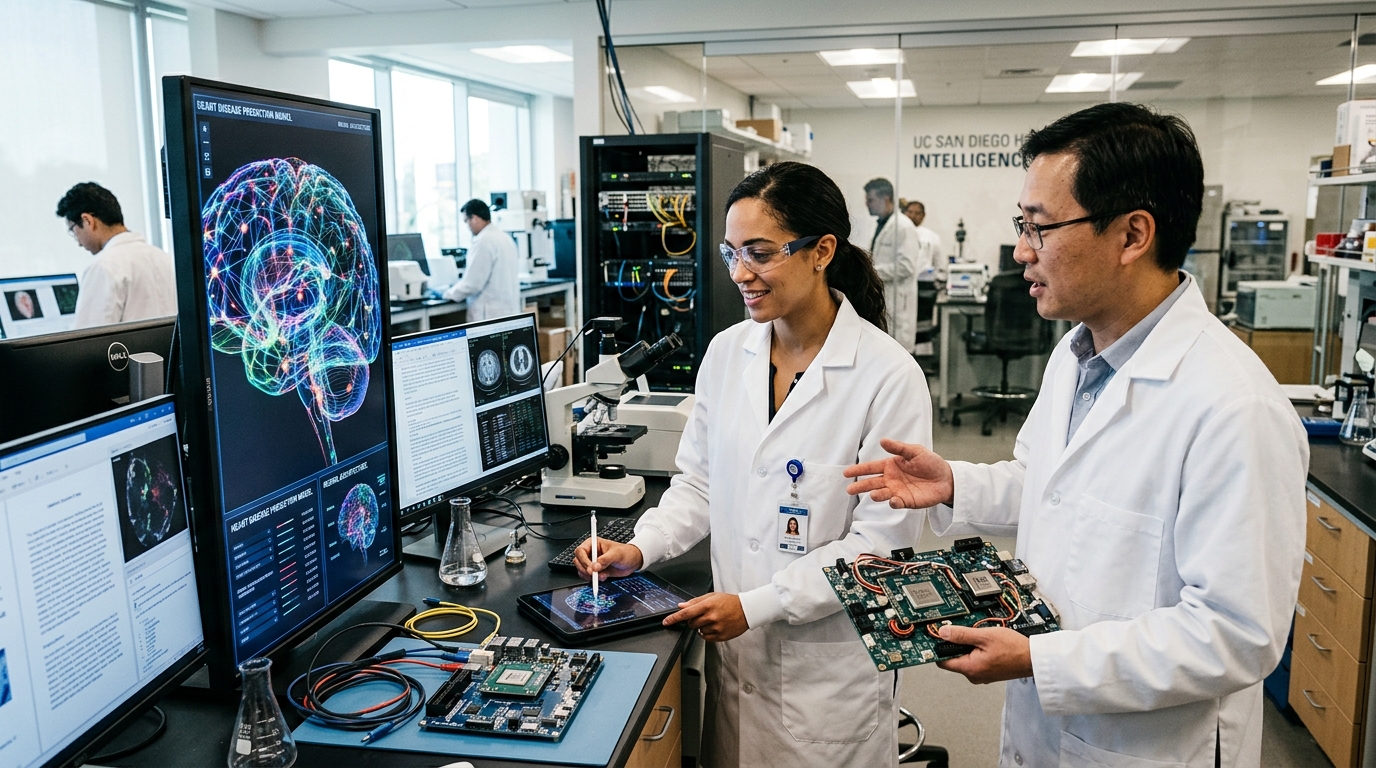
In the heart of La Jolla, where academic rigor meets medical frontier, the University of California San Diego (UCSD) is charting a new course for the future of global healthcare. The establishment of the Health Intelligence Institute (HII) is not merely an addition to the university's prestigious portfolio; it represents a fundamental paradigm shift. For the first time, Artificial Intelligence (AI) is being treated not as an experimental lab tool, but as an organic partner in clinical practice, capable of analyzing data in real-time to save lives.
The Architecture of Intelligence: Beyond Big Data
The Health Intelligence Institute serves as the central pillar of a broader strategy that includes the Joan and Irwin Jacobs Center for Health Innovation. The goal is to create an ecosystem where health data—ranging from heart rates to genomic sequences—is transformed into actionable knowledge. Under the leadership of Dr. Karandeep Singh, the university’s first Chief Health AI Officer, the institute seeks to bridge the gap between theoretical data science and day-to-day medical care.
UCSD’s approach differs from traditional methodologies. Instead of focusing solely on developing new algorithms, the HII emphasizes "Health Intelligence." This means AI is used to understand the context of each case, accounting for social determinants of health, patient history, and current clinical conditions. As experts point out, the objective is not to replace the physician but to augment their capabilities with tools that can identify patterns the human eye might miss within the vast sea of digital information.
From Algorithms to the Bedside
The applications currently being piloted at UC San Diego Health provide a glimpse into the future. One of the most critical fields is the early detection of sepsis, a condition where every hour of delay drastically increases the likelihood of mortality. Through machine learning models that continuously monitor patient vitals, the system can alert nursing staff hours before clinical symptoms manifest.
- Predictive Modeling: Forecasting patient deterioration before it becomes critical.
- Operational Optimization: Using AI to manage bed capacity and surgical schedules, reducing wait times.
- Mitigating Burnout: Automating administrative tasks and documentation, allowing doctors to focus on patient interaction.
Furthermore, the institute is focused on personalized medicine. By analyzing thousands of similar cases, AI can suggest the optimal treatment regimen for a specific patient, considering how others with similar genetic profiles or underlying conditions responded. This "precision medicine" is the holy grail of modern healthcare, and UCSD appears to be at the forefront of its realization.
Ethics, Governance, and the Legal Landscape
However, the integration of AI into healthcare is not without its hurdles. As highlighted by legal analysis from Foley & Lardner LLP, the use of these technologies raises serious questions regarding liability, data privacy, and algorithmic transparency. UC San Diego has established rigorous governance protocols to ensure that AI models are equitable and do not perpetuate racial or socioeconomic biases.
"AI in healthcare must be responsible, transparent, and above all, human-centric. We cannot allow the 'black box' of algorithms to make life-and-death decisions without strict oversight," the institute’s leadership emphasizes.
The institute works closely with regulatory bodies to shape the standards of tomorrow. The challenge lies in balancing rapid innovation with patient safety. In a world where technology evolves faster than legislation, initiatives like UCSD’s serve as living laboratories for defining the ethical boundaries of digital medicine.
Conclusion: A New Era for Healthcare
The Health Intelligence Institute at UC San Diego is more than a research center; it is the harbinger of an era where medicine will be more proactive than reactive. The integration of AI into daily clinical life promises to make hospitals smarter, physicians more effective, and ultimately, care more humane by relieving staff of the data-processing burden and allowing them to return to the essence of medicine: caring for the human being.