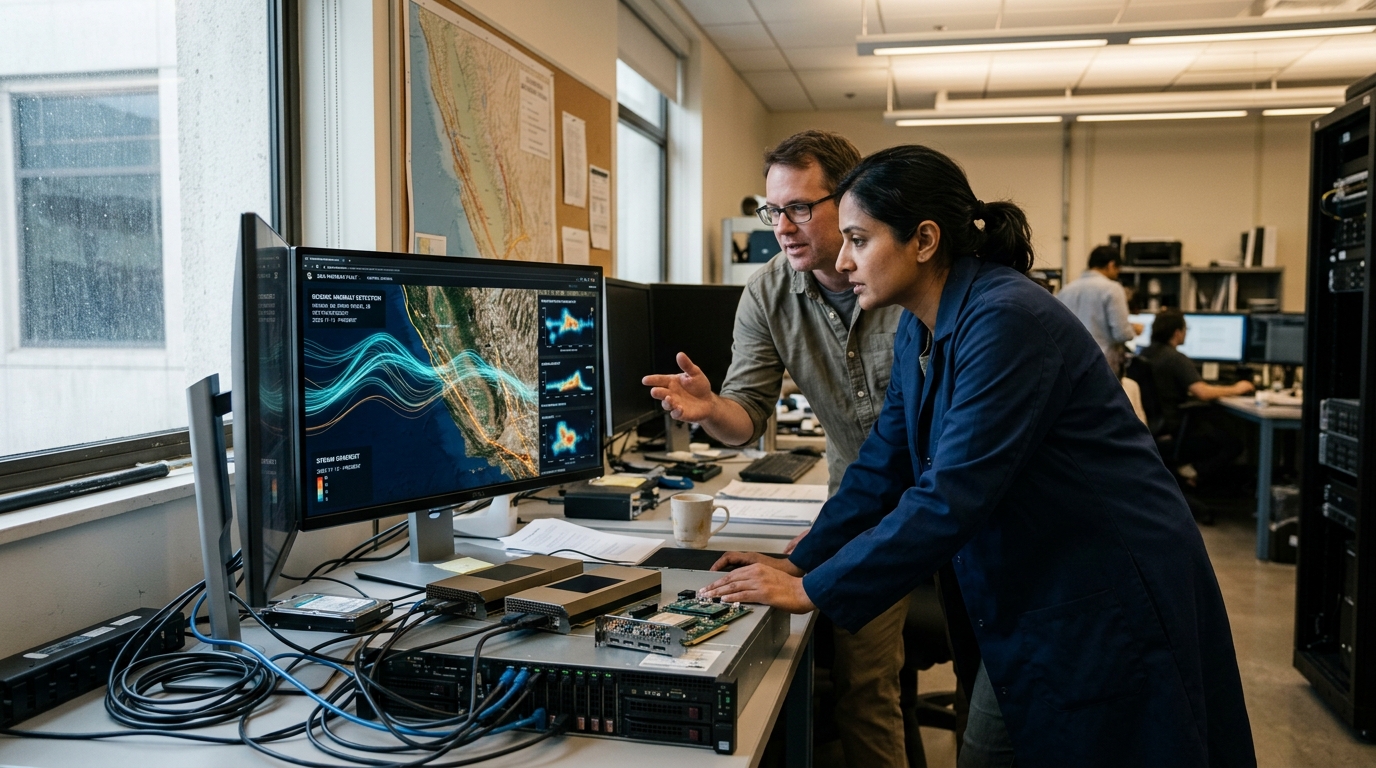
For decades, California's San Andreas Fault has stood as a monument to geological awe and existential dread for millions. Despite the region being blanketed by high-tech seismometers and sensors, the Earth continued to keep its most critical secrets buried deep within the crust. Until now. New research, highlighted via Phys.org, demonstrates how Artificial Intelligence (AI) is managing to "hear" the whispers of tectonic plates that traditional seismology had long failed to interpret.
The Challenge of Noise and the Machine Learning Solution
The primary hurdle in seismology is not a lack of data, but its quality. Earth is a noisy planet. From the rhythmic pounding of ocean waves and heavy traffic to atmospheric shifts, seismographs record a constant "white noise" that often masks the incredibly faint signals of micro-earthquakes. These tiny tremors, however, are the keys to understanding how stress builds up along a fault line.
Using advanced Deep Learning algorithms, researchers trained neural networks to distinguish signal from noise with unprecedented precision. The AI functioned as a "digital hearing aid," isolating thousands of micro-movements previously dismissed as background chatter. These movements reveal a far more dynamic and "fluid" image of the San Andreas Fault, where plates are not merely stuck but are in a state of constant, slow-motion adjustment.
Decoding "Slow Slip": The Hidden Variable
One of the study's most compelling findings is the identification of "slow-slip events." These are tectonic plate movements that last for days or even weeks without triggering noticeable surface vibrations. Yet, their significance is immense: these events can transfer stress from the deeper layers of the crust to the upper sections, potentially priming the fault for a major, catastrophic rupture.
"The ability of AI to map these invisible phenomena allows us to view the fault not as a static line, but as a living organism that breathes and accumulates energy," the researchers noted.
This shift in perspective is revolutionary. By identifying where the fault is "creeping" and where it is truly "locked," AI provides a real-time stress map. This goes beyond simple observation; it allows scientists to model the progression of tectonic strain with a granularity that was unthinkable a decade ago.
Toward a New Era of Forecasting
It is crucial to clarify that AI cannot yet "predict" an earthquake in the sense of providing a specific time and date. However, it can offer a much more accurate "diagnosis" of a fault's health. The transition from reactive seismology (analyzing after the fact) to proactive seismology is now within reach.
The implications for public safety are fundamental. With a better understanding of micro-movements, authorities can update risk assessments by zone, reinforce infrastructure where stress is accumulating most rapidly, and educate the population based on hard data rather than statistical averages. AI does not tame nature, but it provides the tools to live in greater harmony with its violent tendencies. As we refine these algorithms, the "Big One" may still be inevitable, but our ability to withstand it will be vastly improved by the insights gained from the Earth's smallest shudders.