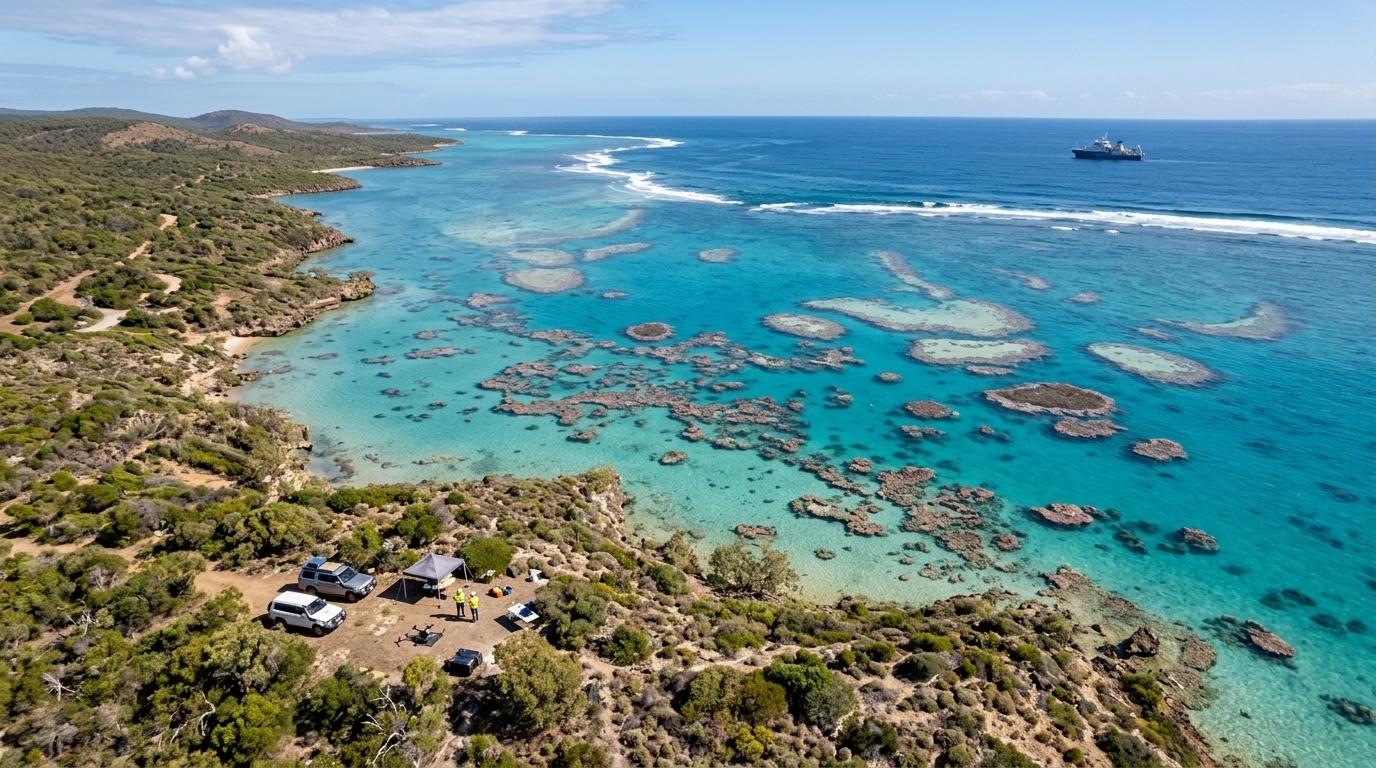
In a decision that carefully balances political diplomacy with environmental urgency, the UNESCO World Heritage Committee has announced that Australia's Great Barrier Reef (GBR) will not be placed on the 'In Danger' list for the time being. This development provides a significant reprieve for the Australian government, which has engaged in an intensive lobbying campaign over recent years to avoid a designation that would tarnish the nation's reputation and threaten its vital tourism industry.
However, this decision is far from a clean bill of health. UNESCO remains on high alert, demanding that Australia strictly adhere to its commitments regarding water quality improvement and climate change mitigation. The world's largest living ecosystem remains on the precipice, with scientists warning that diplomatic maneuvers cannot cool the rapidly warming seas.
The Diplomatic Chessboard and the 'Reef 2050' Plan
Avoiding the 'In Danger' label is seen as a major victory for Canberra, which presented its updated 'Reef 2050' plan as evidence of its commitment. This plan outlines billions of dollars in investment aimed at reducing sediment and fertilizer runoff from agricultural lands, limiting gillnet fishing in critical zones, and controlling the crown-of-thorns starfish, a predator that devastates coral populations.
UNESCO acknowledged the "significant steps" taken but emphasized that efforts must be accelerated. Criticism from international environmental organizations has been sharp, with many arguing that the committee succumbed to political pressure. Australia, as one of the world's largest exporters of coal and gas, finds itself in a paradoxical position: attempting to save the Reef while simultaneously fueling the global heating that is destroying it.
Climate Change: The Invisible and Relentless Foe
While local interventions in water quality are beneficial, the primary threat to the corals remains heat. In recent years, the Great Barrier Reef has suffered through successive mass bleaching events. This phenomenon occurs when corals, under thermal stress, expel the symbiotic algae that provide them with food and color, leaving them white and vulnerable to disease and death.
- In 2024, one of the most widespread bleaching events in history was recorded, affecting over 70% of the reef.
- Rising ocean temperatures are shortening the recovery periods between bleaching episodes.
- Ocean acidification, a result of CO2 absorption, makes it increasingly difficult for corals to build their calcium carbonate skeletons.
Scientists from the Australian Institute of Marine Science (AIMS) point out that even if the Paris Agreement's goal of limiting warming to 1.5°C is met, 70-90% of the world's corals are still at risk of being lost. On our current global trajectory, the Great Barrier Reef faces the grim prospect of becoming a vast limestone graveyard within the coming decades.
Economic Stakes and Political Implications
For Australia, the Reef is not just an ecological marvel; it is an economic powerhouse. It contributes approximately $6 billion annually to the national economy and supports over 64,000 jobs, primarily in the tourism sector. An official 'In Danger' listing would act as a global deterrent for visitors, diminishing the destination's allure and market value.
"Protecting the Reef is our duty to humanity, but also an economic necessity for the local communities of Queensland," a government official stated following the UNESCO decision.
Nevertheless, the contradiction in Canberra's policy remains the central point of friction. While the government pledges 'Net Zero' by 2050, it continues to greenlight new fossil fuel extraction projects. UNESCO has requested Australia to submit a new progress report by 2027, effectively keeping the nation under continuous surveillance. The battle for the Great Barrier Reef is a proxy for the future of our oceans; for now, diplomacy has bought time, but nature continues to lose ground.