

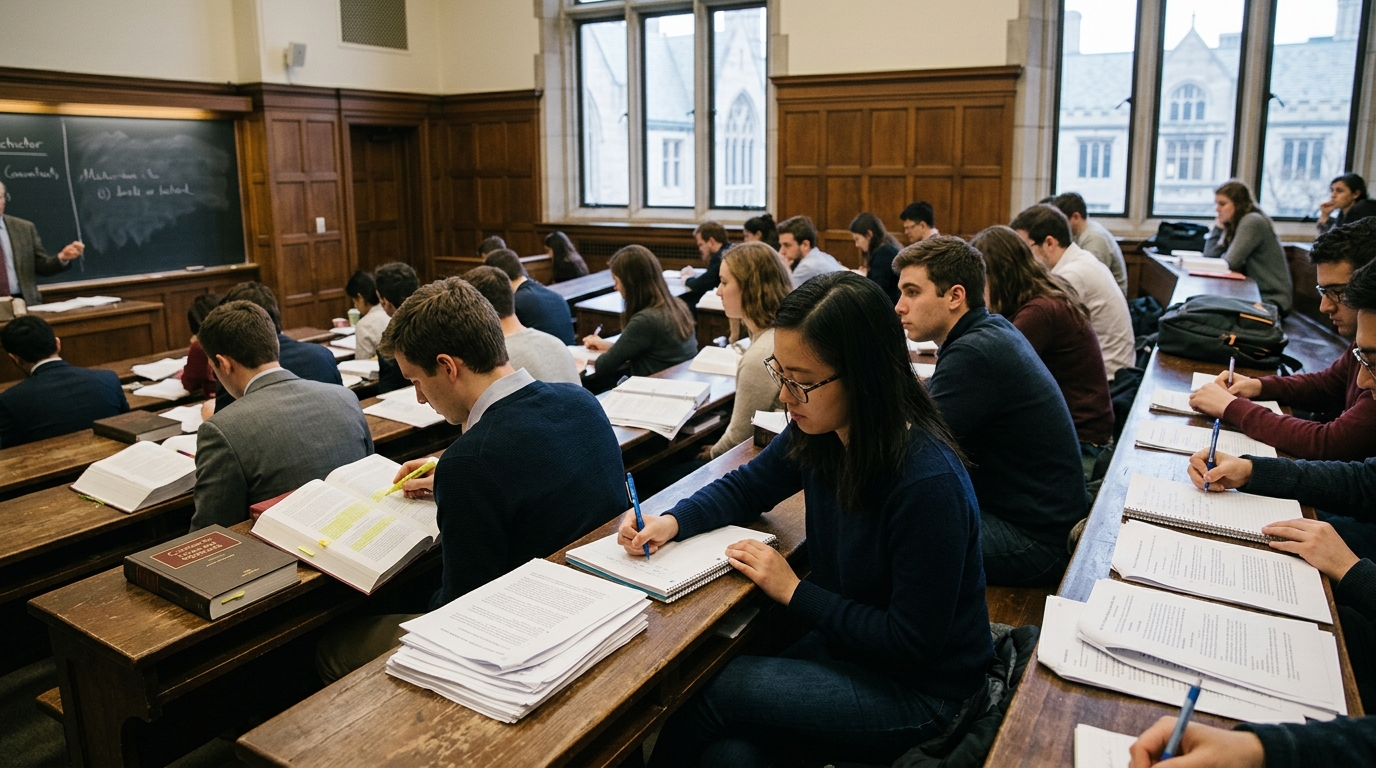
In an era where most educational institutions worldwide are scrambling to integrate Artificial Intelligence (AI) into every facet of learning, the University of Chicago Law School (UChicago Law) is taking the opposite path. In a new, radical strategy, the school has announced a total ban on the use of laptops and mobile phones in classrooms for first-year students (1Ls). This decision is not a mere return to the past, but a strategic move to safeguard the foundations of legal reasoning in a world dominated by algorithms.
The Socratic Method Under Threat
UChicago Law is globally renowned for its rigorous adherence to the Socratic method—a pedagogical approach where professors pose continuous questions to students, forcing them to analyze legal principles deeply and defend their positions under pressure. The school’s administration argues that the presence of laptops acts as a "wall" between professor and student. Instead of active listening and critical thinking, many students are consumed by passively typing every word they hear, turning themselves into mere stenographers.
With the advent of Generative AI tools, the danger became even more visible. A student's ability to feed a question into a chatbot in real-time and receive a structured answer negates the very essence of legal education: the process of intellectual struggle to find the solution.
A Strategy of Sequencing, Not Rejection
It is important to note that UChicago Law is not rejecting AI entirely. On the contrary, the ban applies exclusively to the first year of study. The philosophy behind this decision is that students must first master the "manual" skills of legal analysis, case reading, and oral advocacy before being allowed to use technological aids. Just as a student must learn arithmetic before using a calculator, a future lawyer must learn to think without the help of Claude or ChatGPT.
- Focus on Attention: Studies show that handwritten note-taking aids in better information retention.
- Social Interaction: The absence of screens encourages eye contact and vibrant dialogue.
- Intellectual Autonomy: Preventing immediate recourse to AI forces the student to trust their own judgment.
Reactions and the Future of Legal Education
Reactions to the decision have been mixed. Some students complain that the ban deprives them of the ability to organize their notes efficiently, while others with learning disabilities express concerns about accessibility (though the school provides exceptions for medical reasons). However, the legal community is closely watching the experiment. If UChicago can prove that its graduates are sharper and more capable in the courtroom due to this "digital detox," it is highly likely we will see other top-tier universities, such as Harvard or Yale, following suit.
"Legal thinking is not information retrieval. It is the synthesis of ideas under conditions of uncertainty. AI can do the former, but only a human can do the latter with ethics and judgment," a member of the academic faculty noted.
In a world racing at the speed of light toward full automation, UChicago Law reminds us that the most powerful technology remains the human brain—provided we give it the space and silence to function.




