

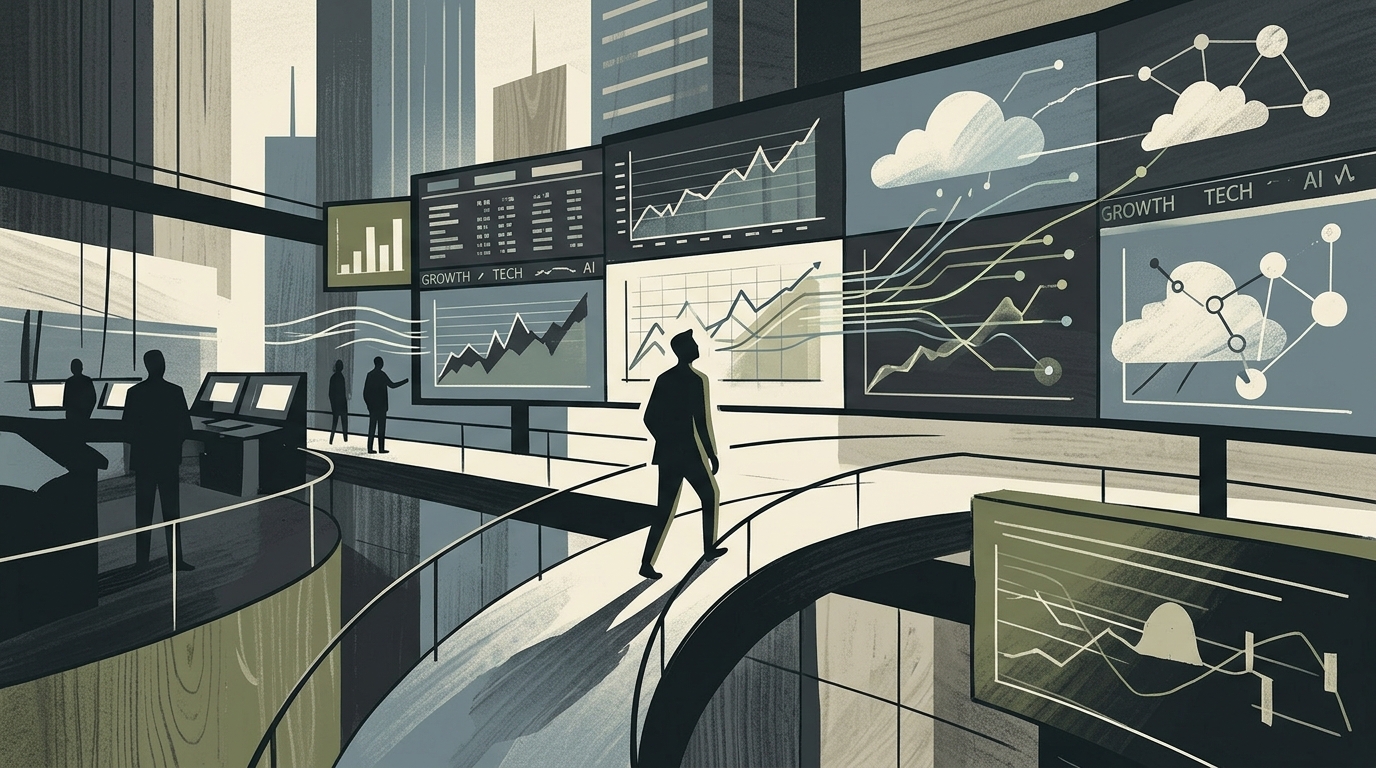
In an era where technological advancement seems to have outpaced all historical precedents, Ankur Crawford, Executive Vice President and Portfolio Manager at Alger, provides a piercing look into the forces reshaping the global economy. Speaking with Bloomberg Tech, Crawford highlighted a fundamental truth for 2026: the pace of innovation in Artificial Intelligence (AI) is not just fast; it is exponential, forcing tech giants and investors to redefine their strategies in real-time.
Meta’s Strategic Metamorphosis
Crawford focused specifically on the case of Meta, which under Mark Zuckerberg’s leadership has executed a stunning pivot. From a social media company reliant solely on advertising, Meta has evolved into one of the most significant players in AI infrastructure. Its decision to invest billions into open-source models, such as the Llama series, has fundamentally altered the rules of the game.
According to Crawford, Meta's strategy is not merely an attempt at innovation but a tactical move to create a new ecosystem. By offering powerful models for free or at minimal cost, Meta undermines the "walled gardens" of its competitors while establishing its own standards as the foundation upon which thousands of developers build. This creates a network effect that bolsters the company’s long-term value, despite short-term margin pressures from massive capital expenditures.
The CapEx Conundrum
A central point of Crawford’s analysis is the issue of Capital Expenditures (CapEx). Investments in data centers and AI processors (such as those from Nvidia) have reached dizzying levels. "Everything is moving so fast," she noted, referring to the necessity for companies to constantly upgrade their hardware to remain competitive.
However, Crawford poses a critical question: When will we see the tangible return on these investments? While cloud providers (Microsoft Azure, AWS, Google Cloud) are seeing revenue growth, the market is beginning to demand clearer evidence that AI is improving productivity and profitability for end-users. Crawford argues that we are in a "build phase," where infrastructure precedes application, but the pressure for results will escalate dramatically over the coming year.
Cloud Computing and the New Hierarchy
The rise of AI has revitalized the cloud computing sector, transforming it from a simple storage service into an "intelligence factory." Companies possessing the greatest computational power are becoming the new market regulators. Crawford observes that "Hyperscalers" are no longer competing solely on price, but on the quality of the AI models they can host and the speed at which they can offer inference solutions.
Crawford’s analysis concludes that despite the volatility, AI is not a bubble but a structural shift. A company’s ability to adapt to this pace—to "run" alongside the technology—will determine its survival in the digital economy of the future. Meta, with its bold approach, seems to have understood that in a world moving this fast, stagnation is the greatest risk.
"The speed of the cycle is unlike anything we've seen in tech history; you either lead the disruption or you are consumed by it."
As we move further into 2026, the focus will shift from who has the most chips to who can create the most value from them. The transition from training massive models to deploying them at scale (inference) will be the next major battleground for the tech sector.





