

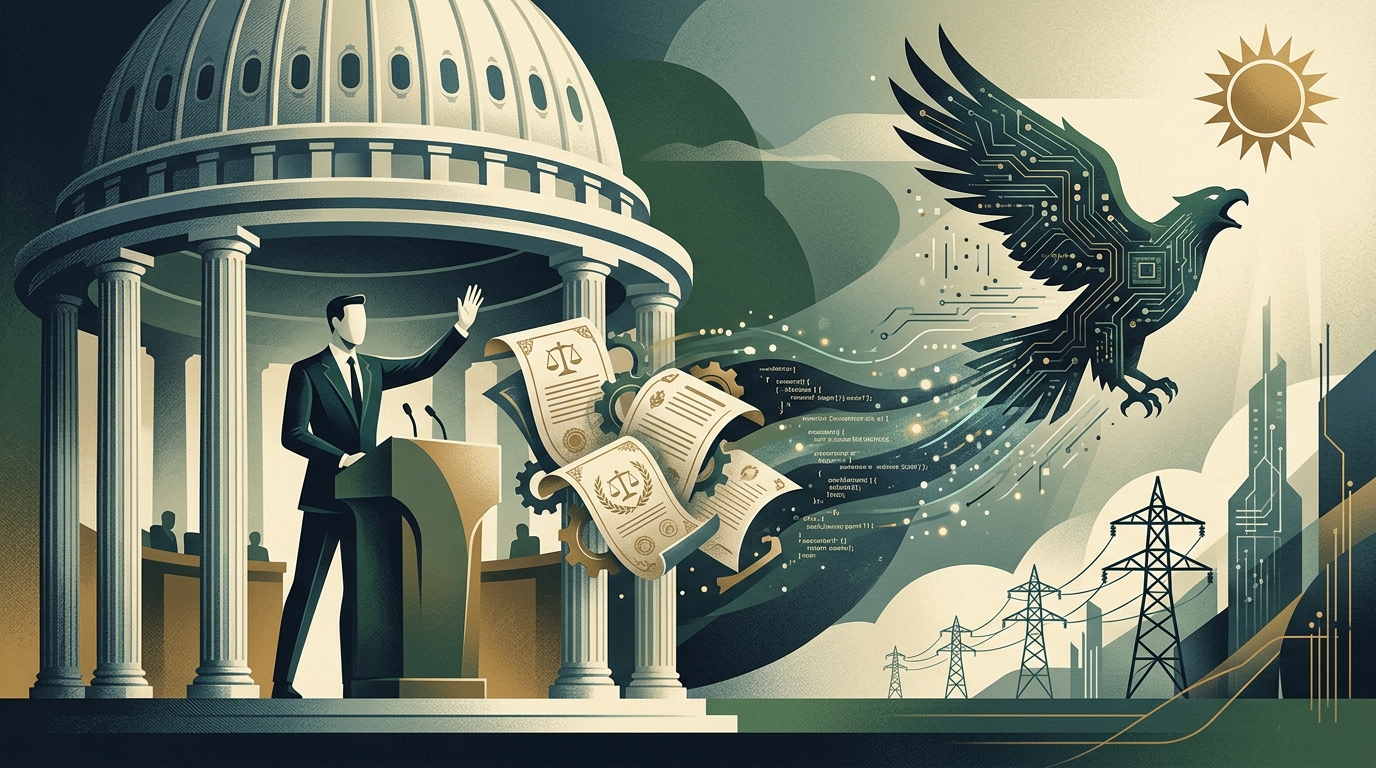
In an era where the global community is struggling to strike a balance between technological advancement and ethical safeguards, Donald Trump is making his position clear: America must run faster than everyone else, unburdened by the "lead weight" of strict regulations. In his recent interview with Bloomberg, the former president and current White House contender outlined a vision for Artificial Intelligence (AI) with "as little as possible" in terms of guardrails, signaling a radical departure from the Biden administration's current trajectory.
Dismantling the Biden Framework
Trump’s central promise involves the immediate repeal of Joe Biden’s Executive Order 14110. Signed in 2023, this order is considered by many to be the most comprehensive attempt at AI regulation in the US, requiring companies to share safety test results with the government before releasing powerful models. For Trump, however, these measures are "bureaucratic hurdles" that stifle innovation. His rhetoric focuses on the idea that regulation does not protect the citizen but instead grants an advantage to America’s adversaries.
According to analysts, Trump’s approach is not merely economic but deeply ideological. He has repeatedly characterized current AI models as "biased" or "woke," arguing that safety constraints embed a liberal agenda that restricts free speech. His promise of "AI freedom" resonates with a segment of Silicon Valley that views regulations as a brake on the development of the next "big thing."
The Geopolitical Chessboard and China
The strongest argument from the Trump camp is the competition with Beijing. "If we don’t do it, they will," is the constant refrain. The logic is simple: every hour an American company spends on compliance checks is an hour China gains in the field of military and economic AI application. Trump argues that America’s supremacy depends on its ability to develop technology at the speed of the private sector, without federal government interference.
However, this approach ignores the warnings of top scientists, including the "godfathers" of AI, who point out that without international cooperation and basic safety rules, the risk of an existential accident or an uncontrolled arms race increases exponentially. Trump’s "speed strategy" could lead to a global "race to the bottom," where safety is sacrificed on the altar of dominance.
The New Silicon Valley Lobby
Perhaps the most interesting aspect of this political shift is the new alliance between Trump and some of technology’s most powerful players. Names like Marc Andreessen and Ben Horowitz, alongside support from Elon Musk, show that a significant portion of Silicon Valley capital is moving toward the Republican camp. These investors see deregulation as an opportunity for massive profits, free from the fear of antitrust legislation or ethical constraints.
"Artificial Intelligence is the new oil, and Trump promises to open the taps without asking about the environmental cost of our digital security," notes one tech policy analyst.
In conclusion, the proposal for "minimal guardrails" in AI represents a high-stakes experiment. If it succeeds, the US may consolidate its technological hegemony for the next century. But if it fails, the consequences of unregulated AI—from disinformation at scale to catastrophic cybersecurity breaches—will be a legacy that no government can easily rectify.





