

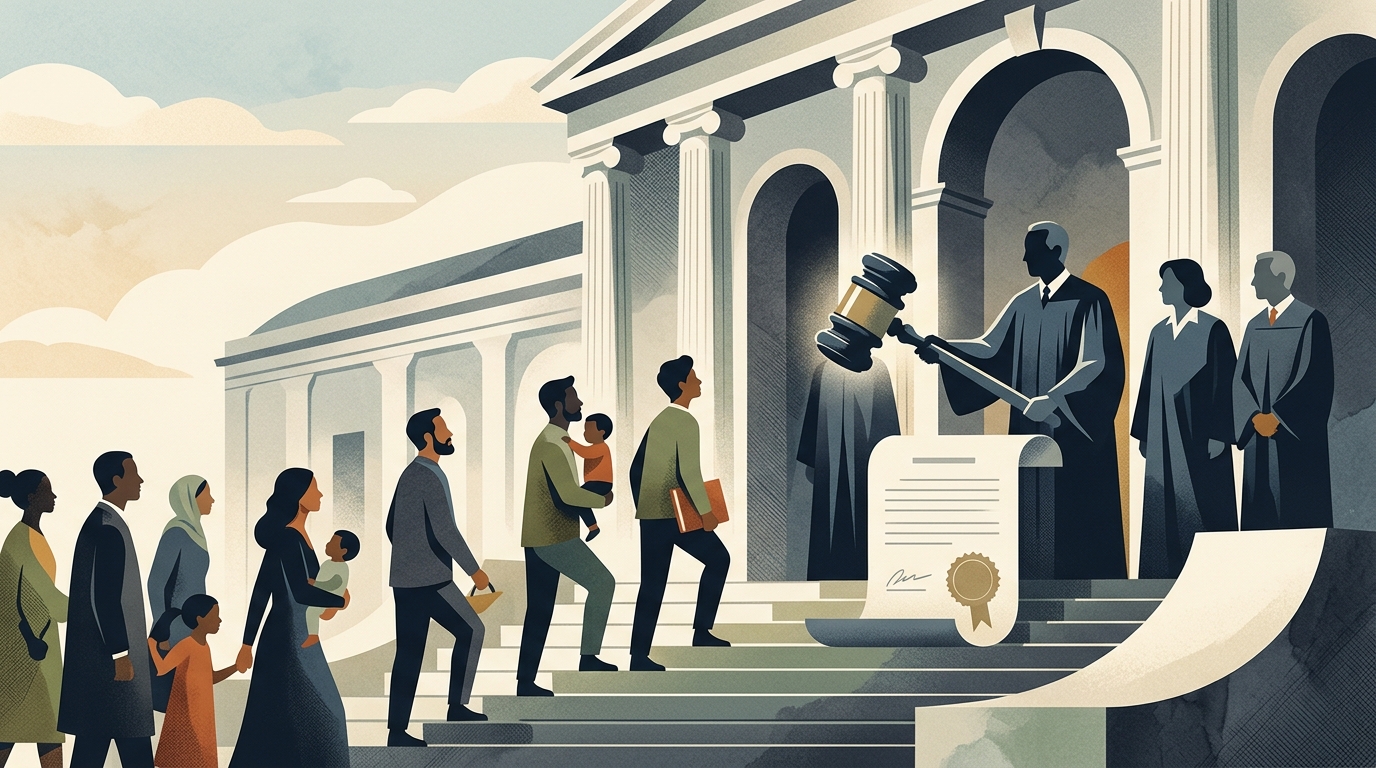
In a decision destined to be a cornerstone of American jurisprudence for decades to come, the Supreme Court of the United States has rejected the Trump administration's attempt to terminate the automatic granting of citizenship to those born on U.S. soil. The 6-3 ruling confirms that birthright citizenship (jus soli) is constitutionally protected and cannot be altered via executive order, despite intense political pressure from the White House.
The Constitutional Foundation and the 14th Amendment
At the heart of the legal battle lies the first sentence of the 14th Amendment to the U.S. Constitution, ratified in 1868 in the aftermath of the Civil War. The amendment clearly states: "All persons born or naturalized in the United States, and subject to the jurisdiction thereof, are citizens of the United States and of the State wherein they reside." This provision was originally designed to guarantee citizenship to formerly enslaved people, but over time, it became the bedrock for integrating millions of immigrants into American society.
The Trump administration argued that the phrase "subject to the jurisdiction thereof" excludes the children of individuals who are in the country illegally or on temporary visas. However, the Court’s majority, led by Chief Justice John Roberts, dismissed this interpretation, relying on the landmark 1898 precedent *United States v. Wong Kim Ark*, which held that even children of Chinese nationals born in the U.S. were American citizens.
The Composition of the Ruling and the Dissents
The 6-3 split revealed significant fractures within the Court’s conservative wing. While the three liberal justices voted unanimously against the government's effort, they were joined by Chief Justice Roberts and Justices Kavanaugh and Barrett. In their reasoning, they emphasized that constitutional stability outweighs temporary political objectives. "The Constitution is not a document that can be rewritten from the Oval Office," Justice Barrett notably wrote in her concurring opinion.
"Birthright citizenship is not a privilege granted by the government, but a right derived directly from the soil and the law of the land," wrote Chief Justice Roberts.
In contrast, Justices Thomas, Alito, and Gorsuch dissented, arguing that the issue of jurisdiction remains legally ambiguous and that Congress, if not the President, should have the authority to define citizenship criteria. The minority argued that the current interpretation creates incentives for illegal immigration, an argument that aligns perfectly with President Trump’s rhetoric.
Political and Social Implications
This ruling is a severe blow to Trump’s agenda, as he had made ending birthright citizenship a central pillar of his immigration policy. For his supporters, the move was seen as necessary to curb so-called "birth tourism" and "anchor babies." For his critics, however, the effort was a xenophobic attempt to redefine American identity and exclude marginalized communities.
On a practical level, the decision provides relief to millions of immigrant families who feared their children could be left in a legal vacuum, deprived of basic rights such as access to education, healthcare, and employment. Furthermore, the Court sent a clear message regarding the limits of executive power, reminding the nation that even the world’s most powerful leader must bow to the rules established by the Founders and the 19th-century reformers.
The Future of Immigration Reform
Despite the defeat in court, the debate over citizenship is certain to continue in the political arena. Republican lawmakers have already begun proposing a constitutional amendment to change the citizenship rule, though this process is extremely difficult and requires a broad consensus that currently does not exist. On the other side, Democrats hailed the decision as a victory for democracy and the rule of law.
History teaches us that the concept of the "citizen" in the United States has always been a battlefield. From the *Dred Scott* decision that denied citizenship to Black Americans to the 14th Amendment that restored it, the evolution of American citizenship reflects the evolution of the country itself. Today's Supreme Court decision ensures that, at least for now, the promise of America remains tied to its soil and not to the lineage of one's parents.




