

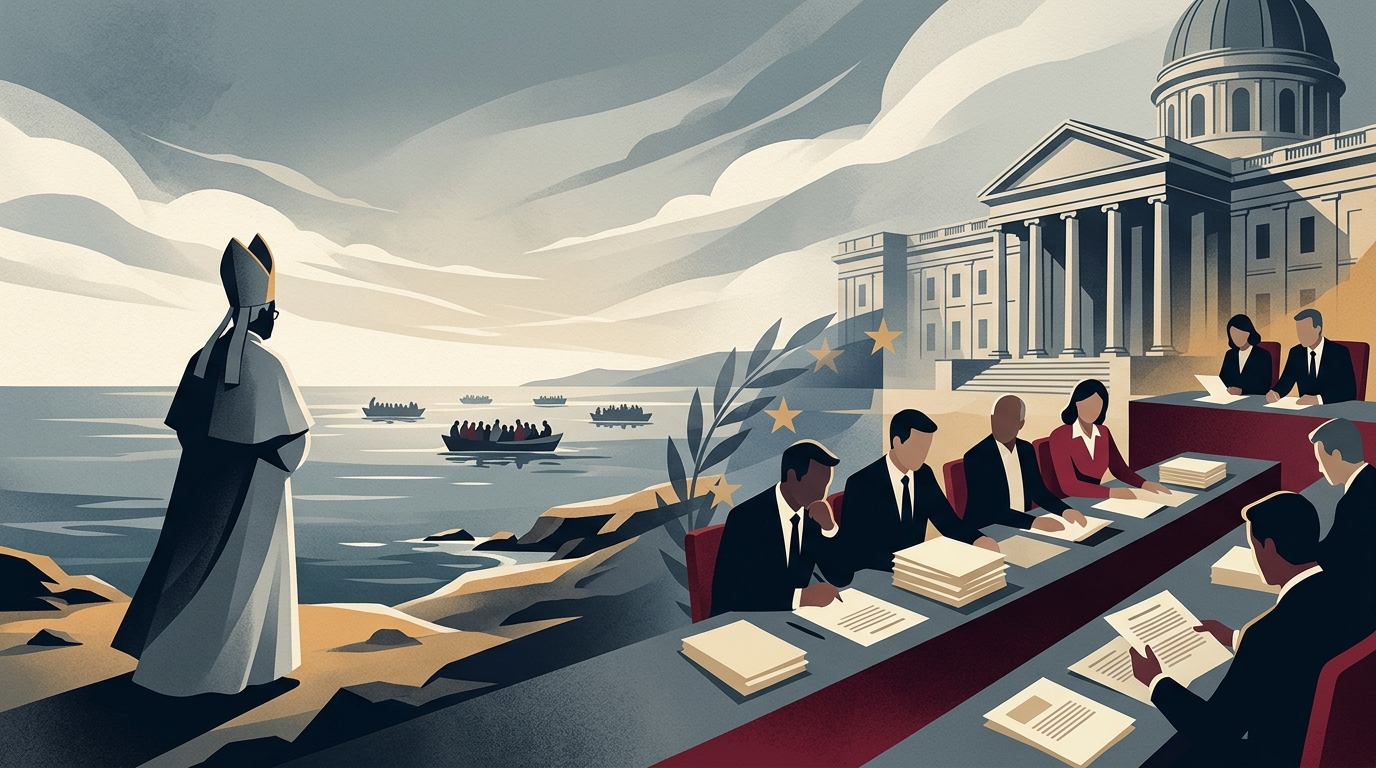
In a historic visit set to define the humanitarian discourse in Europe for the remainder of 2026, Pope Leo XIV traveled to Lampedusa today. This small Mediterranean island, which for decades has served as the poignant symbol of the migration crisis, became the stage for one of the most powerful interventions by the Roman Catholic Church in recent memory. The Pontiff, continuing the legacy of his predecessors but with a notably sharper political edge, did not limit himself to prayers; he held the European Union accountable for its systemic failures.
The 'Globalization of Indifference' and the End of Illusions
During his address, delivered against the backdrop of rusted hulls of migrant boats, Leo XIV used uncompromising language. "We can no longer look the other way," he declared, emphasizing that the Mediterranean has been transformed into the "world's largest cemetery." His choice to speak of the "collective guilt" of European nations was deliberate. Vatican analysts suggest the Pope views the Brussels bureaucracy as having become dangerously detached from the Christian and humanist values that are supposed to be the continent's foundation.
The Pope underscored that managing the refugee crisis is not merely a technical problem of logistics or border security, but a profound moral crisis. "When numbers replace names and statistics replace human beings, humanity has already been defeated," he stated. His criticism was aimed directly at nations erecting fences, arguing that security cannot be achieved by excluding the 'other,' but only through genuine solidarity.
The Political Dimension: Beyond Theology
What distinguishes Leo XIV's intervention today is his direct reference to the need for a new European compact. He called for the abolition of archaic regulations, such as the Dublin Regulation, which place a disproportionate burden on frontline states like Greece, Italy, and Spain. His call for "legal migration pathways" represents a clear political proposal that clashes with the increasingly restrictive policies of many European governments.
- The necessity for fair burden-sharing among all EU member states.
- The creation of safe humanitarian corridors to bypass smuggling networks.
- Investing in countries of origin not as a control mechanism, but as a path to development.
- The protection of unaccompanied minors as an absolute priority.
This intervention comes at a time when Europe stands at a crossroads. With the rise of nationalist movements, the Pope's rhetoric serves as a counterweight, reminding the world that Europe's identity is inextricably linked to the protection of the vulnerable. However, the question remains: will his voice be heard by leaders who are often more concerned with political costs than moral imperatives?
The Mediterranean: 'Mare Nostrum' or a Wall?
Concluding his speech, Pope Leo XIV urged the faithful and the citizens of Europe to rethink the meaning of a "border." For the Pontiff, the Mediterranean must once again become the sea that unites civilizations rather than the moat that divides them. "History will judge us not by the wealth we accumulated, but by how many lives we saved from the waves," he concluded.
"Europe is not endangered by refugees, but by the loss of its own soul." — Pope Leo XIV, Lampedusa, 2026.
The visit ended with a symbolic gesture: the Pope cast a wreath of flowers into the sea in memory of the thousands who have perished in Mediterranean waters. It was a moment of silence that spoke louder than any political declaration. The message has been delivered; the responsibility for the response now rests solely with the governments of the Old Continent.




