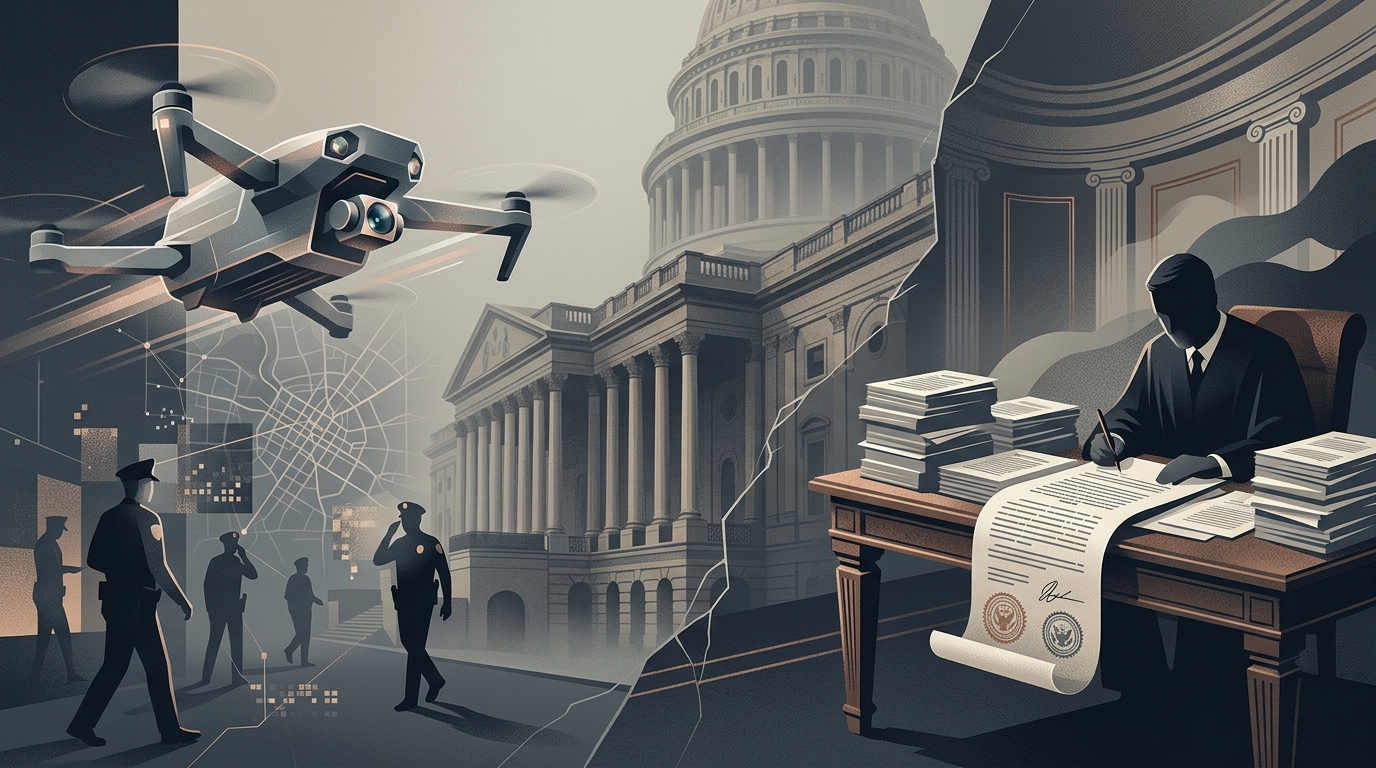
In the twilight of the 2020s, the image of a police officer patrolling the streets has fundamentally shifted—not necessarily in appearance, but in the digital tools carried in their arsenal. Artificial Intelligence (AI) is no longer a science fiction scenario for law enforcement; it is a daily reality. From automated license plate and facial recognition to 'predictive policing' algorithms that forecast where the next crime might occur, technology promises a new era of security. However, this progress is accompanied by a disturbing lag: the legal and ethical framework that should govern these systems remains desperately behind the curve.
The Digital Arsenal of Modern Law Enforcement
The use of AI in policing is no longer confined to experimental stages. Today, in June 2026, authorities utilize advanced data analysis systems to map criminal activities with a precision once thought impossible. Facial Recognition has evolved to the point where it can identify individuals in dense crowds in real-time, linking city surveillance cameras to vast databases. Meanwhile, predictive policing uses historical data to direct patrols to specific neighborhoods, creating an algorithmic heat map of risk.
Furthermore, the emergence of Generative AI tools has enabled authorities to analyze thousands of hours of body cam footage in minutes, identifying behavioral patterns or suspicious movements that the human eye might overlook. This efficiency is the primary argument of technology proponents: in a world of limited resources and growing security challenges, AI acts as a force multiplier.
The Regulatory Compliance Gap
The main problem, however, lies in the fact that the adoption of these tools often occurs in a 'legislative vacuum.' While the European Union's AI Act has established strict rules for 'high-risk' systems, its practical implementation remains labyrinthine. In the United States and other regions, the landscape is even more fragmented, with police departments purchasing software from private companies without public consultation or transparent auditing of the algorithms.
"Technology moves at the speed of light, while justice and legislation move at the pace of the last century," say digital rights experts.
This asymmetry creates serious risks. Without clear rules on data retention, privacy protection, and accountability, the use of AI can easily slide into mass surveillance practices that violate fundamental human rights. The question is no longer whether AI can help solve crimes, but at what cost to personal liberty.
The Trap of Algorithmic Bias
One of the darkest aspects of police AI is bias. Algorithms are trained on historical data, which often reflect pre-existing social and racial prejudices. If a predictive policing system is fed data from an era when a specific minority was disproportionately targeted, the algorithm will 'learn' to view those areas as inherently criminal, perpetuating a vicious cycle of police pressure and social exclusion.
- False Identifications: Facial recognition has been proven less accurate for women and people with darker skin tones.
- Lack of Transparency: The 'black box' algorithms of private companies do not allow defendants to challenge the evidence against them.
- Automated Suspicion: Over-reliance on machines can lead to police escalations based on erroneous system indicators.
The need for a 'human-in-the-loop' is imperative. AI must function as an advisory tool, not as the final arbiter. Transparency in algorithmic operations and regular auditing by independent authorities are the only guarantees that technology will not turn into a tool of authoritarianism.
Conclusion: Balancing Security and Liberty
As we move through 2026, the challenge for democratic societies is to find the middle ground. Security is a public good, but liberty is the foundation of our existence. Regulating police AI should not be seen as an obstacle to efficiency, but as a necessary condition for its legitimacy in the eyes of citizens. Without trust, even the most advanced security system is destined to fail, causing social rifts that no technology can heal.