

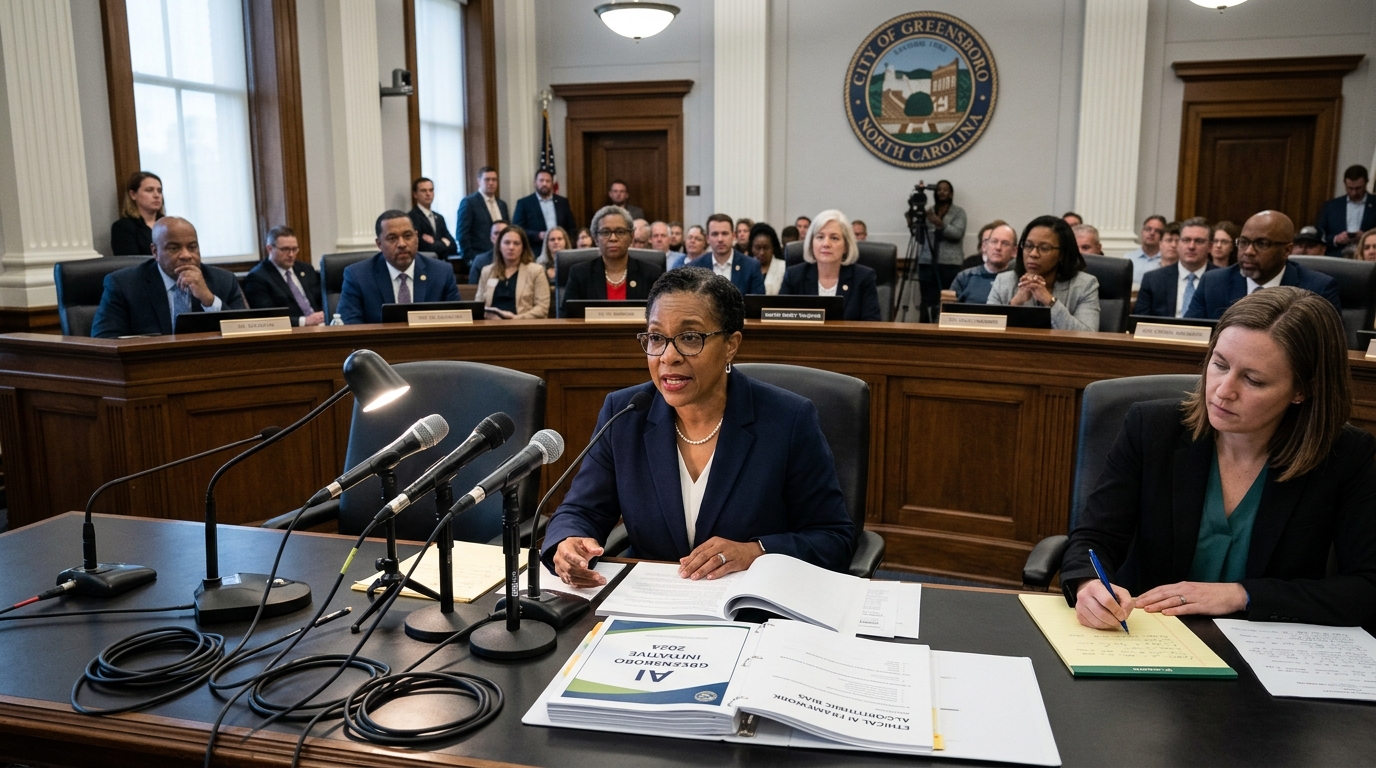
In the heart of North Carolina, the city of Greensboro has become an unexpected focal point for a debate that will define the future of urban governance in the 21st century. As we navigate the summer of 2026, Artificial Intelligence (AI) is no longer a futuristic promise but a daily toolkit promising to streamline public services. However, recent City Council meetings have revealed a deep divide—not just political, but philosophical—regarding how much space we should cede to algorithms in the public sphere.
The Clash of Priorities: Efficiency vs. Accountability
The primary argument for broad AI adoption in Greensboro centers on fiscal and operational efficiency. Proponents within the council point out that AI systems can manage water grids, optimize traffic flow, and automate bureaucracy at speeds no human organization can match. In an era of tightening budgets, the promise of "doing more with less" is seductive. Yet, the opposing side raises critical questions about transparency. As some council members argued, the use of "black boxes"—algorithms whose decision-making process is opaque—clashes directly with democratic accountability.
"We cannot delegate governance to code that we do not fully understand," stated one council member, expressing the fear that technological convenience might undermine public trust in institutions.
Surveillance and Public Safety: The Most Thorny Issue
Perhaps the most controversial point of the debate concerns the use of AI in policing and public safety. Greensboro, like many other American cities, is considering the use of predictive policing algorithms and advanced facial recognition systems. Here, opinions are radically split. On one hand, there is the hope for reducing crime through prevention. On the other, there is the documented concern regarding embedded racial and social biases in the training data of these systems. The region's history makes this issue particularly sensitive, with activists warning that AI could automate and amplify existing discrimination.
- Risk of algorithmic bias in minority neighborhoods.
- Lack of a regulatory framework for citizen data retention.
- The necessity for human oversight (Human-in-the-loop) in every law enforcement decision.
The Future of Public Sector Work
Beyond ethics and safety, there is the dimension of the workforce. Municipal employees are watching the discussions on job automation with trepidation. While the administration argues that AI will "free up" employees from repetitive tasks, the reality of the 2026 labor market shows that the transition is often painful. The council must decide whether to invest in staff retraining or proceed with drastic job cuts in favor of digital solutions. Greensboro's decision will serve as a bellwether for how mid-sized cities manage social cohesion in the age of automation.
Conclusion: A City as a Laboratory of Democracy
The case of Greensboro is not a minor local news story. It is a mirror of the challenges facing every modern society. Artificial Intelligence offers tools of unprecedented power, but their use requires a new form of "digital contract" between the state and the citizen. Whether Greensboro chooses technocratic efficiency or ethical caution will determine not only the quality of life for its residents but also the template that hundreds of other cities worldwide will follow. Governance in the 21st century is no longer just about "what" we do, but about "who" or "what" makes the decisions for us.




