The global economy stands at the threshold of a new era, where decision-making in financial markets is no longer the exclusive domain of humans or even simple algorithms. The advent of agentic Artificial Intelligence (AI) promises to transform trading, risk management, and liquidity, but it simultaneously sends shivers down the spines of central bankers. From Frankfurt to Washington, regulatory authorities are desperately searching for 'safety brakes' to prevent a potential systemic collapse triggered by autonomous systems acting in milliseconds.
The Transition from Algorithms to Autonomous Agents
For decades, markets have been dominated by High-Frequency Trading (HFT) and algorithmic models executing predefined instructions. However, agentic AI represents a qualitative shift. These systems do not merely execute orders; they analyze real-time data, adjust their strategies without human intervention, and interact with other AI models. Their ability to 'learn' from market conditions means they can develop behaviors their creators never anticipated.
Central bankers fear that this autonomy could lead to 'herding behavior.' If multiple AI models are trained on similar datasets, they might simultaneously arrive at the same selling decision, causing a flash crash that no human intervention could intercept in time. The complexity of these systems also makes it difficult to trace the cause of a sudden shift, creating a 'black box' at the heart of the financial system.
Challenges to Systemic Stability
The European Central Bank (ECB) and the Federal Reserve have already begun mapping the risks. One of the primary concerns is the concentration of power. As developing top-tier AI models requires immense resources, there is a risk that most financial firms will rely on the same few AI infrastructures. This interconnectedness means a failure in a cloud service provider or a vulnerability in a widely used model could be transmitted instantaneously across the entire global system.
- Cyber Risks: AI can be used to create more sophisticated attacks, and AI itself can fall victim to 'data poisoning,' influencing market decisions.
- Lack of Transparency: The difficulty in explaining why an AI made a specific decision (explainability) makes oversight by regulatory authorities nearly impossible.
- Ghost Liquidity: AI can provide massive liquidity in good times but withdraw it entirely during crises, exacerbating the downward spiral.
Searching for the 'Panic Brake'
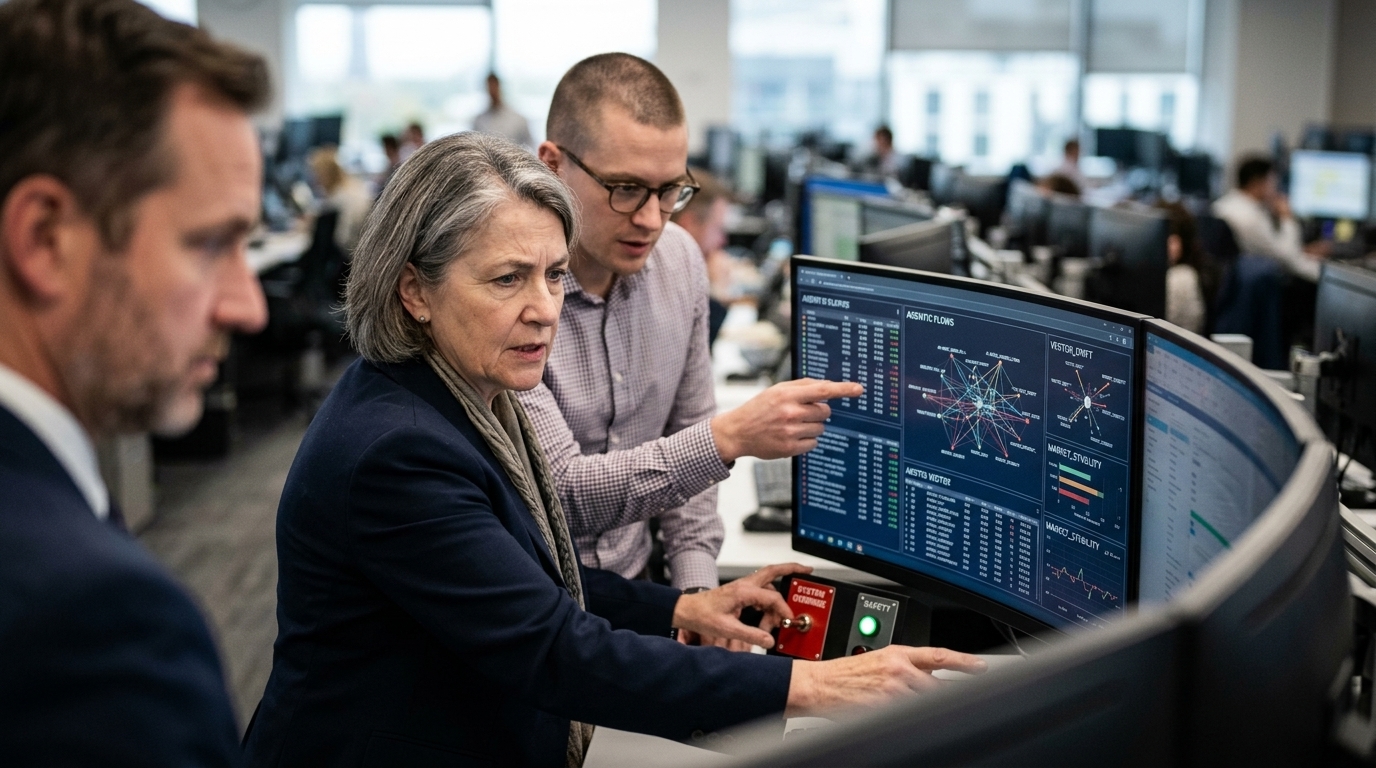
But how can you impose rules on something that moves faster than thought? Discussions focus on three pillars. First, strengthening 'circuit breakers,' which would automatically stop trading when abnormal AI activity is detected. Second, the requirement for 'human-in-the-loop' supervision, where no critical decision is made without final human approval—though many doubt the effectiveness of this in high-speed environments.
"Technology moves at the speed of light, while legislation moves at the speed of bureaucracy. We must bridge this gap before the next crisis is written in Python code," a senior official from the Swiss Financial Market Supervisory Authority noted.
Third, stricter stress tests for banks' AI models are being considered. Banks will have to prove that their 'agents' can handle extreme scenarios without causing a domino effect of failures. However, the dynamic nature of AI means a model that is safe today could become dangerous tomorrow through continuous learning.
The Political Dimension and Competition
There is also the fear of regulatory arbitrage. If the EU imposes very strict rules through the AI Act and supplementary banking directives, investors might move their capital to jurisdictions with more relaxed frameworks. This competition to attract technological innovation complicates efforts for a globally coordinated response. Central bankers are in a delicate balance: they do not want to stifle innovation that could make markets more efficient, but they cannot allow AI to become the 'invisible hand' that drives the economy off a cliff.
In conclusion, the integration of AI into markets is irreversible. The question is not whether it will be used, but whether regulatory authorities will manage to develop equally sophisticated monitoring tools. The battle for control of future markets will not be fought on trading floors, but in the codes and servers of central banks.