

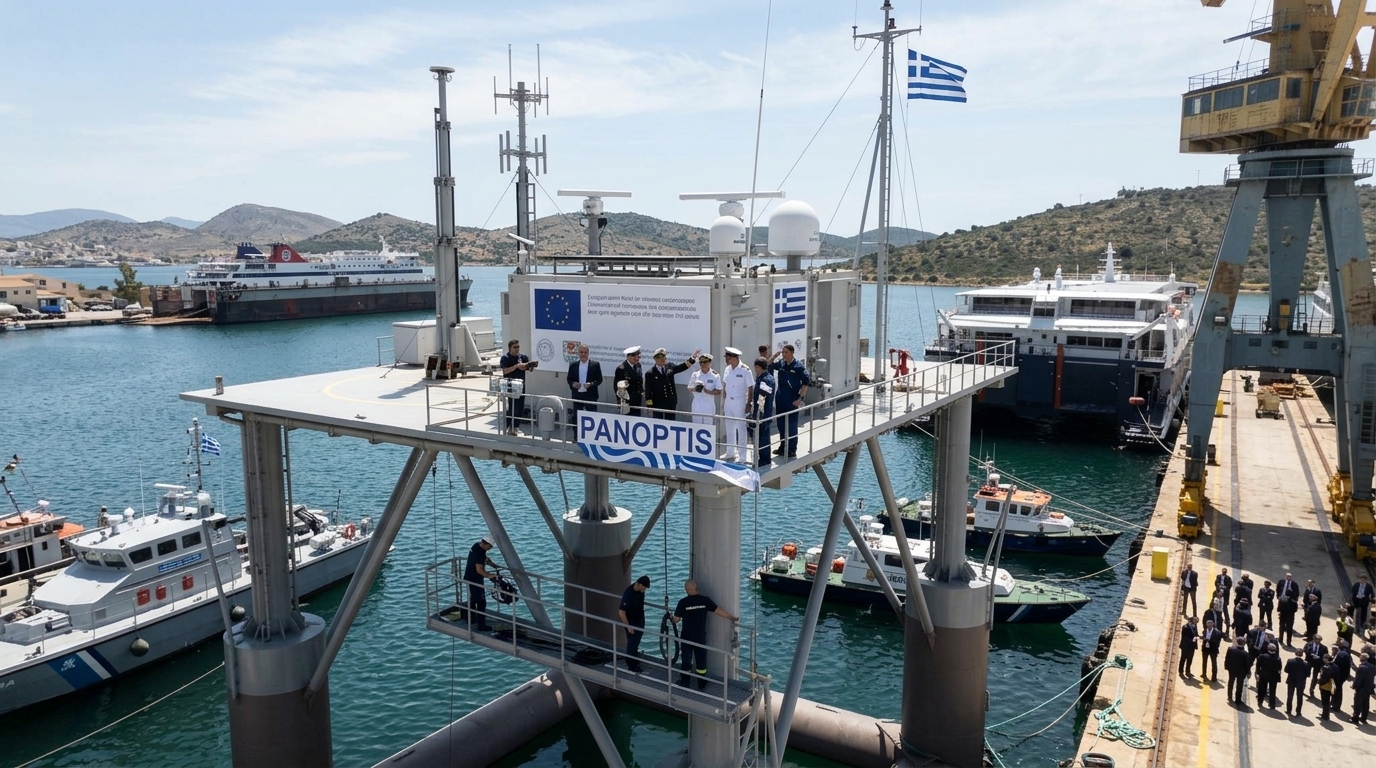
In an era where geopolitical instability in the Eastern Mediterranean demands constant vigilance and technological superiority, Greece is taking a decisive step toward autonomous maritime surveillance. The official debut of the first Unmanned Semi-fixed Sea Platform for Maritime Surveillance (USSPS), aptly named 'Panoptis' (The All-Seeing), at the Salamis Shipyards, is not merely a technical achievement; it is a statement of strategic intent.
The Technological Core of 'Panoptis'
Panoptis is the culmination of years of collaboration under the European Defense Industrial Development Programme (EDIDP). Designed to serve as a 'sleepless guardian' in remote or critical maritime zones, this station integrates cutting-edge technologies that make it unique in its class. It is a semi-fixed platform capable of being moored at significant depths while retaining the flexibility to be relocated according to operational requirements.
The system features an impressive suite of sensors, including high-definition radar, long-range electro-optical cameras, and passive monitoring systems. The integration of Artificial Intelligence allows the platform to automatically identify and categorize targets, significantly reducing the cognitive load on land-based control centers. Furthermore, its energy autonomy is secured through renewable sources, such as photovoltaic panels and wind turbines, enabling it to remain at sea for months without human intervention.
Strategic Significance and National Sovereignty
The project's importance extends far beyond the narrow confines of defense technology. For Greece, a nation with thousands of islands and an extensive Exclusive Economic Zone (EEZ), the ability to perform low-cost, high-efficiency surveillance is vital. Panoptis offers solutions across three primary fronts:
- Border Security: Early detection of illegal activities, ranging from smuggling to migration flows, becomes more effective and less costly compared to continuous patrols by Coast Guard vessels.
- Infrastructure Protection: With the deployment of subsea data and energy cables, as well as offshore extraction rigs, the need for a permanent presence above this infrastructure is imperative.
- Environmental Monitoring: The platform can function as a laboratory for the future, recording data on water quality and climate change impacts.
"Panoptis is not just a ship or a buoy; it is the embodiment of Greek innovation, marrying maritime tradition with a digital future," stated a consortium executive during the ceremony.
The Renaissance of Salamis Shipyards
The selection of Salamis Shipyards for the construction and presentation of the prototype highlights the growth trajectory of the Greek shipbuilding industry. After decades of decline, participation in high-tech programs proves that the domestic industry can compete at a European level. The collaboration of the Greek company ETME, which leads the consortium, with giants like France's Naval Group, creates an ecosystem of knowledge transfer essential for the future.
However, challenges remain. Integrating such autonomous systems into the national surveillance network requires a robust legal framework and guaranteed cybersecurity, as these platforms are potential targets for digital attacks. The success of Panoptis will be judged by its ability to operate seamlessly in the harsh environment of the Aegean, where weather conditions and geopolitical tensions daily test the limits of technology.
The Future of Autonomous Systems
Panoptis represents the spearhead of a broader trend toward the 'dematerialization' of defense. In the future, maritime dominance will not only depend on the number of frigates but on the network of sensors covering every square mile. By investing in such technologies, Greece is not only fortifying its borders but positioning itself as an exporter of security and technology within the European Union.





