

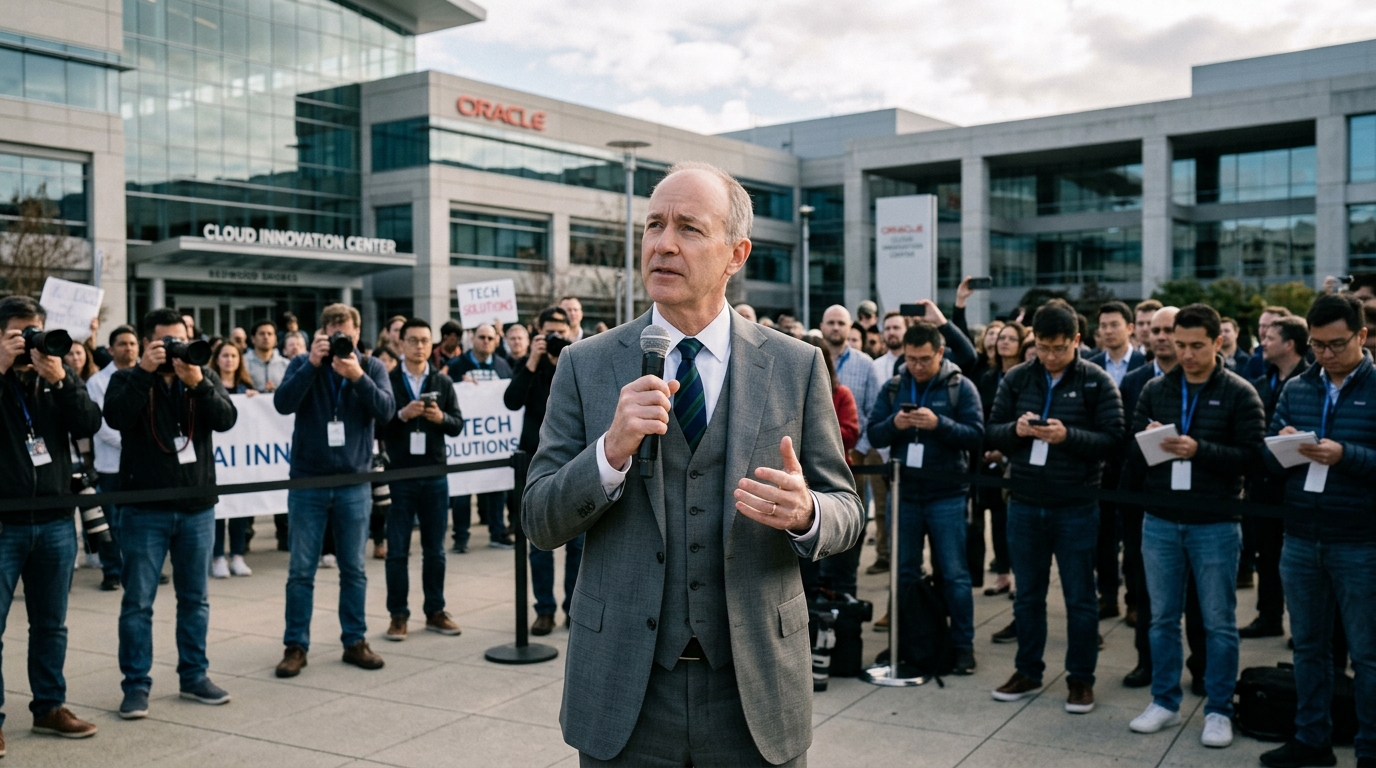
As of May 1, 2026, Oracle Corporation finds itself at a critical crossroads that has deeply divided the investment community. On one side, Wall Street analysts are painting Larry Ellison’s tech giant as the "dark horse" of the artificial intelligence revolution, issuing a steady stream of buy ratings. On the other, institutional and retail investors appear to be holding back, wary of the foundations upon which this new growth narrative is built. A recent report from Bloomberg Tech highlights this exact paradox: a company deemed "cheap" and "undervalued" by experts, yet "risky" by those actually deploying capital.
The Strategic Alliance with OpenAI and Microsoft Azure
The core argument for the Oracle bulls centers on Oracle Cloud Infrastructure (OCI). Unlike legacy cloud providers, Oracle designed its Gen2 cloud with large language models (LLMs) in mind, utilizing RDMA (Remote Direct Memory Access) networking that allows GPUs to communicate with unprecedented efficiency. This technical edge paved the way for a high-profile partnership with Microsoft and OpenAI, where Oracle provides the raw compute power necessary to train and run the world’s most advanced AI models.
However, investors are questioning the sustainability of this growth. Dependence on a handful of mega-clients in the AI space creates significant concentration risk. If OpenAI further diversifies its infrastructure providers or if the broader demand for AI compute hits a plateau, Oracle could be left with massive, expensive data centers operating under capacity. Furthermore, competition from Amazon (AWS) and Google remains fierce, as these rivals develop their own custom AI silicon to reduce reliance on third-party hardware like Nvidia’s, a move Oracle has yet to fully replicate at scale.
The Debt Burden and the Cerner Legacy
A primary driver of investor skepticism is Oracle’s balance sheet. The $28 billion acquisition of Cerner, a leader in electronic health records, left Oracle with a staggering debt load. In an economic environment where interest rates remain a factor in refinancing costs, managing this debt limits the company's operational flexibility. Investors fear that Oracle is being forced to pour billions into capital expenditures (CapEx) to stay relevant in the AI race while simultaneously servicing legacy obligations.
The transition of Cerner’s massive data sets to the cloud has proven slower and more capital-intensive than initially projected. While Wall Street focuses on the long-term potential of AI-driven healthcare analytics, shareholders are witnessing current margins being squeezed by the integration of a lower-margin business. Oracle promises that AI will transform healthcare, but for many market participants, this feels more like a long-term aspiration than an immediate financial catalyst.
Transitioning from Legacy Software to Cloud Dominance
Oracle remains a titan in the database market, but its legacy on-premise software business is inevitably shrinking as enterprises migrate to the cloud. The central challenge is whether OCI’s growth can outpace the decline of traditional software licensing. Analysts argue that the "vendor lock-in" Oracle enjoyed in the database era will naturally transition to its cloud services. Yet, modern cloud-native startups often favor open-source alternatives or more modular ecosystems, threatening Oracle’s historical dominance.
In conclusion, Oracle in 2026 is a company in the midst of a profound metamorphosis. To bridge the gap with investors, it must do more than announce flashy partnerships with AI pioneers. It needs to demonstrate a clear path to generating free cash flow that can de-leverage the balance sheet while maintaining cloud growth rates that exceed the industry average. Until then, the disconnect between analyst enthusiasm and investor caution will likely define the stock's performance.
"Oracle is building the specialized plumbing for the AI era, but the market is still worried about the mortgage on the house." — Industry Analyst





