

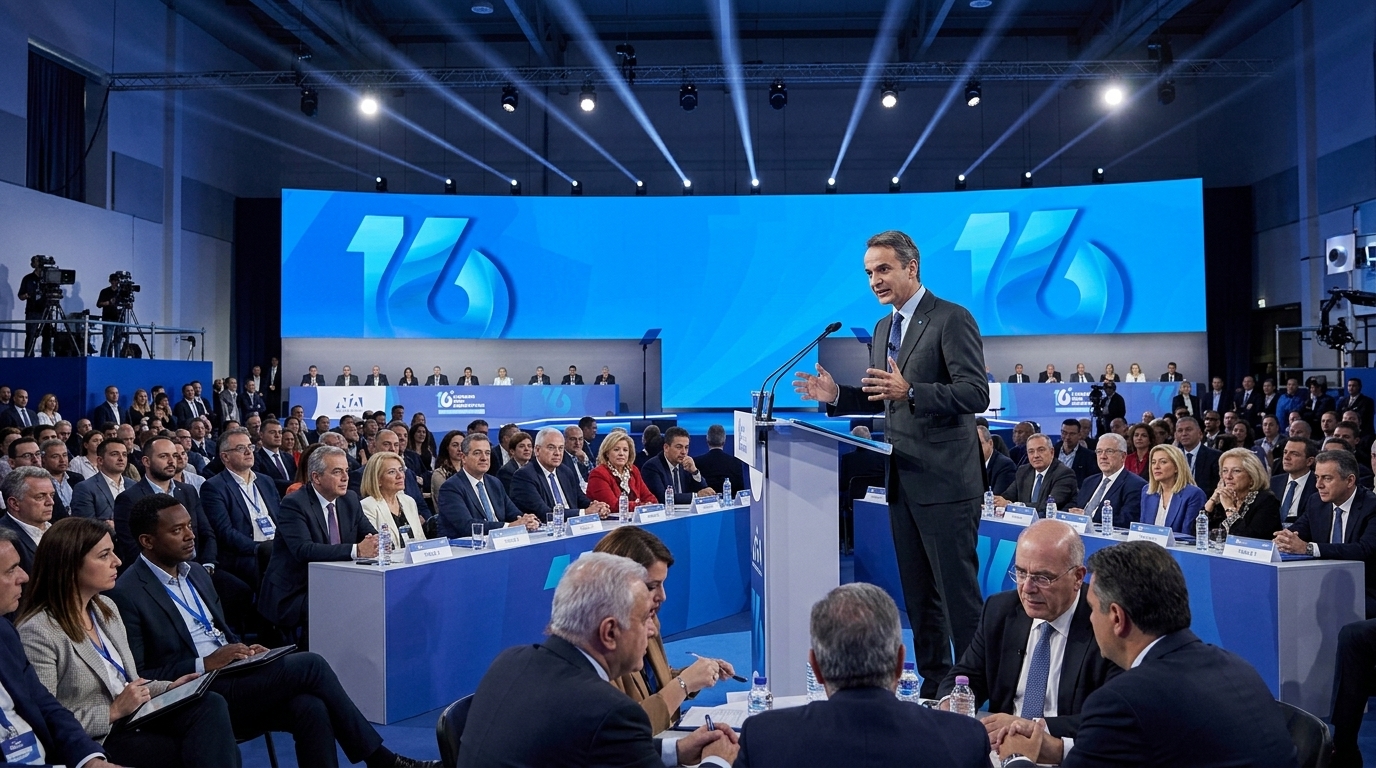
The completion of half a century of existence for New Democracy (N.D.) is not merely an anniversary of historical memory, but a critical political turning point. As Greece navigates the first half of the 2020s, the ruling party is attempting to synthesize a narrative that looks toward 2030, while simultaneously keeping the "ghost" of 2015 alive as the ultimate cautionary tale. This strategy, though effective so far, raises questions about the long-term sustainability of a political discourse based on comparisons with the past.
Historical Continuity and the 1993 Slogan
The reference to 1993 and Konstantinos Mitsotakis is no accident. The slogan "Greece will not go back" echoes once again in conference halls, suggesting that the danger of regression still lurks. However, the political landscape of 2026 is radically different. The opposition no longer possesses the cohesive dynamics of Andreas Papandreou, nor the momentum of SYRIZA from the previous decade. Nevertheless, the leadership of New Democracy chooses to maintain the front against populism, believing that the memory of economic suffocation and the experiments of 2015 remains the strongest adhesive for the centrist electorate.
Trend analysis shows that invoking 2015 acts as an "insurance policy" for moderate voters. As long as the country remains on a path of investment grade and fiscal stability, the comparison with the period of capital controls remains a potent weapon. However, political history teaches that fear has an expiration date. For the younger generation of voters, who were children in 2015, these references seem distant and disconnected from contemporary problems like the housing crisis and the high cost of living.
The Vision for 2030: Reforms and Challenges
The real bet for the government is transforming stability into a new national ambition. The "2030 Plan" includes the full digitalization of the state, the overhaul of the National Health System, and the energy transition. These pillars represent the answer to the natural wear and tear of power. New Democracy is trying to evolve from a traditional conservative party into an agent of modernization, attracting figures from the broader centrist space.
- Digital State: Completing the interconnection of all public services using AI technologies.
- Economy: Reducing public debt to below 130% of GDP by 2030.
- Education: Linking higher education with the labor market and establishing non-state universities.
- Justice: Accelerating judicial decisions, which remains the "thorn" for foreign investments.
However, implementing these goals faces decades-old pathologies. Bureaucracy and resistance within the state mechanism remain strong. Furthermore, internal criticism from the party's traditional "right-wing" wing creates friction. Dissatisfaction over national issues and the social agenda (such as the same-sex marriage law) shows that expanding toward the center comes at a cost on the right.
Internal Geography and Two Schools of Thought
Within New Democracy, two trends coexist. One, under Kyriakos Mitsotakis, prioritizes liberal modernization and European normalcy. The other, often expressed by veteran members and former prime ministers, insists on the need to return to the party's "roots," emphasizing national identity and conservative values. Managing this balance is crucial for party unity ahead of future electoral contests.
"New Democracy is the only party that managed to survive the crisis without splitting, precisely because it functioned as a large 'umbrella' for different trends," political analysts note.
The question arises whether this "umbrella" can withstand pressure from its right, where smaller formations are trying to capitalize on the dissatisfaction of traditional voters. The strategy of "fleeing forward" with an eye on 2030 is the leadership's response, but its success will be judged by the daily life of the citizen, not by macroeconomic indicators.
Conclusions: From the Past to the Future
Closing its 50 years, New Democracy finds itself in a position of power rarely seen in Greek political history since the restoration of democracy. The absence of an alternative government pole gives it the time and space to implement its policy. However, the risk of arrogance and disconnection from social reality is real. 2015 must remain a lesson on where populism leads, but it cannot be the sole argument for 2030. The Greece of the future requires a vision that inspires rather than frightens.





