

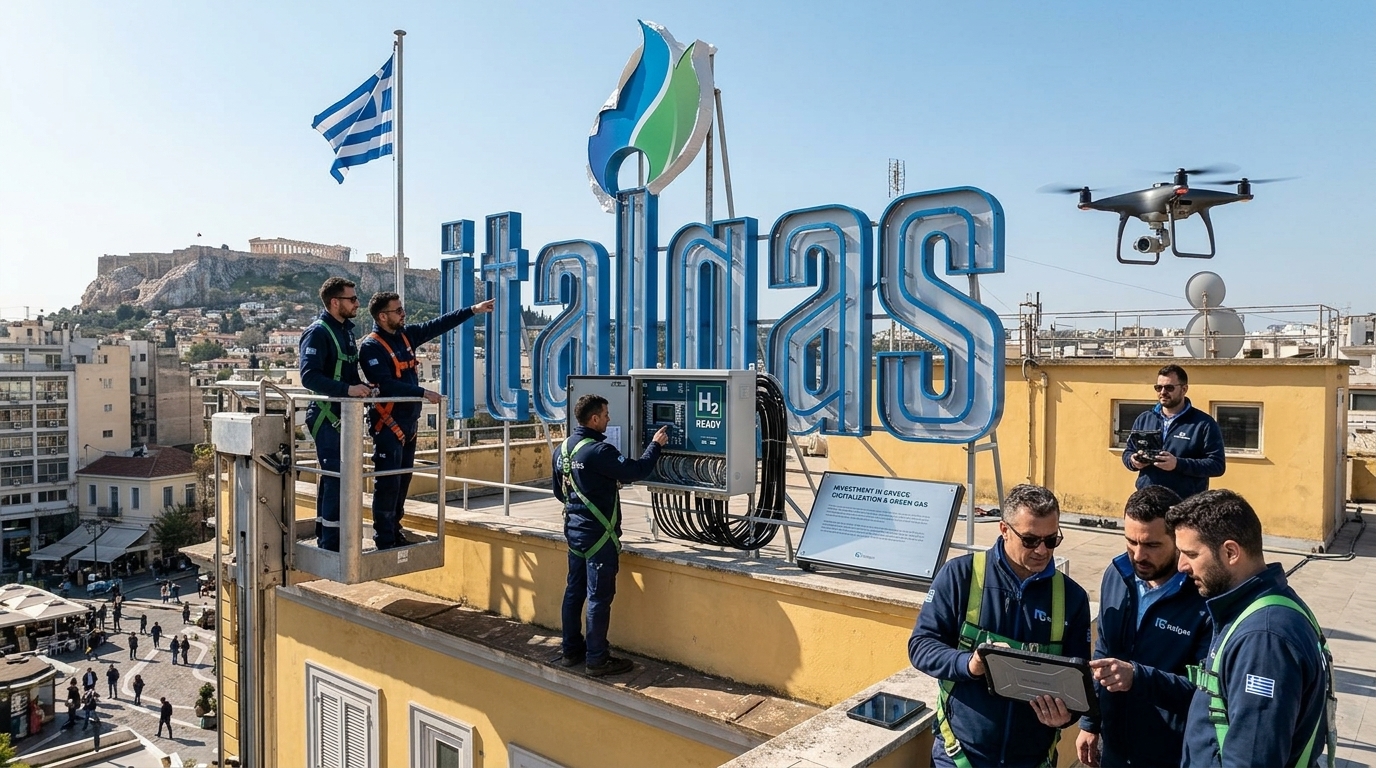
In a move that redefines the energy landscape of Southeast Europe, the Italian industrial giant Italgas has unveiled its Strategic Plan for the 2026-2032 period. The headline for the Greek market is the commitment to invest €1 billion in Greece, channeled through ENAON (formerly DEPA Infrastructure). This plan is far more than a simple infrastructure expansion; it represents a comprehensive technological overhaul aimed at creating a "smart" and flexible network capable of meeting the rigorous demands of climate neutrality.
Expanding the Reach: 2,700 Kilometers of New Infrastructure
The backbone of this investment plan is the aggressive geographic expansion of the distribution network. Italgas plans to construct an additional 2,700 kilometers of distribution pipelines, bringing natural gas to regions that have historically remained energy-isolated. This expansion is not merely about residential heating; it is a critical catalyst for empowering local industries and small-to-medium enterprises in the Greek periphery. Italgas’s strategic decision to invest heavily in regional Greece signals long-term confidence in the country's growth potential beyond the major urban hubs of Athens and Thessaloniki.
This expansion is coupled with an ambitious policy for new connections. The goal is to increase the number of users with access to cleaner energy sources compared to traditional heating oil, thereby directly contributing to the reduction of the nation's carbon footprint. However, a strategic challenge remains: how to ensure these multi-million euro assets do not become "stranded" in a world rapidly pivoting toward total decarbonization.
Digitalization: The "Nervous System" of a Modern Network
This is where Italgas’s innovation comes to the fore. Out of the total €15.6 billion to be invested across the entire group, a massive portion is dedicated to digitalization. In Greece, this translates to the installation of next-generation smart meters and the full digital transformation of network operations. The deployment of sensors and telemetry systems will allow for real-time flow monitoring, immediate leak detection, and pressure optimization.
Artificial Intelligence (AI) is the heartbeat of this transformation. Italgas is already utilizing advanced algorithms for predictive maintenance—identifying potential failures before they occur. This drastically reduces operational costs and enhances network safety. For the Greek consumer, this means higher reliability and potentially lower network tariffs in the long run as system efficiency improves. The move from analog to digital is not just a technical upgrade; it is a shift toward an intelligent energy ecosystem.
The Transition to Green Gases: Hydrogen and Biomethane
Perhaps the most visionary aspect of the Strategic Plan is the preparation of the network for the transport of "green" gases. Italgas does not view its infrastructure as a conduit solely for fossil gas, but as a multi-purpose energy highway. The new 2,700 kilometers of network are being built to "H2-ready" specifications, meaning they will be capable of transporting hydrogen-natural gas blends or even pure hydrogen in the future.
Simultaneously, there is a strong focus on biomethane—a renewable energy source produced from organic waste. Greece, with its robust agricultural sector, possesses significant potential for biomethane production. Italgas aims to facilitate the connection of biomethane production plants directly to the distribution network, fostering a circular economy. This step is pivotal for achieving REPowerEU targets and reducing dependence on energy imports, turning local waste into local power.
Economic Impact and Regulatory Challenges
The €1 billion investment is expected to generate thousands of jobs, both directly in construction and engineering and indirectly in the technology and service sectors. The merger of the various Greek distribution companies (EDA Attikis, EDA Thess, DEDA) into a single entity, ENAON, provides the necessary scale and organizational synergy to execute such large-scale projects. However, the plan's success hinges on a stable regulatory framework and the acceleration of licensing procedures in Greece—a perennial challenge for large infrastructure projects.
In conclusion, Italgas is betting on Greece not just as a consumer market, but as a testing ground for cutting-edge energy technology. The transition from "traditional" natural gas to a digitalized network of green gases is a one-way street, and Greece appears to be positioning itself at the forefront of this evolution under the stewardship of Italgas.





