

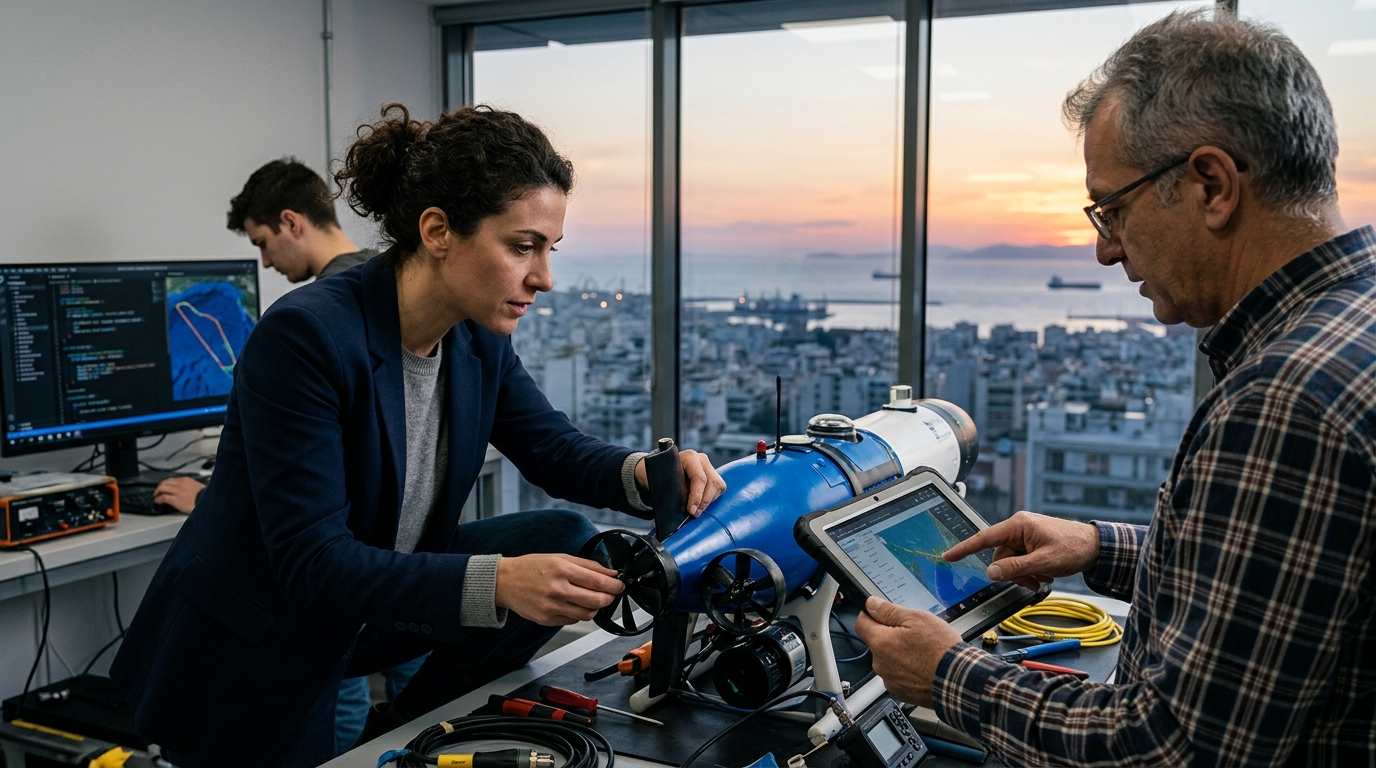
In a country defined by its maritime geography, where the Aegean and Ionian Seas are hubs of intense shipping activity and humanitarian challenges, technology is stepping in where human vision reaches its limits. A Greek researcher is at the forefront of this effort, developing a sophisticated system of Unmanned Aerial Vehicles (UAVs) that utilize advanced Artificial Intelligence algorithms to automatically detect shipwreck survivors in real-time.
This endeavor is not merely an academic exercise but a critical necessity. In Search and Rescue (SAR) operations, time is the most decisive factor. Hypothermia and exhaustion work inversely with the probability of survival. Until now, detection has largely relied on manned assets (helicopters, ships) and visual observation by crews—a process that is grueling, expensive, and often ineffective under high wave conditions or limited visibility.
The Technology Behind the 'Digital Eye'
The system under development is based on Deep Learning neural networks trained on thousands of images of sea surfaces. The challenge for AI in this environment is immense. The sea is not a static surface; sun glints, whitecaps, shadows, and floating debris (such as plastics or wood) create 'noise' that can easily lead to false positives.
The Greek researcher and his team have managed to optimize Computer Vision algorithms to run directly 'on-board' (edge computing). This means the drone does not need to constantly stream high-resolution video to a ground station for analysis—which would require massive bandwidth and cause delays. Instead, the drone 'thinks' and 'sees' independently, sending an alert only when it identifies a target resembling a human figure or a life raft.
- Integration of thermal cameras for nighttime detection.
- Autonomous flight path generation based on SAR patterns (expanding square search).
- Swarm intelligence capabilities for covering vast maritime areas.
- Satellite connectivity for operations in remote, off-grid regions.
From the Lab to the Greek Seas
Applying this technology in the field requires close cooperation with the Hellenic Coast Guard and volunteer rescue teams. Field tests have shown that an AI-equipped drone can scan an area ten times faster than a surface vessel, with a success rate reaching 95% in calm seas and remaining remarkably high even in moderate sea states (4-5 Beaufort).
A major advantage is cost-efficiency. Flying a Super Puma helicopter for a single hour costs thousands of euros, whereas deploying a fleet of drones costs a fraction of that amount. Furthermore, drones can be launched from small vessels or even from the shore within minutes of a distress signal. Current research is focusing on improving material durability against salt spray and the strong winds frequently encountered in the Aegean.
"Technology does not replace the rescuer; it grants them the superpowers needed to win the battle against time," the researcher states, emphasizing the human-centric approach of the project.
Ethical Challenges and the Future of Research
Despite the obvious benefits, the use of AI drones at sea raises important questions. The fine line between 'rescue' and 'surveillance' is a topic of ongoing debate within the European Union and international organizations. However, this Greek initiative focuses purely on the humanitarian aspect: saving lives. The system's ability to recognize people in distress without storing personal data or identifying faces serves as a crucial safeguard for privacy protection.
Looking ahead, the integration of 5G systems is expected to allow for real-time medical data transmission—if the drone is equipped with sensors capable of 'reading' vital signs from a distance—or even the precision dropping of survival gear (inflatable vests, thermal blankets) directly at the scene. Greece, through such innovations, proves it possesses the intellectual capital to lead in the global 'Blue Economy' and maritime security markets.





