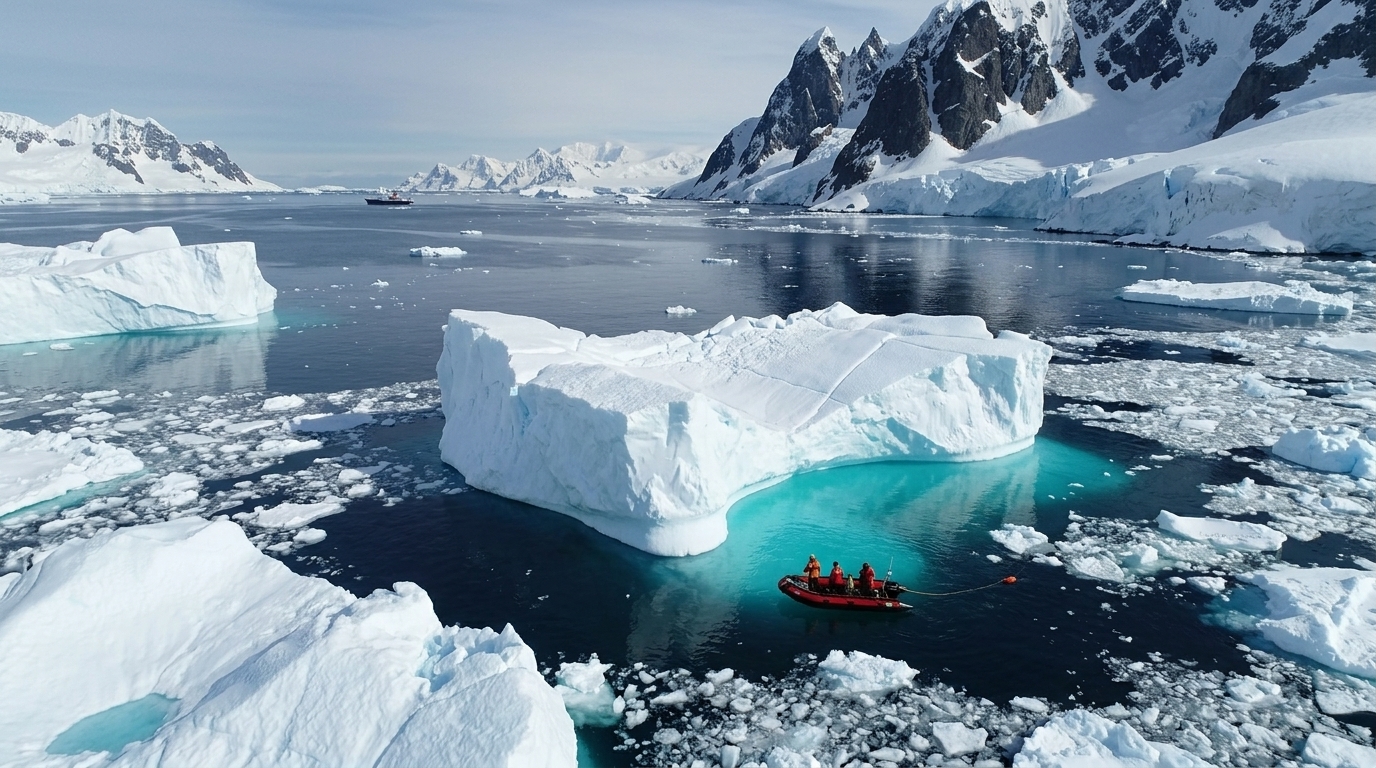
Antarctica, the most remote and enigmatic continent on our planet, was for decades considered a region of limited seismic activity. However, a groundbreaking scientific study, powered by advanced artificial intelligence algorithms, is overturning this perception. Researchers have successfully identified hundreds of "hidden" earthquakes occurring beneath the thick ice sheet, suggesting that the frozen continent is far more geologically active than previously thought.
The Challenge of Noise and the Machine Learning Solution
Why did these earthquakes remain invisible for so long? The answer lies in the harsh Antarctic environment. Traditional seismographs constantly record vibrations, but distinguishing between a genuine tectonic earthquake and the "noise" generated by moving glaciers, howling winds, or ice cracking is exceptionally difficult. In practice, this ambient noise often masks weak seismic signals (micro-earthquakes), rendering human analysis or legacy algorithms insufficient.
Artificial Intelligence, specifically deep learning, provided the breakthrough. Scientists trained neural networks to recognize the unique "fingerprints" of P and S seismic waves, filtering them out from environmental interference. The results were staggering: the AI identified over 300 earthquakes in a region where only a handful had been previously recorded. This ability of AI to sift through massive datasets with precision far exceeding human capability marks a new chapter in geosciences.
Geological Implications and Plate Tectonics
This discovery is more than just a statistical update. The presence of so many earthquakes implies that the tectonic plates beneath Antarctica are in constant motion and interaction. Specifically, many of these quakes were located along fault lines that were previously deemed dormant. Understanding this seismicity is crucial for mapping the structure of the Earth's crust beneath the ice, which remains one of the greatest mysteries of modern geology.
Furthermore, seismic activity is directly linked to geothermal heat flux. If the region is geologically active, it indicates internal heat that may be affecting the base of the ice sheets. This heat acts as a lubricant, accelerating the slide of glaciers toward the ocean, which has direct implications for global sea-level rise projections.
The Climate Change Connection
One of the most compelling questions arising from this data is whether the climate crisis is influencing Antarctica's seismicity. As ice melts due to global warming, the immense weight pressing down on the Earth's crust is lifted. This process, known as "isostatic rebound," can trigger the activation of faults that have been "locked" by the weight of the ice for millennia.
- The reduction in ice mass causes the land to rise.
- This uplift creates stress in the underlying rock, leading to earthquakes.
- These earthquakes, in turn, can cause further fracturing in ice shelves, creating a feedback loop.
The use of AI allows scientists to monitor this dynamic relationship in real-time, providing data that is essential for the climate models of the next decade.
The Future of Scientific Exploration
The success of this study serves as a harbinger for how research in extreme environments will be conducted in the future. It is not limited to Antarctica. Similar techniques could be used to explore the icy moons of Jupiter or Saturn, where conditions are equally hostile and data is similarly noisy. Artificial Intelligence is transforming from an analytical tool into a "digital explorer" that sees where human senses and traditional instruments fail.
"We didn't just discover earthquakes; we discovered a new way to listen to our planet," stated a member of the research team.
In conclusion, the revelation of Antarctica's hidden earthquakes via AI underscores the necessity of continued investment in cutting-edge technology. The knowledge we gain is not just about Earth's past; it is the key to our survival in a changing climate, where every tremor beneath the ice can have repercussions for coastlines across the globe.