

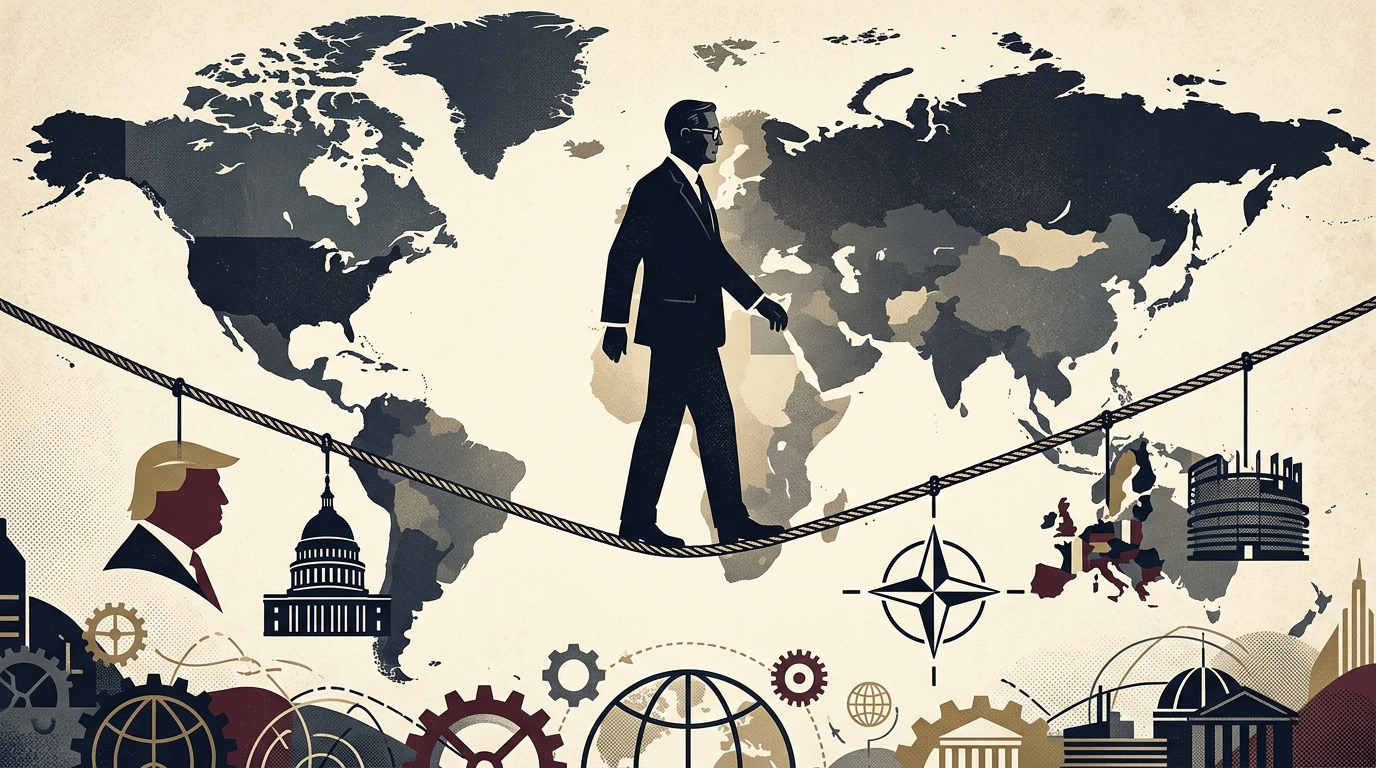
As we navigate the summer of 2026, the geopolitical chessboard of Europe stands at one of its most critical junctures in modern history. Mark Rutte, having taken the helm of NATO during a period of intense uncertainty, faces the challenge of a lifetime: maintaining Alliance cohesion amidst conflicting signals emanating from Washington. His recent assertions regarding Donald Trump, whom he described as "fully committed" to NATO, are not merely an observation but a carefully orchestrated diplomatic maneuver designed to soothe European anxieties.
The 'Trump Whisperer' Faces a Reality Check
Mark Rutte was not chosen as Secretary General by chance. His reputation as the politician who could "speak Trump's language" during his tenure as Dutch Prime Minister was his primary asset. Today, with the specter of a potential Trump return to power or the enduring influence of the "MAGA" wing of the Republican Party, Rutte is attempting to get ahead of the curve. He argues that Trump understands NATO's strategic value—not as an act of US charity toward Europe, but as a power tool serving American interests in the systemic competition with China and Russia.
However, the rhetoric of "full commitment" stands in stark contrast to occasional threats of withdrawing US troops from European soil, particularly Germany, and the resurfacing discussions regarding the purchase of Greenland. For Rutte, these statements are part of a negotiating tactic rather than a genuine strategy of isolationism. The challenge lies in convincing European leaders not to panic, while simultaneously preparing for an America that will demand increasingly more from its partners.
The Greenland Question and Arctic Competition
The reference to Greenland, often met with irony by European commentators, masks a deeper geostatistical reality. The Arctic is heating up, both literally and figuratively, as new trade routes and vast mineral deposits become a bone of contention between the West, Russia, and China. The persistence of certain circles around Trump in eyeing American presence in Greenland highlights a pivot of interest toward the High North.
Rutte is acutely aware that European security is inextricably linked to the control of the North Atlantic. Rather than dismissing American aspirations, the Secretary General is attempting to integrate them into a framework of NATO cooperation. His strategy is clear: if the US seeks a leadership role in the Arctic, it must do so through NATO structures, thereby ensuring that Europe is not sidelined in these developments.
European Autonomy and the 2% Threshold
Perhaps the greatest success of the pressure Trump exerted in the past—and which Rutte now uses as leverage—is the rapid increase in defense spending across Europe. By 2026, the majority of member states have finally surpassed the 2% of GDP target for defense. Rutte utilizes this data as a "shield" against criticisms from Washington. "Europe is doing its part," is the message he broadcasts, attempting to strip the "freeloader" argument from the American political discourse.
Nevertheless, the debate over Europe's "strategic autonomy" remains thorny. While Rutte publicly supports a stronger European defense capability, he privately works to ensure it does not function competitively against NATO. The balance is delicate: a Europe too dependent on the US is vulnerable to domestic political shifts in Washington, while a Europe too independent could provide the pretext for a permanent US withdrawal.
Conclusions for a New Era
Mark Rutte’s tenure will be judged by his ability to manage the unpredictable. Trump’s commitment, as described by Rutte, is not a blank check but a transactional relationship based on mutual benefit. In the world of 2026, alliances are no longer taken for granted based on ideology or shared history. Instead, they must prove their value daily in the arenas of power and economics.
Rutte is called upon to be the architect of a "NATO 2.0," where Europe acts as an equal partner rather than a protectorate. The challenges from the East and the internal divisions within the West make his task Herculean. However, his optimism regarding Trump’s stance may be the only realistic path to avoid a rupture that would leave the old continent exposed to unprecedented risks.




