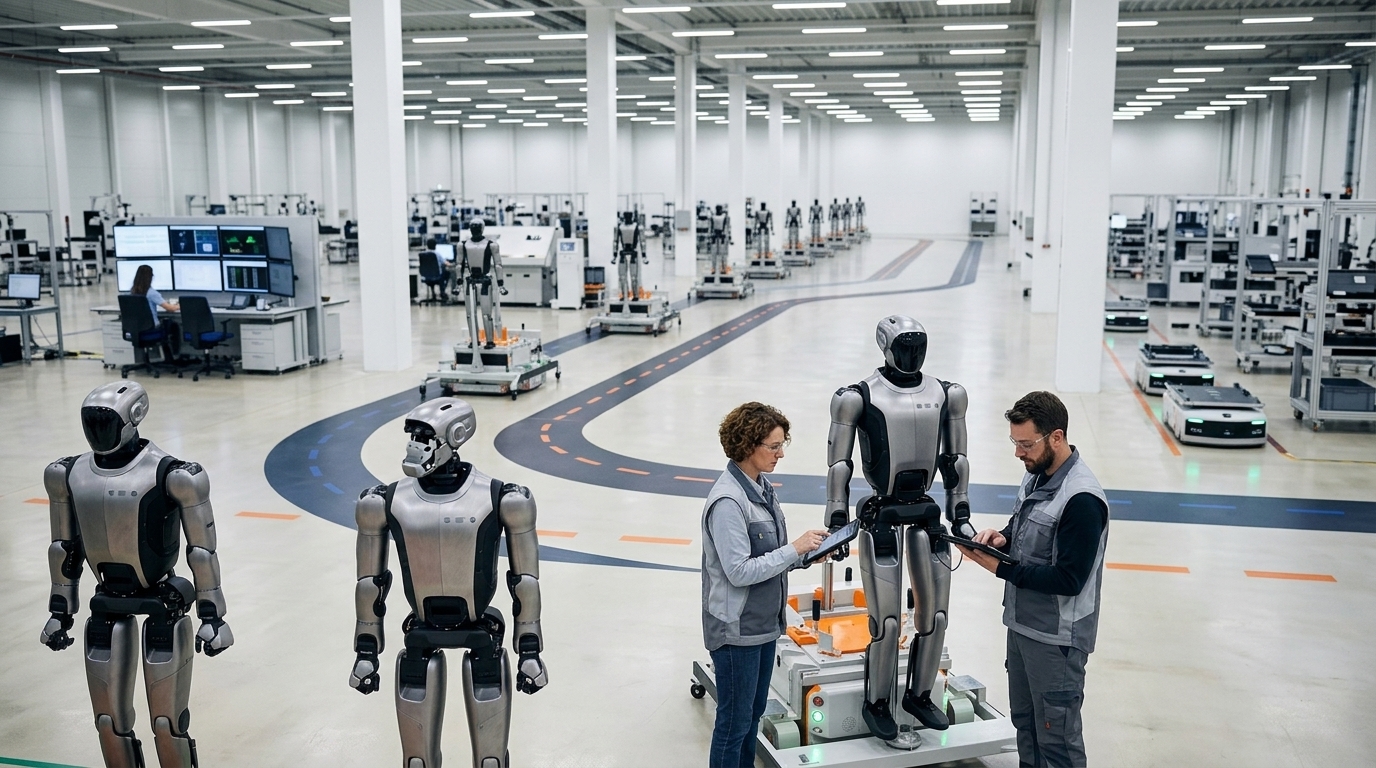
While public discourse on Artificial Intelligence often centers on large language models, the real battle for economic supremacy is unfolding on factory floors. According to recent data, China has already established a hegemonic position in industrial automation, leaving Europe to find ways to leverage its own specialized technical expertise.
China’s Dominance by the Numbers
The figures for 2024 are revealing: China installed 295,000 new industrial robots, accounting for 54% of the global total. With its total operational stock now exceeding 2 million units, Beijing has moved far beyond the pilot stage, with AI adoption in manufacturing reaching 67%.
Through the state-led "AI Plus" initiative, China aims for the full integration of AI across all industrial sectors. Notably, September 2026 benchmarks show that Chinese AI models have narrowed the performance gap with American industry leaders to a mere 3%.
The European Data Strategy
Recognizing that it cannot compete with China in raw hardware production, Europe is choosing the path of "data sovereignty." This strategy rests on three main pillars:
- Leveraging industrial giants such as Siemens, ABB, and Schneider Electric.
- Establishing a network of 19 "AI Factories" across 16 different countries.
- Focusing on hyper-specialized industrial data to create a commercial edge.
Despite the competition, global interconnectedness remains unavoidable. For instance, in mid-October 2026, Siemens launched six AI test scenarios across five factories within China, highlighting the complexity of the global supply chain.
The Market’s Great Bet
For investors, the critical question remains whether the European approach can be converted into profitable products. Success will depend on whether the AI Factories produce applicable industrial solutions rather than just academic research, and whether companies can convince clients of the value of specialized industrial AI over general-purpose models.