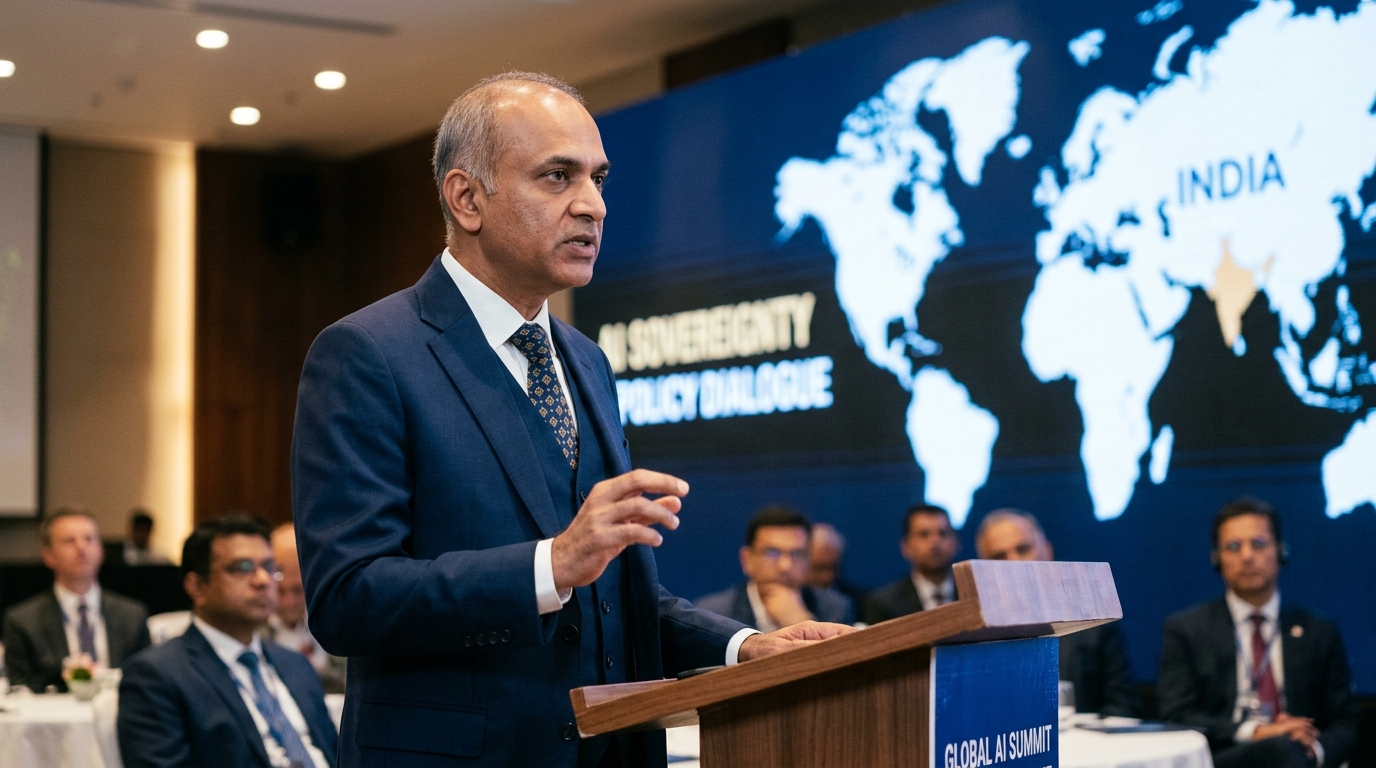
The global AI chessboard is experiencing a seismic shift, and India finds itself at a critical juncture. A new report by Bernstein highlights an existential threat to the country’s burgeoning digital economy: the risk of an 'AI Blackout.' As artificial intelligence transitions from a high-tech luxury to foundational infrastructure, New Delhi’s heavy reliance on foreign models—primarily American—is creating a strategic vulnerability that could paralyze the nation in the event of geopolitical friction.
The emergence of China’s DeepSeek has fundamentally altered the narrative. It proved that achieving frontier-level AI performance does not necessarily require the multi-billion dollar investments and tens of thousands of GPUs consumed by US tech giants. For India, a nation renowned for 'jugaad' (the art of finding clever, low-cost solutions), the DeepSeek model is not just a technological breakthrough; it is a survival blueprint.
The Threat of Dependency and the 'Blackout' Scenario
The term 'AI Blackout' used by Bernstein is far from hyperbole. Imagine an India where banks, healthcare systems, and government services are powered by APIs from OpenAI or Google. If, for any reason—be it sanctions, a shift in US foreign policy, or trade wars—this access is severed, India would find itself in a digital dark age. Bernstein argues that India must treat AI with the same strategic priority as energy security or national defense.
The current landscape reveals a paradox: while India possesses the world’s largest tech workforce, it suffers from a dramatic deficit in hardware infrastructure. The lack of domestic AI accelerator chips and limited access to Nvidia’s top-tier GPUs make developing Large Language Models (LLMs) a prohibitively expensive endeavor. However, DeepSeek’s approach—focusing on algorithmic efficiency rather than brute-force hardware—offers New Delhi a unique window to close the gap.
Sovereign AI: Beyond Nationalistic Rhetoric
The push for 'Sovereign AI' in India is not merely about prestige; it is about data and culture. Western models are often biased toward Western values, the English language, and American societal norms. India, with its 22 official languages and hundreds of dialects, requires models that understand the local context. An 'Indian DeepSeek' could be trained on indigenous data, ensuring that the technological revolution reaches the farmer in Uttar Pradesh as effectively as the software engineer in Bangalore.
- Cost Efficiency: Adopting Mixture-of-Experts (MoE) architectures can reduce training costs by up to 80%.
- Data Sovereignty: Keeping the data of 1.4 billion citizens within national borders is a cornerstone of national security.
- Linguistic Inclusion: Developing models that natively support Hindi, Tamil, Bengali, and beyond.
The Narendra Modi administration has already launched the 'IndiaAI' mission with a budget exceeding $1 billion. However, Bernstein analysts warn that these funds must be channeled into R&D for domestic architectures rather than simply purchasing foreign-made hardware.
The Geopolitics of Intelligence
On the international stage, India is performing a delicate balancing act. It is a member of the Quad and a close partner of the United States, yet it fiercely guards its 'strategic autonomy.' Reliance on US technology makes it susceptible to the whims of Silicon Valley and Washington. Conversely, China, despite severe chip export restrictions, managed to produce DeepSeek, proving that innovation can thrive under pressure and constraints.
"India cannot afford to be a mere consumer of AI. It must become a producer, or it risks becoming a digital colony in the 21st century," the report states.
The conclusion is inescapable: the path to economic dominance in the modern era is paved with algorithms. If India can successfully synthesize its engineering talent with the efficiency-first philosophy demonstrated by DeepSeek, it will not only avert a potential 'blackout' but also position itself as the leader of the Global South in the AI age.