

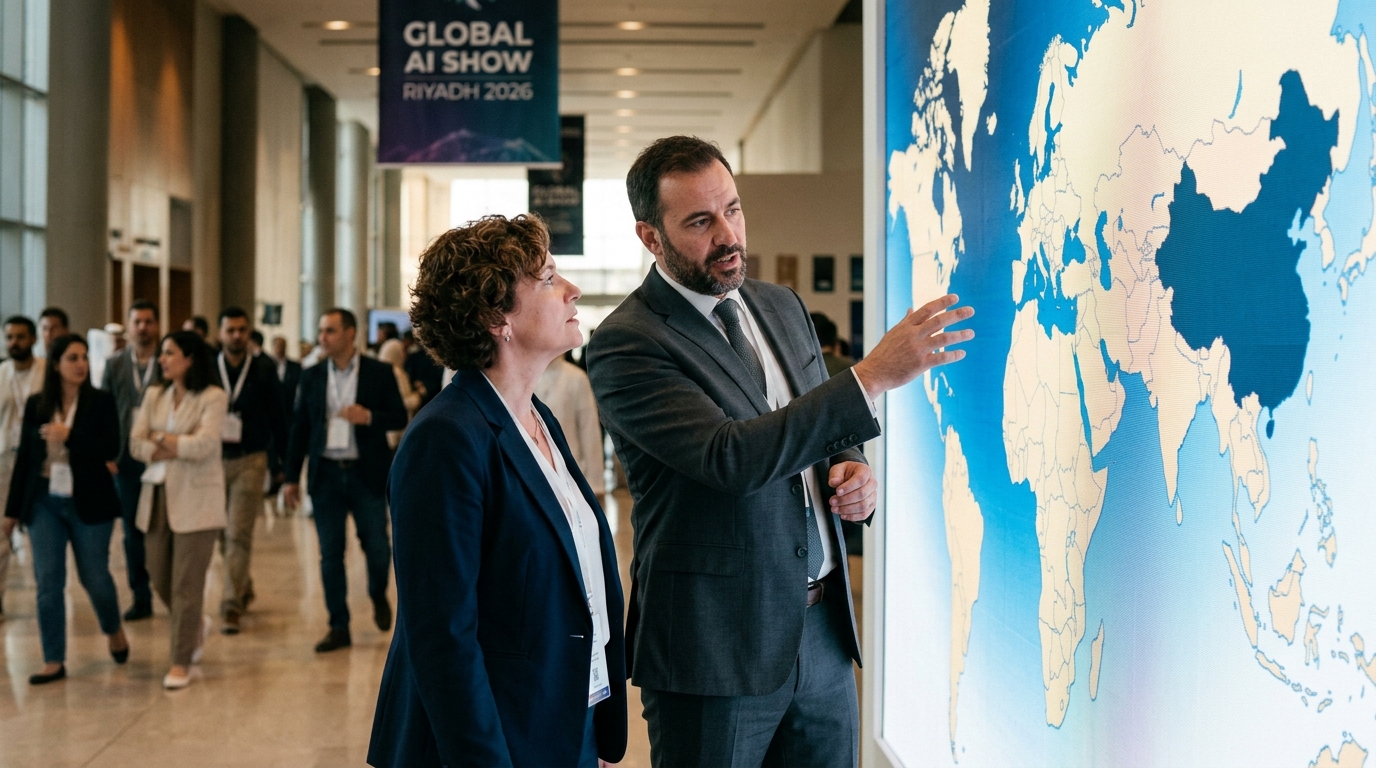
In the heart of the desert, where black gold once reigned supreme, a new form of power is emerging: digital code. The Global AI Show 2026 in Riyadh is not merely another tech exhibition; it is the manifesto of a new era. Saudi Arabia, through its Vision 2030, is positioning itself as the global arbiter of "Agentic AI"—a technology that promises to transform the state from a bureaucratic machine into a living, autonomous ecosystem.
The Shift to Agentic AI: From Generation to Action
Until recently, the conversation surrounding Artificial Intelligence (AI) focused on its generative capacity (Generative AI)—creating text, images, and code. However, the Riyadh summit has made it clear that 2026 is the year of Agentic AI. "Agents" are not just chatbots; they are systems capable of setting goals, devising strategies, and executing complex tasks without constant human intervention.
In the context of nation-building, Agentic AI is assuming roles traditionally held by ministries and state agencies. From optimizing energy grids in real-time to autonomously managing the supply chain for the gargantuan NEOM project, AI agents operate as the invisible architects of a new social infrastructure. Their ability to make decisions based on vast amounts of data drastically reduces human inefficiency and corruption, creating a governance model predicated on absolute precision.
Sovereign AI and Geopolitical Power
A central theme of the Global AI Show is the concept of "Sovereign AI." By investing billions in semiconductor infrastructure and solar-powered data centers, Saudi Arabia is sending a clear message: national independence in the 21st century depends on owning the AI models and the data they are trained upon.
In a world polarized between the technological hegemony of the US and China, Riyadh is asserting its role as a third pole. The strategy of "Nation-Building" via AI is not just about domestic growth; it is about exporting expertise. Saudi Arabia aspires to become the provider of "Government OS" (Operating Systems) for the Global South, offering Agentic AI tools that can accelerate the development of nations lacking traditional infrastructure. The geopolitical chessboard is changing, and the pieces are now algorithms.
The Ethics of Automated Governance
Despite the enthusiasm, the rise of Agentic AI at the heart of the state raises serious questions. Who bears responsibility when an AI agent makes a flawed decision affecting the lives of millions? The transition from a "welfare state" to an "algorithmic state" carries risks for privacy and civil liberties. In Riyadh, discussions on "Responsible AI" were intense, with participants seeking a balance between absolute efficiency and human oversight.
The proposed model is one of "Augmented Governance," where AI handles 90% of operational tasks, leaving high-level policy-making and ethical judgment to humans. However, the line between execution and policy-making becomes increasingly blurred when algorithms define the parameters of reality. The challenge for the future is to ensure that Agentic AI remains a tool in human hands rather than a replacement for human agency.
Conclusion: The Road to 2030
The Global AI Show 2026 confirmed that AI is no longer a technological accessory but the foundation of national existence. Saudi Arabia is betting everything on Agentic AI, turning the Kingdom into a global laboratory for the future of humanity. Whether it is NEOM or the digitization of every public service, the message is clear: the future belongs to those who can translate code into sovereignty. The era of passive technology is over; the era of autonomous agent-nations has just begun.





