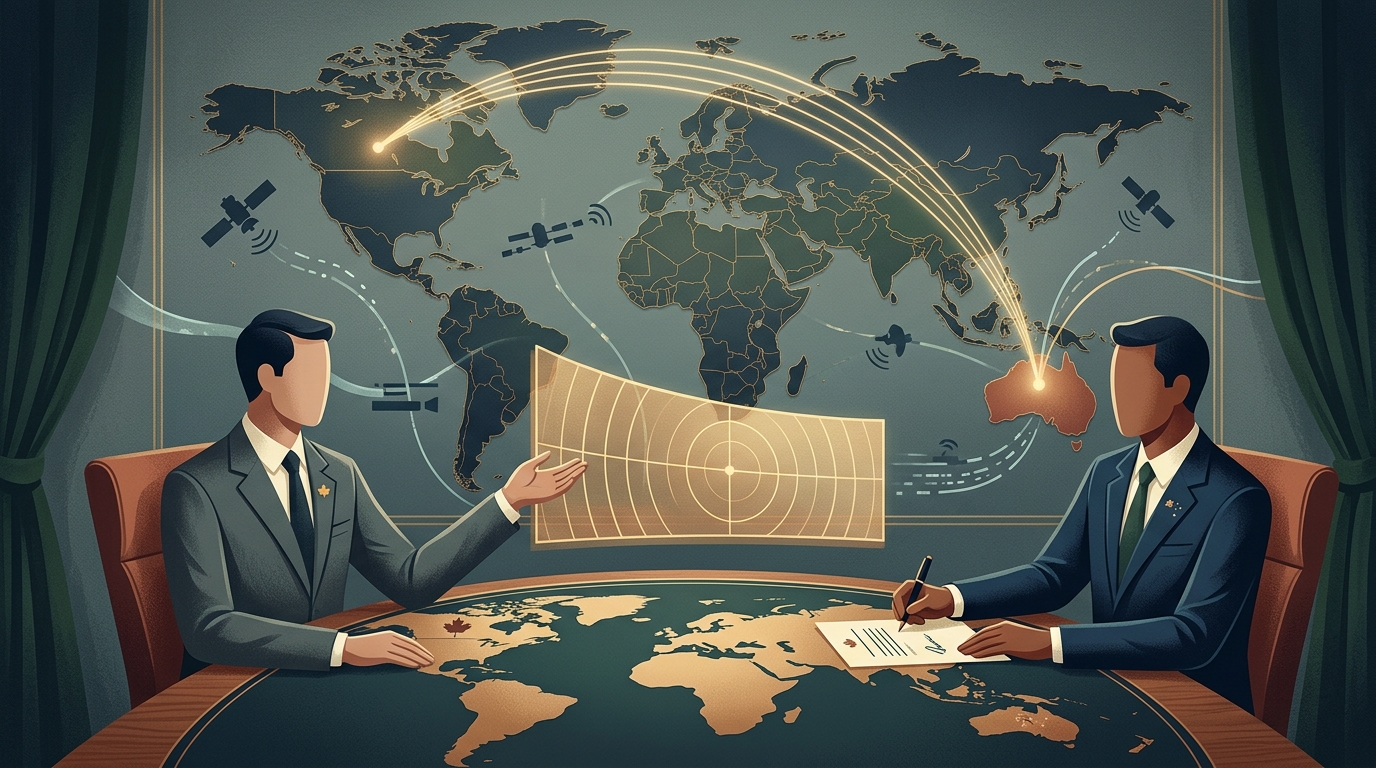
In an era where geopolitical instability underscores the urgent need for advanced early warning systems, Australia and Canada have finalized a landmark defense agreement valued at $2.5 billion. This partnership focuses on the export and joint development of Australian Over-the-Horizon Radar (OTHR) technology, a move that signals deeper military integration among members of the 'Five Eyes' intelligence alliance.
Technology That Defies the Earth's Curvature
The OTHR system is not your conventional radar. While traditional radar systems are limited by line-of-sight and the curvature of the Earth, OTHR technology utilizes the ionosphere as a mirror. By bouncing high-frequency (HF) signals off the upper atmosphere and back down to Earth at vast distances, the system can detect targets—ranging from surface vessels to stealth aircraft—at ranges exceeding 3,000 kilometers.
Australia is a global leader in this field through its Jindalee Operational Radar Network (JORN). Canberra’s decades of experience in monitoring its vast northern maritime approaches now serves as the blueprint for Canada, which faces similar surveillance challenges across the sprawling expanses of the Arctic.
Strategic Implications for the Arctic and Indo-Pacific
For Canada, this deal is a cornerstone of the NORAD (North American Aerospace Defense Command) modernization program. As Arctic ice melts, the region is transforming into a new theater for great power competition, with Russia and China significantly increasing their presence. The OTHR system will allow Ottawa to monitor movements in the region with unprecedented precision, filling gaps that satellite constellations or traditional radars cannot economically cover.
- Enhancing Arctic sovereignty against Russian submarine and aircraft incursions.
- Interconnecting surveillance systems between the Pacific and Atlantic theaters.
- Reducing the cost per square kilometer of surveillance compared to airborne patrols.
Industrial Synergy and the Future of Five Eyes
The agreement is more than a simple procurement; it is a profound industrial partnership. BAE Systems Australia, the primary operator of JORN, will work closely with Canadian firms to adapt the system to the extreme climatic conditions of the North. This technology transfer highlights a growing trend within the Five Eyes (USA, UK, Canada, Australia, New Zealand): the creation of a shared defense industrial base that reduces reliance on individual suppliers.
"This agreement is proof that 21st-century security depends not just on firepower, but on the ability to see a threat before it even nears your borders," noted a senior official from the Australian Department of Defence.
On a political level, this move sends a clear message of unity. While global attention remains fixed on flashpoints like Taiwan and Ukraine, Australia and Canada are "fortifying the back doors" of their respective continents, ensuring that deterrence begins with absolute situational awareness.