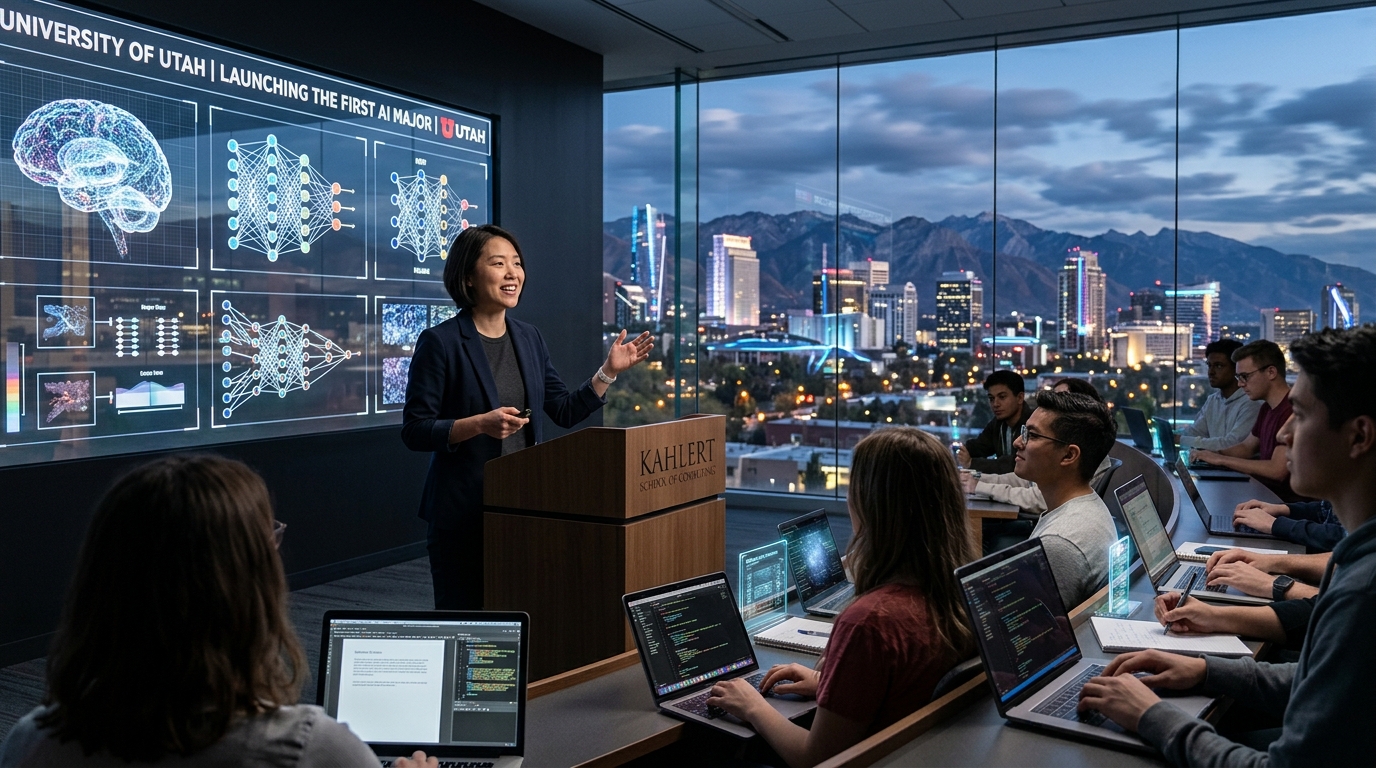
The announcement by the Kahlert School of Computing at the University of Utah regarding the launch of Utah’s first undergraduate major in Artificial Intelligence (AI) marks a pivotal moment for higher education in the United States. In an era where generative AI is reshaping every facet of the global economy, the academic establishment is being forced to decide whether AI remains a subset of Computer Science or an autonomous scientific field requiring its own specialized pedagogical framework.
The Strategic Significance of the 'Silicon Slopes'
Utah is not an accidental choice for such a pioneering initiative. The region, famously known as the 'Silicon Slopes,' has emerged as one of the fastest-growing tech hubs in the world. With the presence of tech giants and a vibrant ecosystem of startups, the demand for a workforce that doesn't just know how to code, but understands the intricacies of machine learning, neural networks, and big data management, is unprecedented. The University of Utah, with its long-standing history of innovation—it was one of the original nodes of ARPANET—is seeking to bridge the gap between theoretical knowledge and the immediate needs of the industry.
This new major is not merely a technical training program. According to the school's leadership, the degree structure has been meticulously designed to balance rigorous courses in mathematics, statistics, and algorithms with a strong emphasis on ethics and sociology. The challenge is twofold: producing scientists capable of building advanced models, while ensuring these same scientists can anticipate and mitigate the societal implications of their creations.
Anatomy of the AI Curriculum
The Kahlert School’s curriculum focuses on four core pillars: Machine Learning, Natural Language Processing (NLP), Computer Vision, and Robotics. Unlike a traditional Computer Science degree, where AI is typically an elective in the third or fourth year, Utah’s students will dive into the principles of machine intelligence from their earliest semesters. This allows for a much higher degree of specialization, moving away from the generalist approach that often defines broader CS programs.
Furthermore, the university is placing a significant premium on interdisciplinarity. Artificial Intelligence does not operate in a vacuum; it is applied in medicine, law, the arts, and climate science. The program encourages students to collaborate across departments, creating an ecosystem where technology meets application. This holistic approach is essential to avoid the 'silos' that often stifle innovation within academic laboratories. Students will be expected to complete capstone projects that solve real-world problems, often in partnership with local industry leaders.
Ethics and Social Responsibility
Perhaps the most critical element of this new direction is the integration of ethics into the heart of the curriculum. At a time when algorithms are frequently criticized for bias, the spread of misinformation, and privacy violations, the education of new engineers cannot be purely technocratic. Students will be required to engage with concepts such as 'algorithmic transparency' and the accountability of autonomous systems. Utah aims to set the standard for how academia can produce responsible leaders in the tech field, rather than just proficient coders.
The program also addresses the 'black box' problem—the difficulty of understanding how complex AI models reach their conclusions. By teaching students the mathematical foundations of these models, the University of Utah hopes to foster a generation of developers who can build explainable and reliable AI systems. This is particularly important for sectors like healthcare and finance, where trust and clarity are paramount.
Conclusion: A Blueprint for the Future
In conclusion, the University of Utah’s move is a clear recognition that Artificial Intelligence is the 'new electricity'—a fundamental infrastructure upon which the future will be built. As other institutions watch closely, the Kahlert School of Computing is positioning itself as a leader in the next wave of vocational and intellectual evolution. The success of this program will be measured not only by the career trajectories of its graduates but by their contribution to creating technology that serves humanity and society at large. It is a bold experiment in a state that is rapidly becoming a central node in the global digital economy.