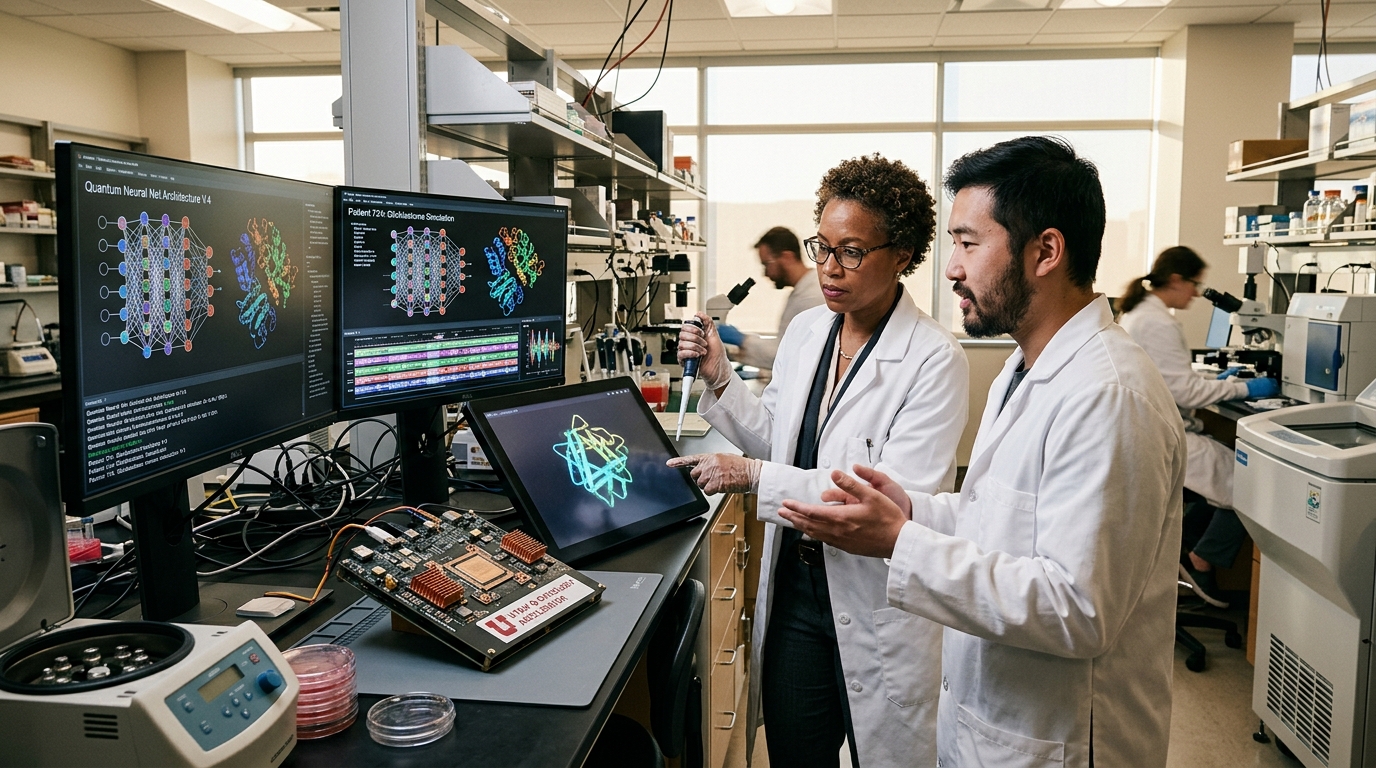
At the intersection of biology and theoretical physics, a new scientific paradigm is emerging from the University of Utah, promising to fundamentally alter our understanding and treatment of cancer. The application of quantum mechanics principles to artificial intelligence (AI) is no longer the stuff of science fiction, but a potent tool in the hands of oncologists. As we navigate mid-2026, the convergence of these two fields offers a solution to modern medicine’s greatest challenge: the staggering complexity of biological systems.
Transcending Classical Computation
Traditional artificial intelligence, while exceptionally effective at pattern recognition, is rooted in binary logic. In the world of tumors, where every cell can exhibit different mutations, linear data processing often proves insufficient. Researchers at the University of Utah’s Huntsman Cancer Institute have developed algorithms that borrow concepts from quantum physics—such as superposition and entanglement—to simultaneously analyze billions of potential combinations of genetic interactions.
This 'quantum-inspired' AI can process data in multi-dimensional spaces that classical AI struggles to navigate. Instead of examining mutations one by one, the system perceives the cancer cell as a dynamic system of probabilities. This allows scientists to predict not just how a tumor will evolve, but how it will respond to specific therapeutic agents before they are even administered to the patient.
Toward Truly Personalized Medicine
The greatest hurdle in oncology is heterogeneity. Two patients with the same type of cancer can have vastly different outcomes with the identical treatment. The University of Utah’s approach aims to eliminate the 'trial and error' method. By utilizing quantum models, AI can simulate the molecular behavior of drugs with atomic-level precision.
- Resistance Prediction: Identifying the mechanisms by which cancer cells evade chemotherapy.
- Combination Optimization: Finding the ideal dosage and combination of drugs for a patient’s specific genetic blueprint.
- Early Diagnosis: Detecting subtle changes in biomarkers that classical systems would dismiss as 'noise'.
According to the researchers, early clinical trial data shows a 25-30% improvement in outcomes for aggressive forms of cancer, such as glioblastoma and pancreatic cancer, where traditional methods often fall short.
Ethical Challenges and the Future of Medicine
Despite the excitement, the introduction of quantum logic into medicine raises significant questions. The complexity of these models makes their 'explainability' extremely difficult. How can a physician trust a decision derived from an algorithm that the human brain cannot fully comprehend? Furthermore, there is the risk of a new 'digital divide' in healthcare, where only the world's elite medical centers have access to such cutting-edge technologies.
"We are not just trying to build a faster computer. We are trying to mimic the way nature itself processes information at the subatomic level," says one of the lead researchers.
In conclusion, the work at the University of Utah marks the transition from the era of 'statistical medicine' to the era of 'quantum precision.' While we are still at the beginning, the promise of a world where cancer is no longer a death sentence, but a manageable data problem, seems closer than ever.