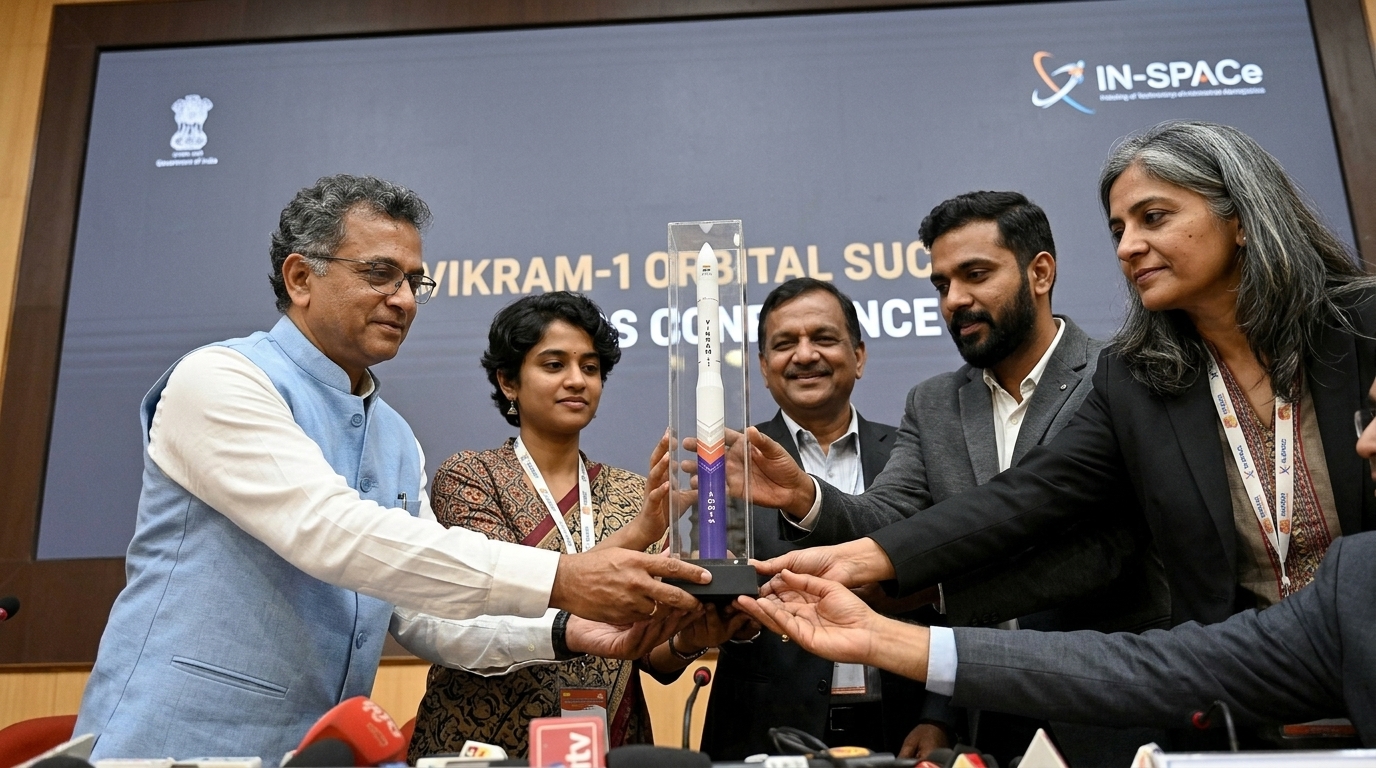
Indian space officials celebrated the debut flight of Skyroot Aerospace’s Vikram-1 rocket, India’s first fully commercial satellite launcher, as a “grand success” on Saturday. The rocket achieved an on-target climb into a 280-mile-high orbit following liftoff from a spaceport on Sriharikota Island in the Bay of Bengal.
A Technical Milestone
Standing approximately 72 feet tall, the Vikram-1 is constructed from lightweight carbon composite materials and named after Vikram Sarabhai, the father of the Indian space program. While modest in size compared to India’s heavy-lift rockets, it can place payloads of up to 770 pounds into low-Earth orbit. The mission utilized three solid-fueled stages and a liquid-fueled fourth stage featuring a 3D-printed engine to reach orbital velocity.
Defying the Odds
Reaching orbit on a first attempt is a rare feat in the private space sector. Skyroot’s co-founder and CEO, Pawan Kumar Chandana, noted that even SpaceX required four attempts to reach orbit with the Falcon 1, while Rocket Lab’s Electron failed its inaugural flight. “On the first attempt, reaching orbit, I never thought it was possible,” Chandana told his team, describing the launch as “nothing short of a suspense movie.”
National Ambition and Support
The breakthrough comes as Prime Minister Narendra Modi seeks to supercharge India’s space industry, setting a goal of 50 launches per year by the end of the decade. Skyroot’s success was bolstered by “handholding and support” from the Indian space agency (ISRO), which provided access to motor casting and test facilities. With a valuation of $1.1 billion and a workforce with an average age of 28, Skyroot has positioned itself as a major player in the global small-satellite launch market.