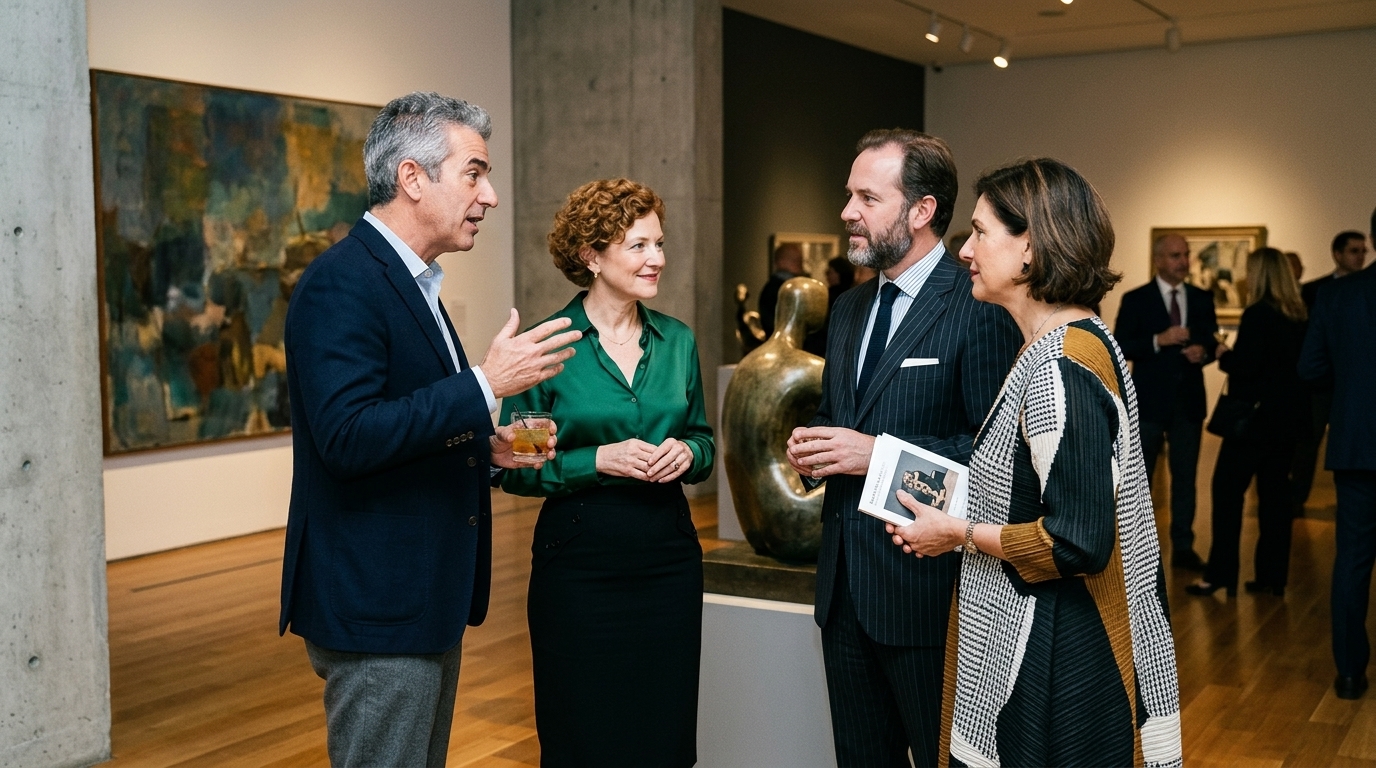
In an era where digital acceleration and artificial intelligence are reshaping our perception of reality, art remains the last bastion of authentic human experience. The recent dialogue between Eugenia and Nikos Papageorgiou with Dr. Leonidas Tzonis, as presented in Fortune Greece, was not merely an interview about collecting; it was a philosophical exploration of the role cultural institutions are called to play in the 21st century. The convergence of private initiative with academic thought highlights a new ethics surrounding the ownership and exhibition of art, transforming "having" into an act of social contribution.
The Philosophy of Collecting: From Private to Public
For Eugenia and Nikos Papageorgiou, art is not a static asset but a living organism that breathes through interaction with the public. The collecting process is described as an internal need to communicate with the past and the present, which, however, gains meaning only when it is diffused into society. This shift from the "ego-centric collector" to the "institutional benefactor" is crucial for the survival of culture in times of crisis. As noted in the discussion, a collection functions as a mirror of its era, preserving not just objects, but the values that gave birth to them.
The Papageorgiou couple's approach emphasizes the importance of "collecting ethics." It is not just about acquiring high-value works, but about curating a narrative that can inspire future generations. In this context, private collections function complementarily to state museums, filling gaps that bureaucracy or lack of resources often leave vacant. Art, therefore, becomes a tool for social cohesion, a common ground where different social groups can meet and converse.
The Role of Institutions and the Educational Dimension
Dr. Leonidas Tzonis, from his academic perspective, raised the critical question of education. Cultural institutions should not be mere custodians of objects but centers of knowledge production. The collaboration between collectors and educational institutions, such as the one promoted through Hellenic American University, creates bridges that allow students and young creators to come into contact with the "material" history of art. Education through art is not just about aesthetic cultivation, but also about the development of critical thinking, essential in a world flooded with digital illusions.
According to Dr. Tzonis, institutional support for art is an investment in human capital. When an institution opens its doors to a collection, it is not just exhibiting paintings or sculptures; it offers a framework for analysis. This framework is what allows the viewer to understand the socio-political conditions behind each work. Art thus ceases to be elitist and becomes accessible, not in the sense of simplification, but in the sense of inclusion.
Technology and Tradition: The New Challenge
One of the most interesting points of the discussion was the impact of technology on the management of cultural heritage. While digitization offers unprecedented possibilities for archiving and global access, the "aura" of the original work, as described by Walter Benjamin, remains irreplaceable. Eugenia and Nikos Papageorgiou emphasized that technology must serve as a servant of art and not as its substitute. The use of artificial intelligence in restoring works or creating interactive tours can enhance the experience, but physical presence in front of the work remains an irreplaceable mystery.
At this point, the role of collectors becomes even more significant. They are called to preserve the materiality of art in a world that tends toward the intangible. Preserving the physical existence of works is an act of resistance against oblivion. At the same time, institutions must find the golden mean between tradition and innovation, using new media to attract a younger audience accustomed to immediate and digital information.
Conclusions: Art as a Compass for the Future
The conversation between these three personalities leads to an optimistic conclusion: art and its institutions are more necessary than ever. In a future that seems uncertain, cultural legacy acts as a compass. The collections of Eugenia and Nikos Papageorgiou, combined with the vision of Dr. Tzonis, show the way for a new form of cultural diplomacy and social responsibility. Art is not a luxury for the few, but a necessity for the many, a way to understand what it means to be human in a constantly changing world.
"Art is the bridge between what we were and what we aspire to become, and institutions are the pillars that hold this bridge steady."