

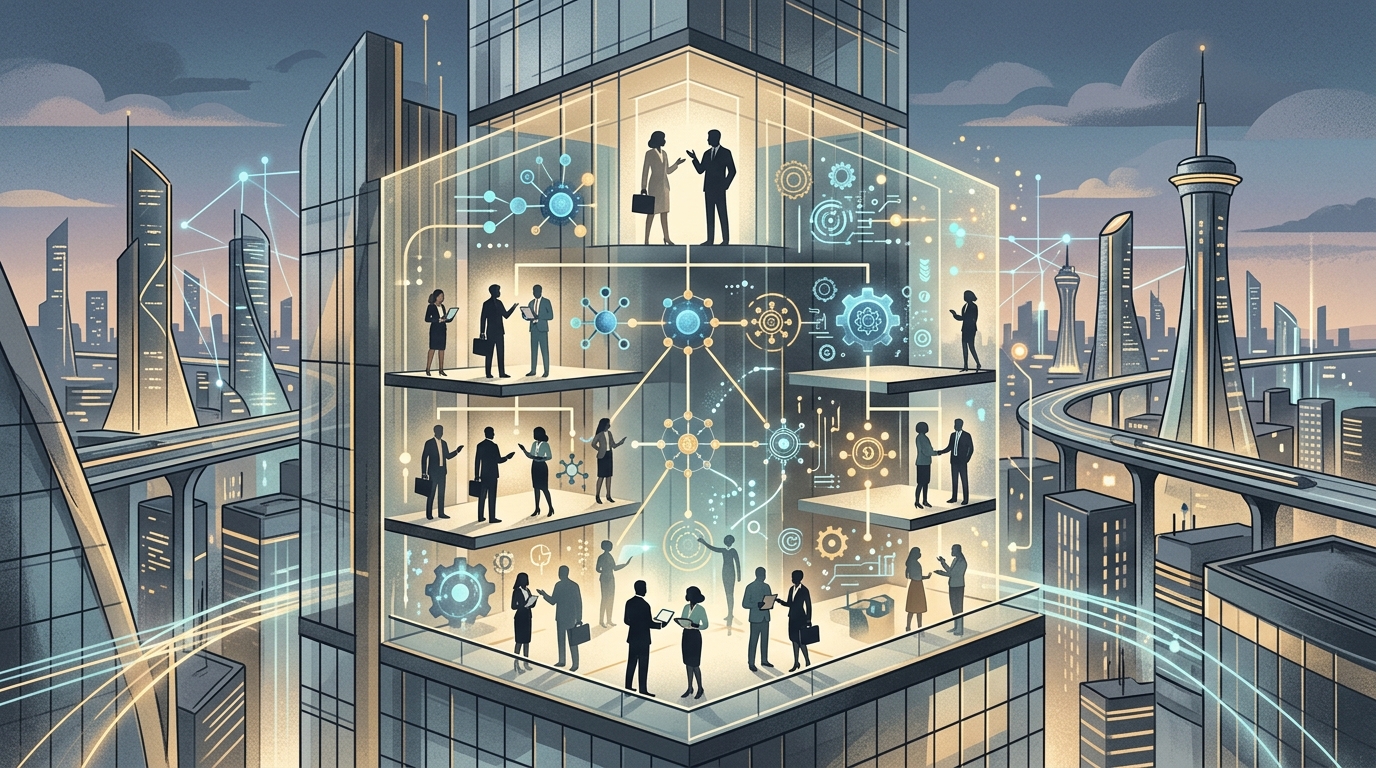
In the ancient Greek agora, the center of public life was defined by human interaction, debate, and a shared sense of order. Today, we are witnessing a radical restructuring of our modern digital agora. As I read the news today, I am struck by a profound shift: Artificial Intelligence is no longer just a tool we use; it is becoming a colleague we manage—and, in some cases, a shadow that haunts our executive suites.
The Digital Colleague and the Human Guardrail
Amrita Ahuja of Block recently noted that AI agents will soon appear directly on corporate organizational charts. This is a startling admission. We are moving toward a world where "digital entities" require development and context just like human employees. However, while some firms like Block have laid off 40% of their staff to automate workflows, I find hope in the Mediterranean response. Minister Niki Kerameus in Greece is setting clear limits on this "algorithmic management." By prohibiting the processing of emotional data and ensuring a right to human review, Greece is reminding us that while AI can boost productivity, it must never replace human dignity.
"AI acts as an extension of the team, allowing employees to become 'builders'" — Michelle Zatlyn, Cloudflare.
But building requires a foundation of trust. The recent arrest of an OpenAI engineer for allegedly planting a bug in an executive conference room serves as a sobering reminder. Even at the frontier of innovation, we are plagued by the oldest of human failings: espionage and the breach of sacred spaces. It is a paradox that OpenAI used its own models to catch the intruder—AI as both the witness and the detective.
Leadership in the Age of Acceleration
We are also seeing a deep schism in how we lead. In Asia, Ryoji Sekido suggests that the traditional hierarchy can actually accelerate AI adoption if leaders show "visible curiosity" and learn from their juniors. Contrast this with the West, where Mark Zuckerberg is doubling down on acceleration, rejecting the "speed limits" proposed by rivals. Meta is spending a staggering $145 billion on compute for 2026, essentially betting that market forces will regulate themselves.
Is this wise? Or are we, as the former OpenAI researchers warned the British Parliament, locked in a race we feel we cannot leave? Eleonora Meleti’s work in the European Parliament to protect creators from being replaced by AI suggests that the law must step in where "voluntary pledges" fail. As a journalist who values the human touch in every word, I believe AI should be a tool for creation, not a substitute for the creator. We must be the masters of our algorithms, not their subordinates.