As we approach the end of the first quarter of the 21st century, humanity finds itself at a paradoxical crossroads. While Artificial Intelligence promises to solve every material problem and biotechnology flirts with the idea of "curing" aging, a deep sense of emptiness permeates the social fabric. Professor of Philosophy at the University of Patras, Spyros I. Rangos, through his recent interventions, sounds the alarm regarding what he calls "spiritual drought" and a "mechanized life."
Professor Rangos' analysis is not merely an academic exercise but an existential cry against the "herd-ification of humans." In an age where identity is often reduced to digital footprints and consumer habits, returning to the roots of Greek philosophical thought appears as the only way out for reclaiming human dignity.
The Dialectic of Mortality and the Zest for Life
A central point in Rangos' thought is the coupling of two concepts often considered opposites: mortality and the "oistros" (zest or frenzy) of life. According to the Professor, these two states are nothing but "aspects of one and the same unified impulse." The consciousness of the finite nature of existence is not a source of melancholy, but the very driving force that generates creation, eros, and spiritual elevation.
"Mortality and the zest for life... aspects of one and the same unified impulse," notes the Professor, reminding us that the denial of death, which dominates modern Western culture, inevitably leads to the weakening of life itself.
When life attempts to be sterilized from risk and decay, it ends up becoming a flat process of survival without meaning. "Oistros"—that sacred mania described by the ancients—presupposes the acceptance of fragility. In the context of today's technological dominance, where AI promises a form of digital immortality, Rangos' thought serves as a reminder that the perfection of the machine is, in reality, a form of deathly stillness.
A Critique of Technocratic Mechanism
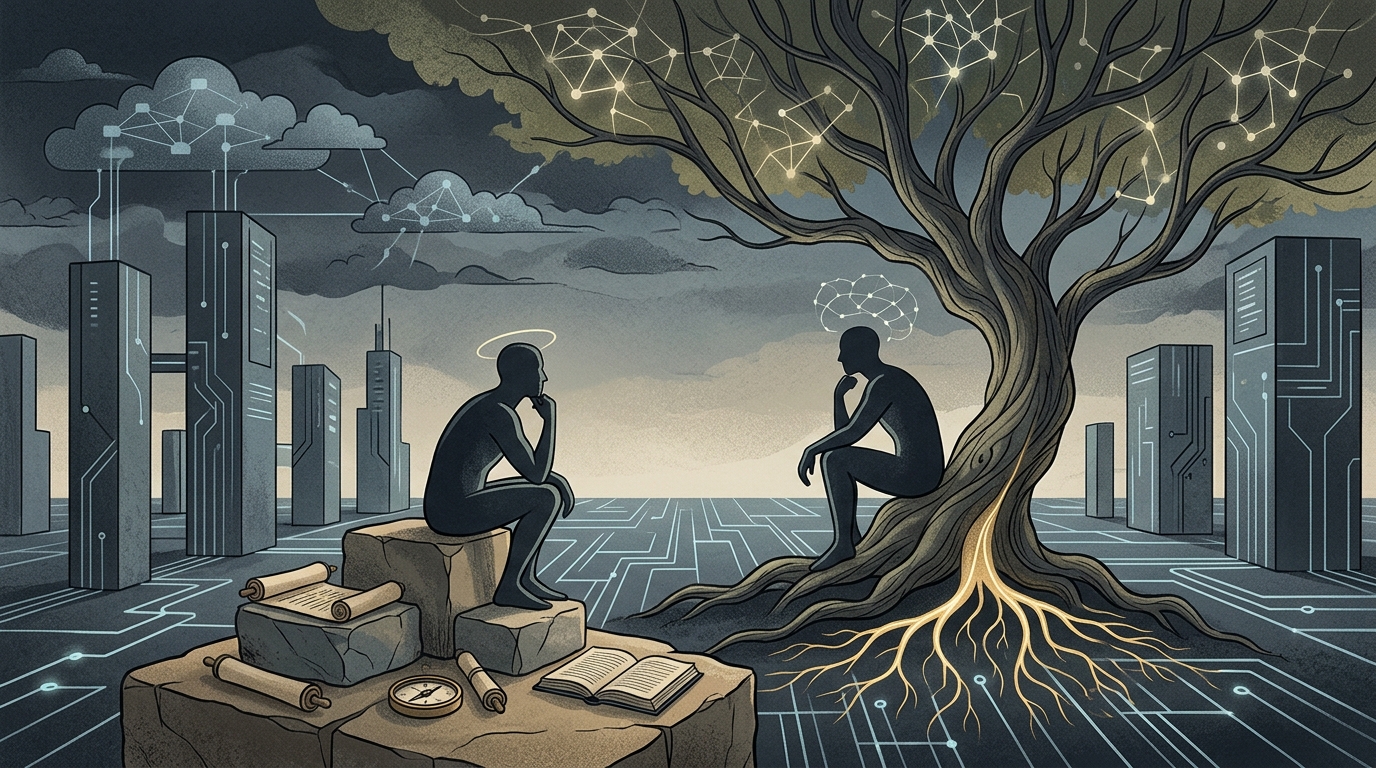
Professor Rangos directs his arrows against the "arrogance of material power." We live in an era where "doing" has completely displaced "being." The technocratic approach to reality treats the human being as a set of data to be processed, a machine in need of optimization. This perspective, however, ignores spiritual depth and the need for internal freedom.
- The mechanization of life leads to the loss of spontaneity.
- Herd-ification through social networks suppresses critical thinking.
- Material abundance is often accompanied by unprecedented spiritual poverty.
This critique is particularly relevant in 2026, as the integration of algorithms into every aspect of daily life has created an environment where decisions are made based on efficiency rather than moral value. Mr. Rangos proposes a return to spiritual alertness, which requires disconnecting from the noise of information and reconnecting with the essential.
Spiritual Drought and the Need for "Water"
The term "spiritual drought" used by the Professor vividly describes the state of the modern soul. Despite the overwhelming flow of information, the modern individual thirsts for meaning. Philosophy, for Mr. Rangos, is not a fossilized set of theories but a living spring that can quench the thirst of life's wayfarer.
The challenge he poses is clear: can we use the tools of our time without becoming their tools? The answer lies in recognizing the unified impulse that connects our frailty with our greatness. Education (Paideia), in the sense of character formation and not mere vocational training, remains the only bulwark against herd-ification.
In conclusion, the voice of Spyros Rangos constitutes a necessary dissonance in the monotony of technocratic discourse. He calls us to embrace our mortality, not as a flaw, but as the precondition for a life full of zest, creativity, and true freedom. In a world that prefers the certain answers of algorithms, philosophy insists on asking the right questions.