

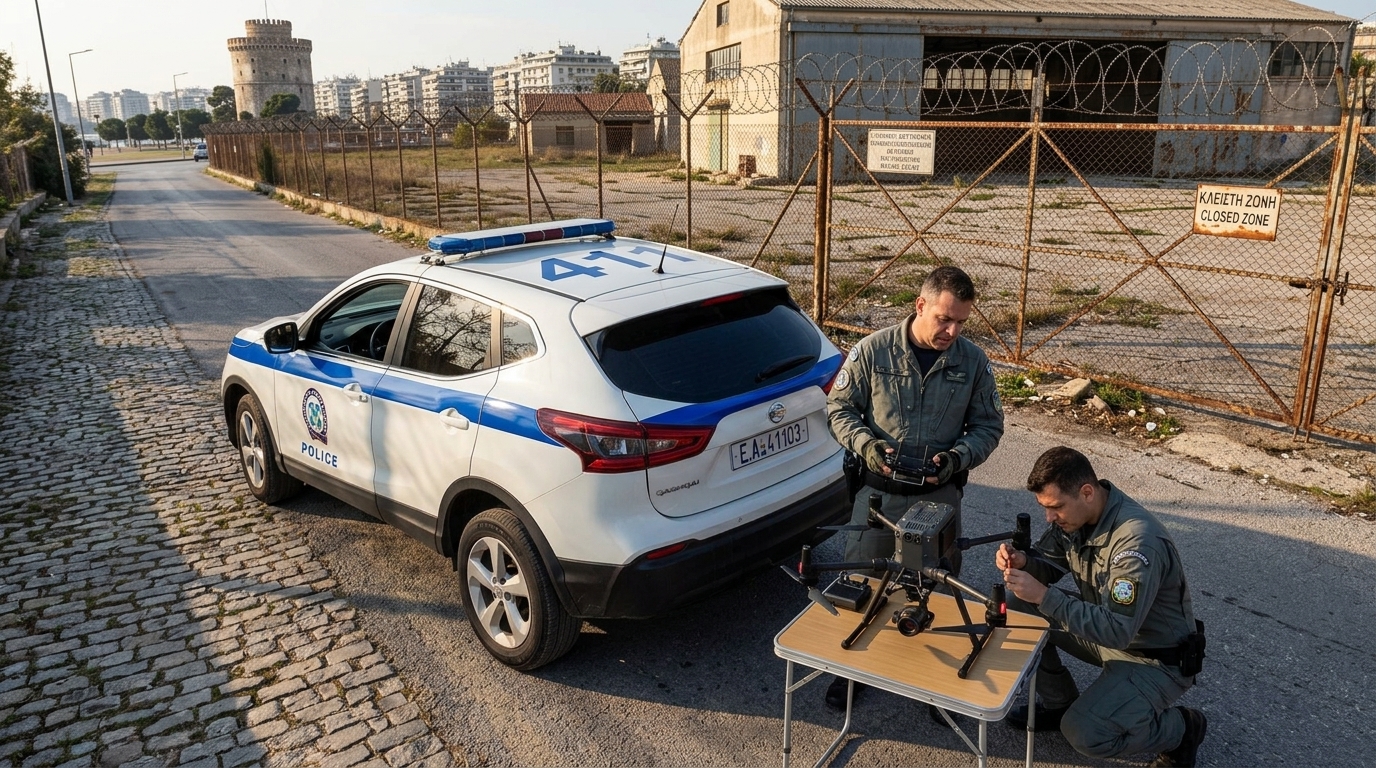
The arrest of a 35-year-old Bulgarian national last Saturday in Thessaloniki on charges of espionage is not merely a routine police incident; it opens a complex debate regarding national security in an era of digital transparency. The individual was caught operating a drone equipped with a sophisticated thermal imaging camera over the former Karatsiou military camp in the Stavroupoli area. This incident raises critical questions: Why would a foreign national be interested in a site that is theoretically inactive? And how easily can commercial technology be transformed into a tool for intelligence gathering?
The Anatomy of the Arrest and Technical Means
According to official statements from the Hellenic Police, the 35-year-old was spotted by a rapid response patrol during the night hours. Operating a drone at night is inherently suspicious, especially when the equipment includes thermal sensors. Thermal cameras (FLIR) do not just record images; they detect temperature differences, allowing the operator to see human presence, running engines, or even underground infrastructure emitting heat, all in total darkness.
The Karatsiou camp, although labeled as "former," remains a site under the supervision of the Ministry of National Defense, while parts of it have been ceded for social use. However, its geographical location and potential proximity to active military or telecommunications structures make it a point of interest. Authorities seized the drone and memory cards, which are being meticulously examined in the forensic laboratories of the Criminological Investigations Directorate to determine if the material had already been transmitted to a remote server.
The Legal Framework and Espionage Charges
The 35-year-old was referred to the prosecutor on charges of violating Article 148 of the Penal Code, which pertains to espionage. In Greece, photographing military installations is strictly prohibited, regardless of whether the site is fully active or in a phase of redevelopment. Drone use complicates the situation, as Civil Aviation Authority (CAA) regulations define specific "no-fly zones" over military camps and critical infrastructure.
The question investigative authorities must answer is the motive. Was he a simple technology enthusiast ignorant of the law, or a professional intelligence gatherer? The nationality of the suspect, although coming from an EU and NATO member state, does not rule out the possibility of acting on behalf of third-party interests or even criminal organizations interested in mapping blind spots in the city's security.
The Geopolitical Dimension and Ghosts of the Past
Thessaloniki, as a strategic hub in the Balkans, has historically been a field of operation for intelligence services. Today, the threat has shifted from agents in trench coats to drone operators sitting on a bench with a remote control. The city's former military camps (Karatsiou, Pavlos Melas, Kodra) often constitute "gray zones." While citizens demand their conversion into parks, the state often retains usage rights for emergency situations.
This case underscores the need for a more modern anti-drone system in urban centers with a military presence. If a private individual can so easily fly over a camp, what could an organized state entity do? The case of the 35-year-old Bulgarian serves as a warning about the vulnerability of our infrastructure to cheap but highly effective surveillance technologies.
Conclusions and Next Steps
The case file will determine the suspect's fate, but the political and military message is clear: the security of military sites does not end at the fence. In the age of satellites and drones, the concept of "secrecy" is being redefined. Greek justice is now called upon to balance between strict adherence to national security laws and an objective assessment of the act's danger, at a time when regional balances in the Balkans remain delicate.
"Modern espionage doesn't require a master spy; it requires a 4K camera and a thermal sensor available at any electronics store."
As the investigation continues, the focus will remain on whether this was an isolated incident or part of a broader pattern of surveillance targeting Greek infrastructure.




