

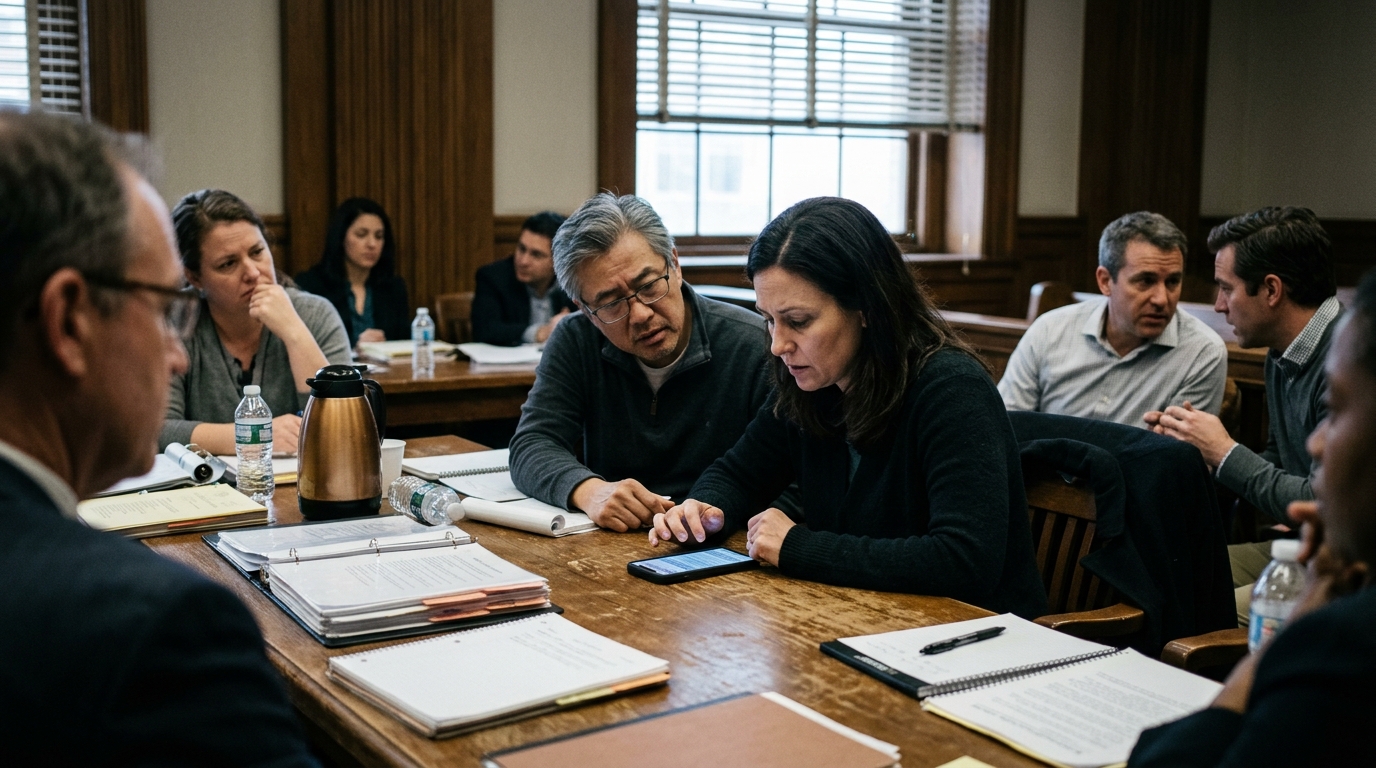
The jury deliberation room has traditionally been considered a 'sacred' space, isolated from the outside world, where justice is rendered solely based on the evidence presented in court. However, the advent of Generative Artificial Intelligence (AI) threatens to dismantle these walls. As tools like ChatGPT and Google Gemini become an integral part of daily life, jurors are increasingly tempted to use them to interpret legal terms, evaluate testimony, or even predict trial outcomes, directly jeopardizing the right to a fair trial.
The Digital Temptation in the Deliberation Room
For decades, judges have warned jurors against conducting 'independent research.' In the internet age, this meant banning Google searches or social media use. But AI represents a qualitative shift. Unlike a simple search engine that points to sources, AI provides ready-made, seemingly authoritative answers, often with a tone of expertise that can mislead a layperson.
The problem lies in the fact that jurors, exhausted by multi-day proceedings and complex legal concepts, seek shortcuts. Instead of relying on the judge’s instructions, they might ask a chatbot: 'What does reasonable doubt mean?' or 'What are the chances of recidivism for a defendant with this profile?' This practice introduces extraneous information into the process that has not been subjected to cross-examination by lawyers, violating fundamental principles of procedural law.
The 'Black Box' and AI Hallucinations
One of the greatest risks is the nature of the technology itself. AI models are known to suffer from 'hallucinations,' fabricating facts or legal precedents that do not exist. If a juror uses such information to persuade others, the verdict is based on falsehoods. Furthermore, the lack of transparency in how AI reaches a conclusion—the so-called 'black box' problem—makes it impossible for the court to correct the error.
"The use of AI by jurors is not merely a procedural irregularity; it is a structural failure of the process, as it replaces human judgment with an algorithm that is accountable to no law," notes a legal analyst in the National Law Review.
Bias is another critical factor. AI models are trained on data that often contains societal prejudices. If a juror uses AI to 'analyze' the credibility of a witness, they risk introducing automated biases into the deliberation room that the justice system has struggled for centuries to eliminate.
Constitutional Implications and Judicial Response
In the United States, the Sixth Amendment guarantees the right to a trial by an impartial jury. The use of AI violates this right because the defendant cannot confront or challenge the 'information' provided by the software. Already, judicial districts are beginning to revise jury instructions to include explicit prohibitions on the use of artificial intelligence tools.
- Stricter Controls: Some courts are considering confiscating mobile phones for the entire duration of the deliberation.
- Juror Education: Judges must now explain not only *what* is prohibited but also *why* AI is unreliable in a legal context.
- Mistrial Protocols: The discovery of AI use can lead to an immediate mistrial, incurring enormous costs for the public and the litigants.
The challenge is immense. In a world where access to information is instantaneous, requiring citizens to 'disconnect' completely to perform their duty seems increasingly difficult. Justice is called upon to find the balance between technological evolution and the protection of human rights.




