The global AI chessboard has just welcomed a new titan into the ranks of the trillion-dollar club. Zhipu AI, the Beijing-based startup frequently hailed as China’s answer to OpenAI, has seen its market valuation surge past the HK$1 trillion mark (approximately US$128 billion) following the high-profile release of its latest large language model, GLM-5.2. This milestone, first reported by the South China Morning Post, is more than a fiscal achievement; it is a definitive signal that the technological decoupling between East and West is fostering two distinct, yet equally potent, intelligence ecosystems.
Decoding GLM-5.2: A Technical Leap Forward
GLM-5.2 is not merely an incremental update. According to technical benchmarks and developer documentation, the new model showcases unprecedented capabilities in multimodal processing and complex reasoning. Zhipu AI appears to have cracked one of the most significant challenges facing Chinese tech: high-performance inference on domestic hardware. By optimizing GLM-5.2 specifically for Huawei’s Ascend chips and other local semiconductor architectures, the company has effectively bypassed the constraints imposed by US export bans on Nvidia’s high-end GPUs.
The model features a massive context window of up to 1 million tokens, enabling the digestion of vast libraries of data in a single prompt. Furthermore, its proficiency in coding and mathematical problem-solving places it in direct competition with OpenAI’s GPT-4o and Anthropic’s Claude 3.5. Crucially, it maintains a linguistic and cultural edge in Mandarin that Western models struggle to replicate, making it the preferred choice for the massive Chinese enterprise market.
The Economic Engine: The 'Tsinghua Mafia' and Market Dominance
Zhipu AI’s pedigree is rooted in the Knowledge Engineering Group (KEG) at Tsinghua University, China’s premier academic institution. This lineage provides the company with unparalleled credibility and a direct pipeline to the country’s brightest research talent. The HK$1 trillion valuation reflects deep-seated investor confidence from a coalition that includes Alibaba, Tencent, Meituan, and several state-backed venture funds.
- Strategic alignment with national goals for AI self-reliance.
- Widespread adoption across China’s public sector and industrial giants.
- A robust internal ecosystem that reduces dependency on Western software stacks.
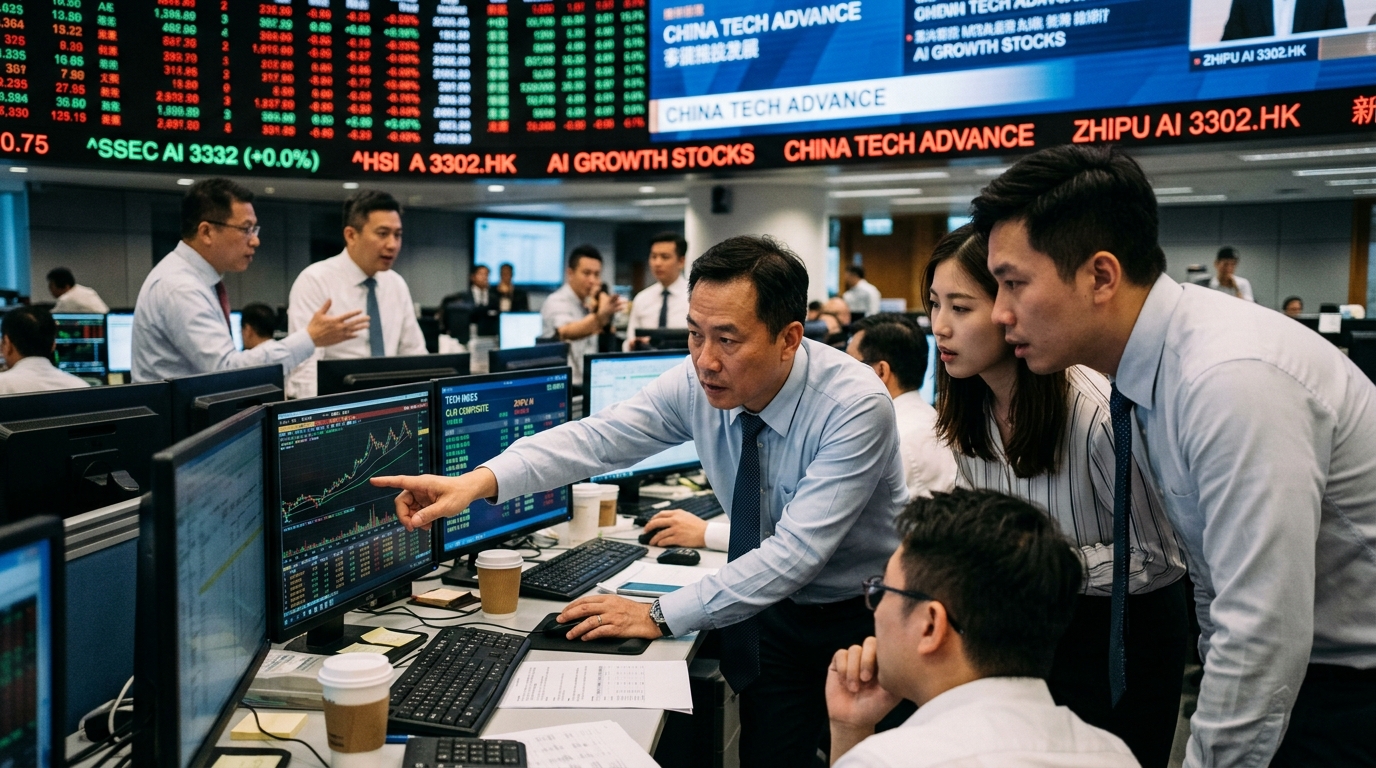
The Hong Kong market has reacted with fervor, viewing Zhipu AI as the bellwether for a new generation of Chinese AI 'decacorns'—including Moonshot AI and MiniMax. This valuation surge is not just about speculative growth; it represents the consolidation of the Chinese AI market around a few dominant players capable of operating at a global scale.
Geopolitical Implications and the Great AI Divide
Despite the celebratory mood, Zhipu AI faces a complex landscape. The company must navigate the stringent content moderation and security requirements of the Chinese regulatory apparatus while pushing the boundaries of generative creativity. Moreover, international expansion remains an uphill battle as Western nations increase scrutiny on AI models originating from Beijing due to data privacy and national security concerns.
"Zhipu AI’s ascent is China’s definitive response to technological containment. It is no longer just about algorithms; it is about establishing a sovereign intelligence infrastructure," notes a senior tech analyst based in Hong Kong.
In a world increasingly bifurcated by digital borders, GLM-5.2 stands as the East's technological fortress. The race for AI supremacy now has two clear poles, and Zhipu AI has just proven it has the financial and intellectual capital to challenge Silicon Valley's hegemony head-on.