

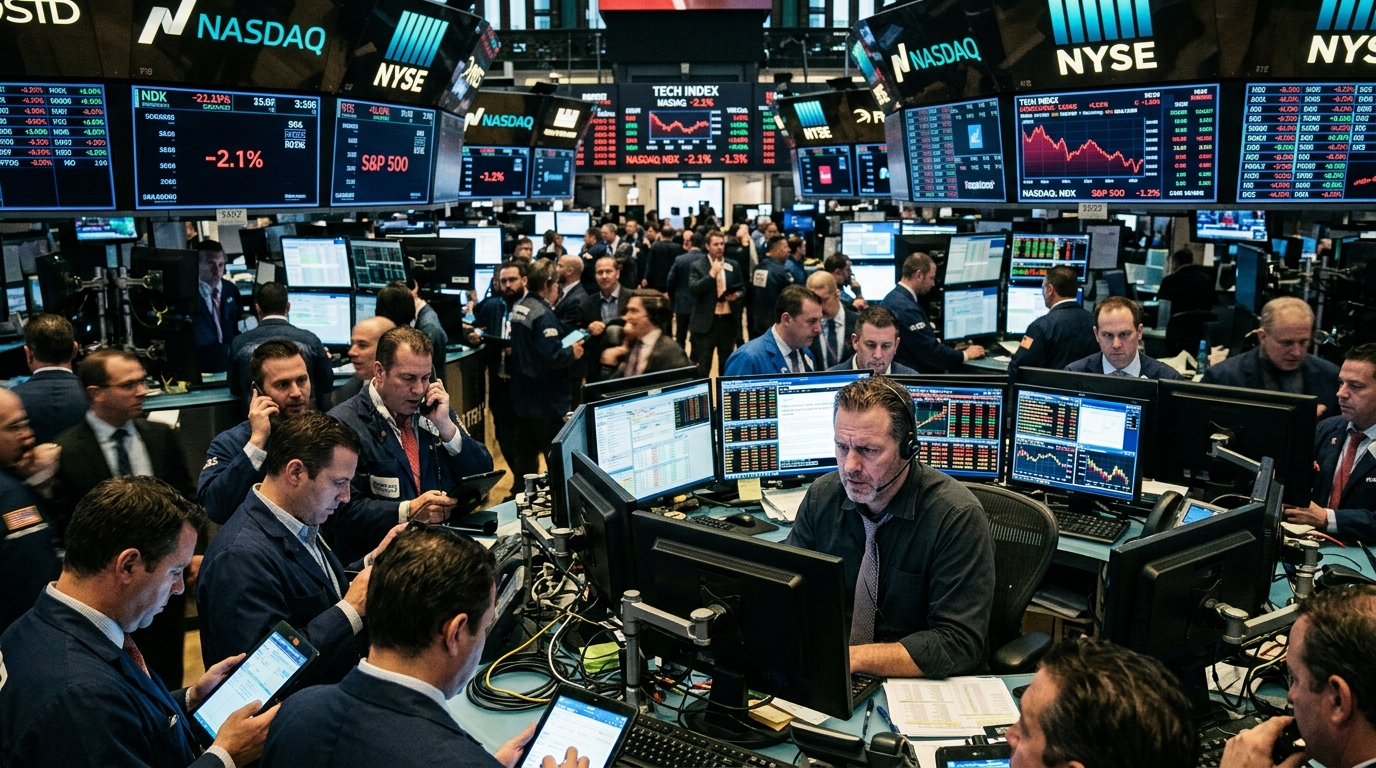
July 11, 2026, finds the global technology market at a critical crossroads. Following the explosion triggered by the emergence of generative artificial intelligence (Generative AI) in late 2022, investors appear to be running out of patience. The era of the "blank check," where any announcement containing the term "AI" led to a skyrocketing market valuation, has given way to a rigorous, almost cynical, analysis of economic fundamentals.
According to recent analyses, such as the one published by Yahoo Finance, Wall Street is no longer satisfied with promises about the future. The capital expenditures (CapEx) of Big Tech—Microsoft, Alphabet, Meta, and Amazon—have reached dizzying levels, touching hundreds of billions of dollars annually. However, the question dominating the offices of fund managers is simple yet relentless: "When will we see the return on this investment (ROI)?"
The Infrastructure Paradox and the GPU Bubble
For nearly three years, the big winner of the race was Nvidia and semiconductor manufacturers. The need for computational power led to an unprecedented accumulation of hardware. But as analysts from Goldman Sachs and Morgan Stanley point out, there is a growing gap between the cost of building this infrastructure and the revenue generated by AI applications at the end-user level.
Software companies are struggling to convince enterprises to pay for expensive subscriptions for tools like Copilot or Gemini Business. Despite impressive capabilities, large-scale adoption is hitting hurdles regarding data security, output accuracy (the well-known hallucination problem), and, most importantly, the inability of companies to integrate AI into their daily workflows in a way that saves real money.
- Data center spending increased by 45% over the last year.
- AI service revenues for most SaaS companies remain below 10% of total turnover.
- The energy cost for training models has tripled, squeezing profit margins.
Comparing to the Dot-com Era
Many economic historians are comparing the current situation to the dot-com crash of 2000. Then, as now, there was a revolutionary technology (the Internet) that indeed changed the world. However, the market had priced in this change much earlier and at much higher valuations than the revenues of the time could support. The current reevaluation does not necessarily mean that AI is a "scam," but that the market is entering a phase of maturity.
"We are not at the end of AI, but at the end of its beginning. Investors are stopping buying the dream and starting to buy the balance sheet," says a leading Wall Street analyst.
The pressure is now shifting from engineers to sales managers. The companies that will survive this "AI fatigue" will be those that can prove their technology is not just an impressive toy, but a tool that drastically reduces operational costs or creates new, tangible revenue streams.
Energy Costs and Geopolitics
Another factor forcing investors to reconsider is the environmental and energy cost. Artificial Intelligence is "thirsty" for power. In an era where the green transition is a political priority, the massive energy consumption of data centers poses a risk to companies' ESG scores. Furthermore, restrictions on chip exports to China and geopolitical tensions in Taiwan create an unstable environment for the AI supply chain.
In conclusion, the reevaluation of AI investments is a healthy correction. The market is moving away from speculation and toward substance. For the next 12-18 months, attention will be focused not on the new models being announced, but on quarterly earnings reports that will show whether customers are truly willing to pay for the "intelligence" of machines.





