

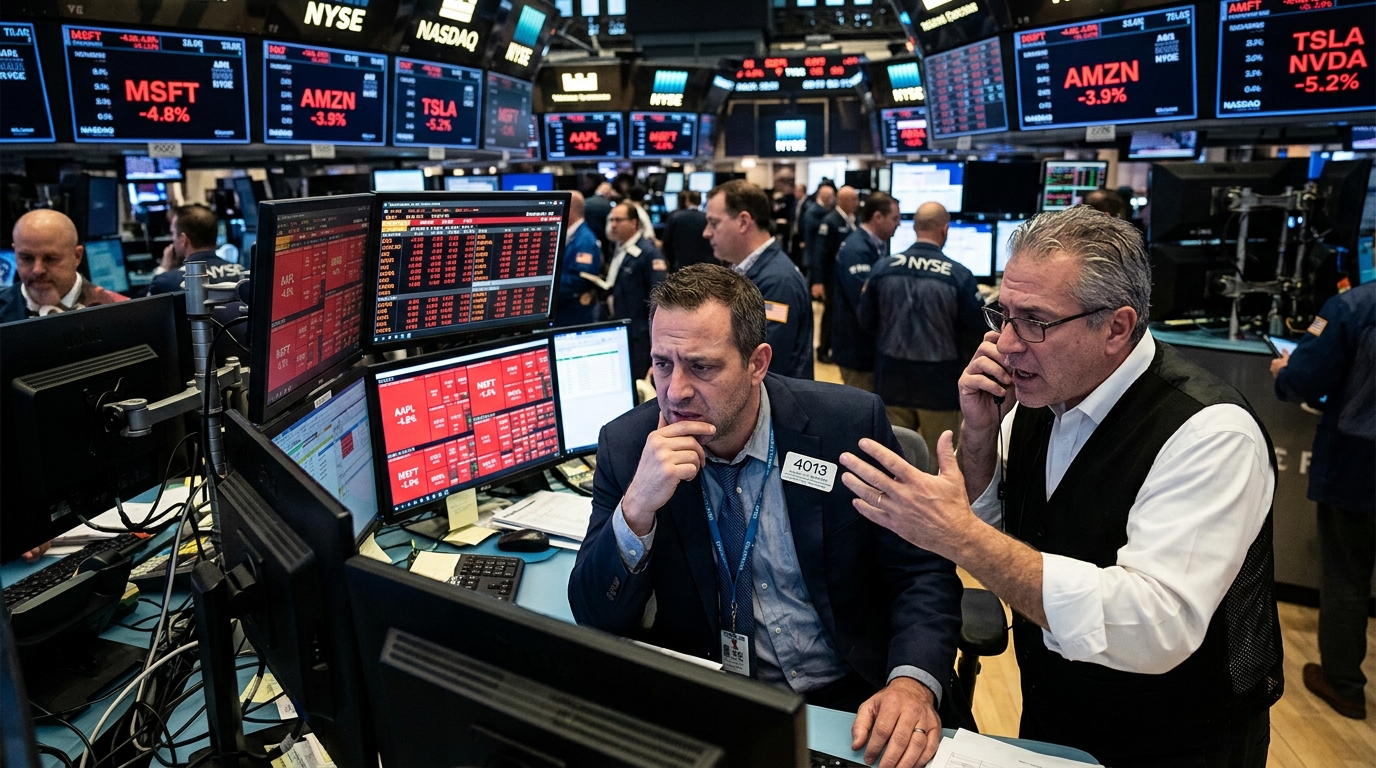
The New York Stock Exchange, which for nearly three years has been riding a wave of euphoria fueled by the Artificial Intelligence (AI) revolution, is now at a critical crossroads. Recent sessions on Wall Street have been marked by a sharp sell-off in big tech stocks, raising questions about whether the so-called "AI trade" has begun to permanently deflate. After a period where Nvidia, Microsoft, and Alphabet drove indices to successive all-time highs, investors appear to be adopting a more skeptical stance, demanding tangible proof of profitability rather than just promises of a digital utopia.
The Expectation Trap and the Hunt for ROI
The primary concern for analysts is no longer the utility of AI, but the pace at which massive infrastructure investments will translate into bottom-line profits. S&P 500 companies have spent hundreds of billions of dollars purchasing GPU processors and constructing massive data centers. However, the adoption of enterprise AI tools is moving at a slower pace than initially anticipated. Investors are asking: When will we see the Return on Investment (ROI)?
The current correction reflects a shift in market psychology from "hope" to "scrutiny." As seen in previous technological revolutions, the first phase is characterized by exuberant excitement for the "picks and shovels" providers (in this case, Nvidia). The second phase, which we are entering now, requires software and service companies to prove they can build sustainable business models on top of this infrastructure. If revenues from AI subscriptions and productivity gains do not spike, current stock valuations will remain precarious.
The Interest Rate Factor and Macroeconomics
It is not just AI skepticism driving prices down. The macroeconomic environment of June 2026 remains complex. Despite expectations for monetary policy easing, inflation in certain sectors remains stubborn, forcing the Federal Reserve to maintain interest rates at levels that do not favor high-growth stocks. When borrowing costs are high, the present value of future earnings—upon which tech companies are valued—automatically decreases.
- A rotation toward value stocks and small-caps (Russell 2000) as investors seek safety.
- Concerns over the energy costs of data centers weighing on balance sheets.
- Geopolitical uncertainty affecting the semiconductor supply chain, particularly in East Asia.
The Dot-com Comparison: History or Coincidence?
Many are quick to compare the current situation to the 2000 crash. However, there are significant differences. In 2000, many internet companies had no revenue, let alone profits. Today, the AI leaders are among the most profitable companies in the history of capitalism. Microsoft and Google possess enormous cash reserves and robust revenue streams from their legacy businesses. What we are witnessing is not necessarily the "bursting" of a bubble, but a recalibration of expectations. AI will not disappear, but its stock market trajectory will become more selective and less uniform.
"The market can stay irrational longer than you can stay solvent, but in the end, fundamentals always prevail," as the old Wall Street adage goes, and the current situation seems to validate this.
In conclusion, the tech sell-off serves as a reminder that innovation never follows a straight line upward. The coming months will be decisive as companies report their quarterly earnings. This is where it will become clear who is truly profiting from AI and who merely used the buzzword to inflate their stock price. Wall Street is not abandoning AI, but it is certainly stopping the practice of buying it with "eyes wide shut."





