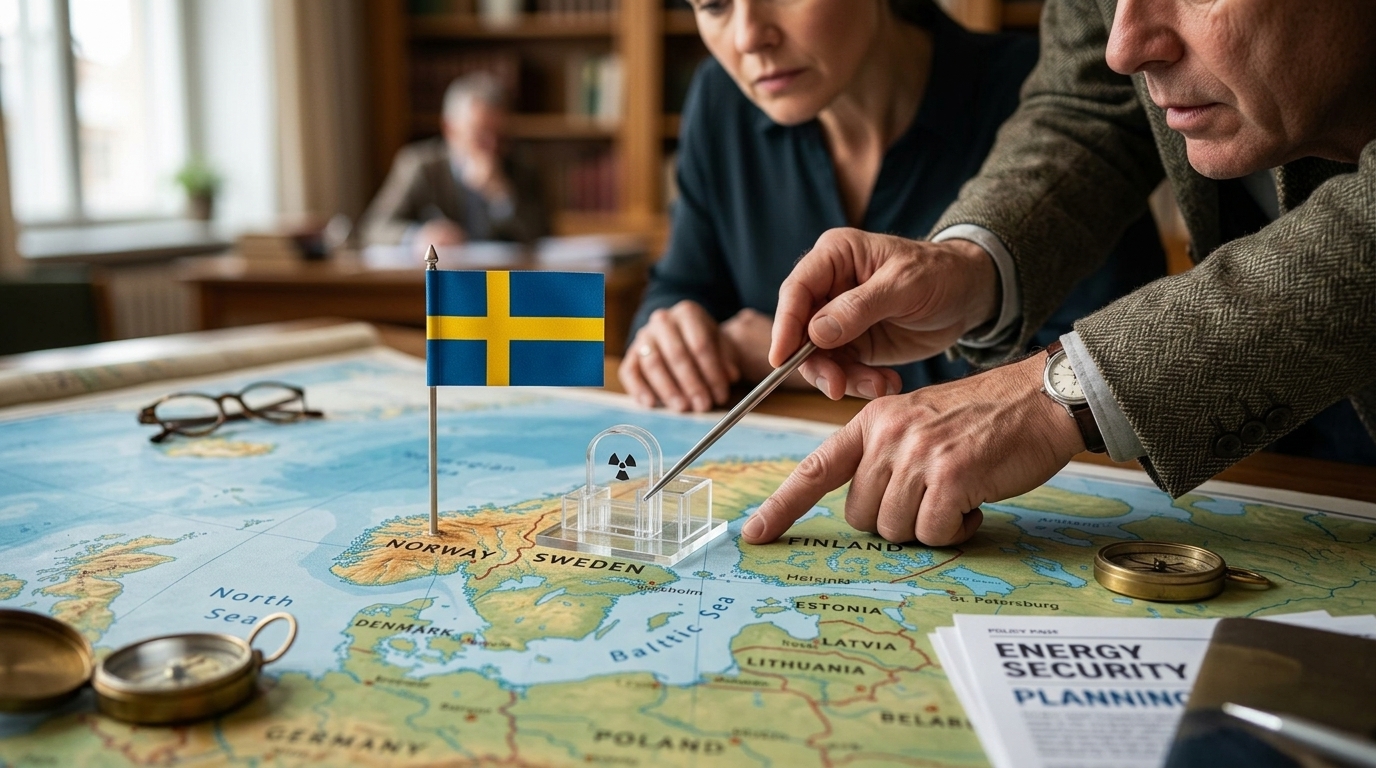
Sweden, a nation that once stood at the forefront of the global movement to phase out nuclear power, is now executing a historic U-turn. The announcement by Ulf Kristersson’s government to acquire a 60% majority stake in Videberg Kraft is more than a simple business transaction; it is the official return of the state as the ultimate guarantor of energy security through atomic fission. This decision comes at a critical juncture as Europe struggles to balance the needs of heavy industry with its climate commitments.
The Videberg Kraft Strategy and the State's Role
Videberg Kraft serves as the primary vehicle through which Sweden intends to develop its next generation of nuclear reactors. The state’s 60% participation indicates a profound shift in the country’s economic doctrine. For decades, the energy market was left to competitive forces, but the massive capital expenditure (CAPEX) and the long-term amortization periods of nuclear projects made it clear that without state intervention, the transition would be impossible. The Swedish state is not just providing guarantees; it is becoming a co-owner, assuming the risk and controlling the strategic infrastructure.
This move aims at constructing new large-scale reactors and potentially adopting Small Modular Reactors (SMRs). The government argues that to achieve the goal of doubling electricity production by 2045, nuclear energy must serve as the 'baseload' upon which renewable sources like wind and solar will rest.
Industrial Thirst for 'Green' Electricity
The primary driver behind this decision is not just household consumption, but the survival of Swedish heavy industry. In the Swedish north, projects such as 'green steel' (H2 Green Steel) and battery production (Northvolt) require vast amounts of stable and affordable energy. The intermittency of renewables creates significant challenges for the continuous operation of blast furnaces and production lines. Nuclear energy provides the necessary stability that investors demand.
- Ensuring energy autonomy from the fluctuations of international natural gas prices.
- Reducing the carbon footprint of industry without sacrificing productivity.
- Creating thousands of high-skilled jobs in the nuclear technology sector.
Furthermore, Sweden aims to become a net exporter of clean energy to the rest of Europe, strengthening its geopolitical position in the Baltic region. The energy crisis triggered by the war in Ukraine demonstrated that reliance on imported fossil fuels is an existential threat.
Political Reactions and the End of a Taboo
The decision to take a 60% stake in Videberg Kraft did not pass without opposition. The Green Party and parts of the Left argue that these funds should have been directed exclusively toward wind energy and battery storage. However, public opinion in Sweden appears to have shifted significantly. The 1980 referendum, which mandated the gradual phase-out of nuclear power, is now viewed as a relic of a different era.
"We cannot build a modern, competitive economy based solely on the weather," a government official noted, referring to the dependence on wind power.
Sweden's strategy reflects a broader trend within the European Union, where nuclear energy has been included in the 'Green Taxonomy,' allowing it to be financed as a sustainable investment. France, Poland, and now Sweden are forming a 'nuclear bloc' that challenges the denuclearization path promoted by Germany in previous years.
Conclusion: A New Model of State Capitalism?
The Swedish state's involvement with such a high percentage highlights the emergence of a new model of state capitalism in Europe. When challenges are existential—such as the climate crisis and energy sovereignty—free-market rules often give way to the necessity of central planning. Videberg Kraft will be the litmus test for whether a Western state can deliver such a complex technological and financial project on time and within budget.