

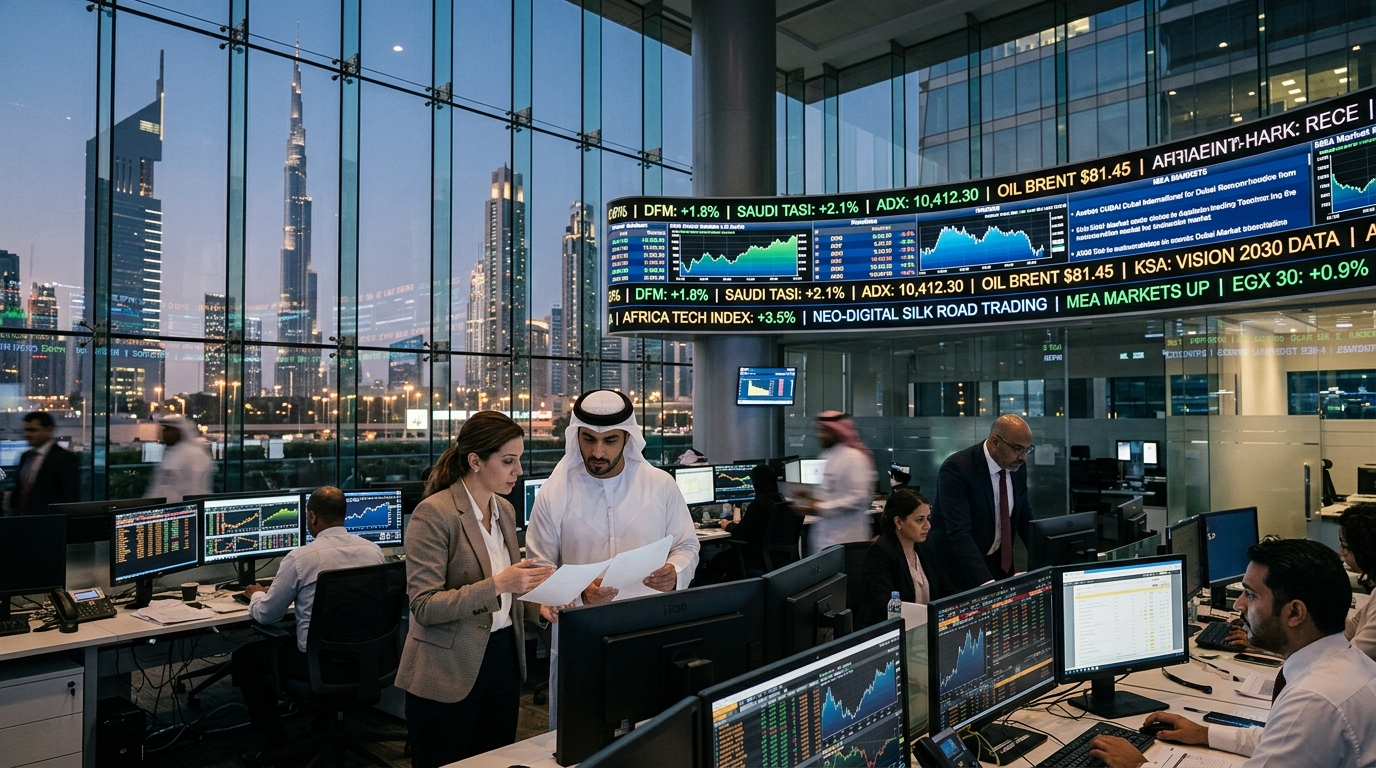
In the height of summer 2026, Bloomberg Tech’s "Horizons Middle East & Africa," broadcasting live from Dubai, is more than just a financial update; it is the chronicle of a tectonic shift. The MEA region, once defined almost exclusively by its hydrocarbon reserves, has evolved into the most dynamic accelerator of the global digital economy. With Dubai functioning as the "New Zurich" of the digital age, capital and innovation flows are redrawing the global map.
The Rise of Sovereign AI in the Gulf
July 2026 finds the United Arab Emirates and Saudi Arabia in a stage of strategic maturity. Riyadh’s "Vision 2030" is no longer a distant promise but a tangible reality built on the foundation of Sovereign AI. The Gulf nations have invested billions in developing their own Large Language Models (LLMs), such as the advanced iterations of Falcon, tailored to Arabic culture and local nuances, effectively decoupling from the technological hegemony of Silicon Valley.
Bloomberg’s analysis highlights a critical pivot: investments are no longer just about purchasing software, but about owning the infrastructure. Massive data centers, powered by the desert’s abundant solar energy, offer the lowest computational costs globally. This has attracted titans like Nvidia and Microsoft, who now view the region not merely as a market, but as the operational hub for the entire Global South.
Africa’s Digital Leapfrog
Simultaneously, Africa is experiencing its own "leapfrogging" moment. In Lagos, Nairobi, and Johannesburg, Artificial Intelligence is not a luxury but a tool for survival and systemic progress. The broadcast underscores the explosion of fintech applications that integrate AI to provide micro-credit to populations previously excluded from the banking system. AI’s application in precision agriculture across sub-Saharan Africa has boosted yields by 40%, actively addressing food insecurity.
Africa possesses the world’s youngest workforce, and in 2026, this translates into an army of "AI-native" developers. Multinational corporations are shifting their R&D centers from the traditional West to Africa, seeking not just cost-effective labor, but fresh perspectives and unparalleled resilience.
Geopolitics and Sovereign Wealth Funds
The economic prowess of the MEA region is mirrored in its Sovereign Wealth Funds (SWFs). Saudi Arabia’s PIF and the UAE’s Mubadala have become the primary financiers of the world’s most ambitious tech startups. As noted in the report, their influence extends beyond ROI; it is about geopolitical leverage. In a world fragmented between the US and China, the Middle East is playing the role of the "honest broker," maintaining deep ties with both sides and ensuring access to critical technologies from both blocs.
“The region is no longer a passive consumer of global technology, but the architect of the new digital order,” a Bloomberg analyst noted during the segment.
Challenges and the Road Ahead
Despite the optimism, significant hurdles remain. Climate change threatens the region with extreme temperatures, making the energy efficiency of data centers a matter of existential importance. Furthermore, the need for unified regulatory frameworks across Africa is urgent to prevent market fragmentation. However, the message from Dubai is clear: the global economic center of gravity has shifted East and South. July 10, 2026, will be remembered as the moment when the MEA region ceased to be viewed as "emerging" and was recognized as a leading global force.





