

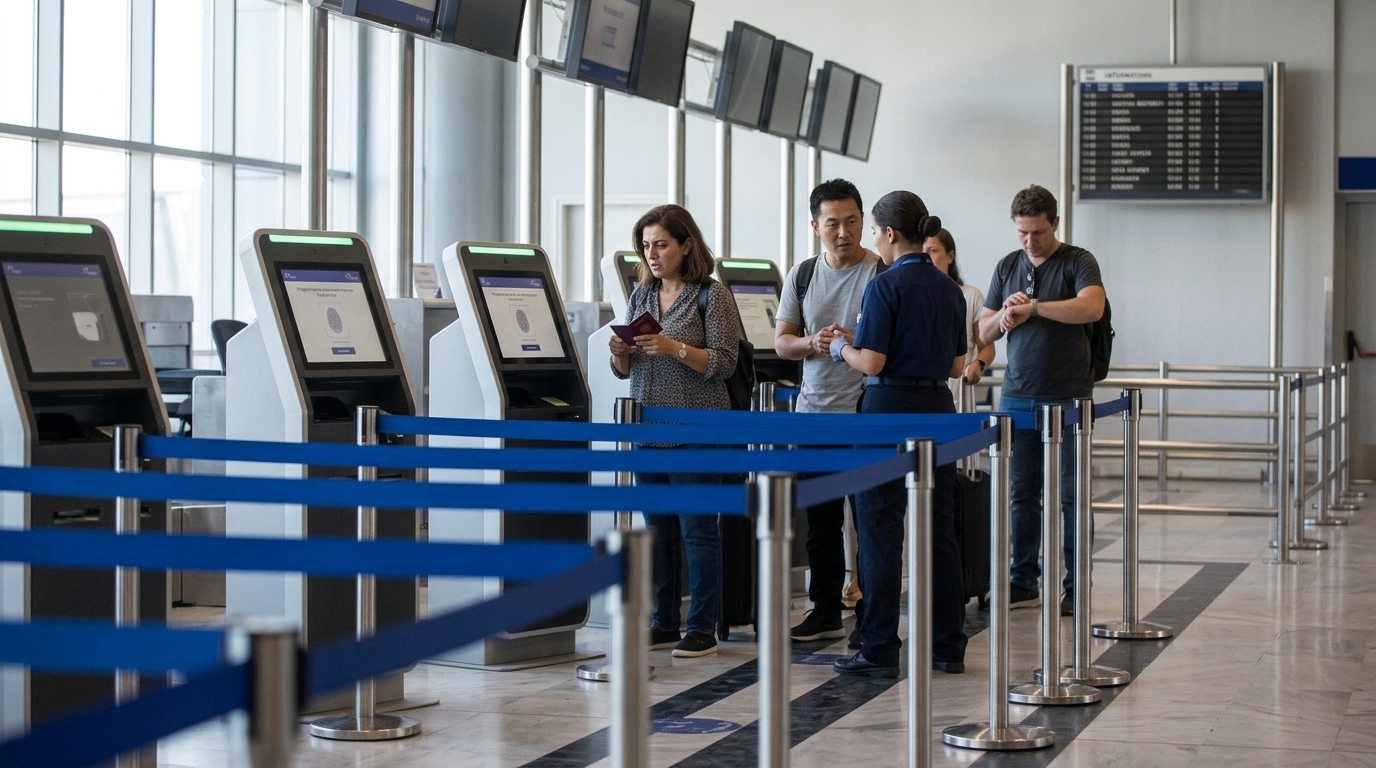
The story of Greek airports in recent years has been one of resounding success, characterized by record-breaking arrivals and significant infrastructure modernization. However, the summer of 2026 finds the tourism industry facing an unforeseen and formidable challenge: the new European Entry/Exit System (EES). In a rare and sharply worded public intervention, Fraport Greece CEO Alexander Zinell has warned that without a radical overhaul of how the system is implemented, the country's airports risk operational strangulation.
Anatomy of a Bureaucratic Storm
The EES was designed by the European Union with the laudable goals of strengthening border security and automating the monitoring of Third Country Nationals. Theoretically, replacing manual passport stamping with biometric data collection—specifically fingerprints and facial scans—should have streamlined processes. In practice, however, its rollout across the 14 regional airports managed by Fraport Greece has proven to be nothing short of a logistical nightmare.
According to Mr. Zinell, the process of registering a first-time traveler into the system can take anywhere from two to four minutes. During peak periods, when hundreds of passengers disembark simultaneously from non-Schengen flights (such as those from the UK, the US, or Australia), the wait times multiply exponentially. "We are not just talking about inconvenience; this is a safety issue," the CEO emphasized, referring to the dangerous overcrowding in terminal areas that were never designed to hold such large volumes of static queues.
The Impact on Greek Tourism
Greece, perhaps more than any other European nation, relies on the fluid movement of visitors. While 2025 saw historic highs in tourism revenue, the nation's reputation for "seamless travel" is now under threat. Tourists arriving to enjoy the Aegean find themselves trapped in endless queues under high temperatures, creating a first impression that is anything but welcoming. This friction at the point of entry threatens to tarnish the brand identity that the country has spent a decade rebuilding.
Fraport Greece has already invested heavily in expanding passport control areas and installing automated e-gates. Yet, technology alone is not a panacea. The issue is structural: the EES requires a sequence of actions that demand physical presence and significant time—commodities that the existing architecture of most airports worldwide struggles to accommodate. Mr. Zinell is calling for a transition period or the simplification of data requirements for low-risk countries to prevent a total breakdown of service.
Political Accountability and European Responsibilities
The problem is not unique to Greece, but Greece experiences it more acutely due to its position as an external EU border and its heavy reliance on non-Schengen air traffic. The European Commission has faced stinging criticism for delays in delivering the necessary software and for a lack of coordination between member states. There is a growing sense that the technical reality on the ground was ignored during the legislative process in Brussels.
The CEO of Fraport Greece points out a fundamental disconnect: while border policing is a state responsibility, the fallout from poor management falls squarely on the shoulders of private operators and the passengers themselves. There is palpable frustration that airports are being forced to solve a problem created by centralized planning in Brussels, without being given the necessary flexibility to manage local crises.
Searching for a Solution
What are the alternatives? Fraport suggests a multi-pronged approach: increasing police staffing at airports, implementing mobile pre-registration apps so data is captured before the traveler reaches the terminal, and, crucially, a political mandate to "relax" checks during periods of extreme congestion for the sake of public order. If immediate steps are not taken, "Brand Greece" could suffer a significant blow—not due to a lack of demand, but because of the inability of bureaucracy to keep pace with modern mobility.
- Urgent need for digital passenger pre-registration.
- Significant increase in police personnel at checkpoints.
- Redesigning passenger flow within terminal buildings.
- Diplomatic pressure on Brussels to amend EES regulations.
The stakes for the remainder of 2026 and the upcoming 2027 season are immense. The success of tourism is no longer judged solely by the quality of hotels or beaches, but by the first and last hour a traveler spends on Greek soil. Currently, that hour is the most problematic link in the entire chain.





