

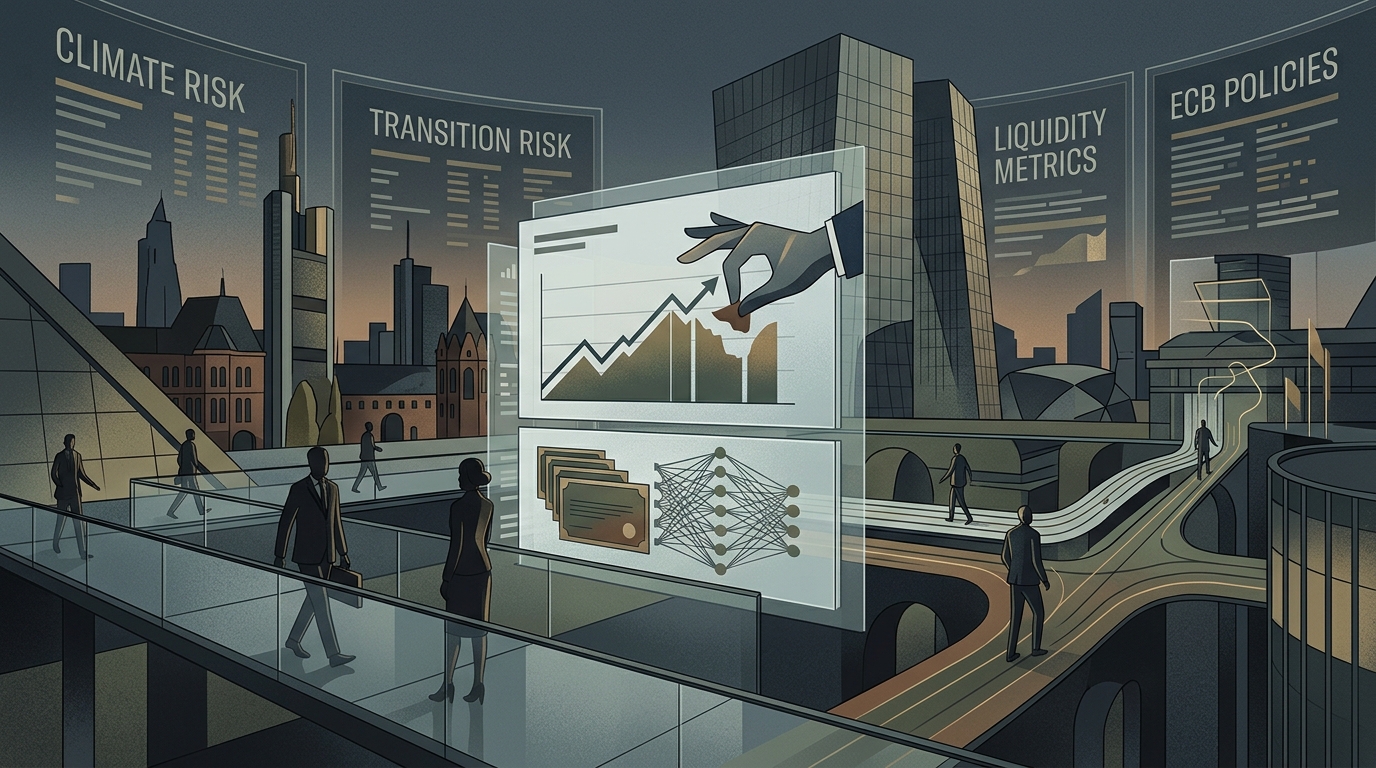
The European Central Bank (ECB) is embarking on a historic overhaul of its operational framework, transforming the climate crisis from an abstract threat into a specific quantitative factor affecting daily banking liquidity. The decision to impose 'climate haircuts' on corporate bonds used by commercial banks as collateral to borrow funds from Frankfurt marks the strongest signal yet that the financial sector must align with the goals of the Paris Agreement.
The Mechanics of 'Haircuts' and the New Reality
In the world of central banking, a 'haircut' is the discount applied to the value of an asset when it is offered as collateral. Until recently, these haircuts were determined almost exclusively by the issuer's creditworthiness and the bond's maturity. Now, the ECB is introducing a third variable: the environmental footprint.
Under the new framework, bonds from companies with high carbon emissions or those lacking a clear decarbonization strategy will face larger reductions in value when deposited as collateral. This means a bank holding 'dirty' bonds will be able to draw less liquidity from the ECB compared to a bank with bonds from 'green' enterprises in its portfolio. This move is not merely technical; it is deeply political and economic, as it increases the cost of holding assets deemed harmful to the environment.
The Three Pillars of Assessment
The ECB does not rely on arbitrary judgments but on a structured scoring system that examines three key areas:
- Carbon Emission Intensity: How many pollutants the company emits relative to its revenue or assets.
- Decarbonization Targets: Whether the company has set ambitious and science-based targets for reducing its emissions in the future.
- Disclosure Quality: The transparency with which the company reports its climate data.
This approach forces banks to become more selective. To maintain access to cheap and abundant liquidity, they will have to pressure their corporate clients to accelerate the green transition. Otherwise, these clients' bonds will become 'dead weight' on bank balance sheets.
"Climate change poses a risk to financial stability. It is no longer a matter of morality, but a matter of risk management," sources close to the ECB Governing Council state.
Market Implications and the European Economy
For the banking system, the challenge is twofold. On one hand, banks have made significant progress in cleaning up their balance sheets. On the other, the corporate sector consists largely of industries that are energy-intensive or still in the early stages of energy transition. 'Climate haircuts' may make borrowing more expensive for companies that cannot demonstrate quick reflexes in adapting to ESG (Environmental, Social, and Governance) standards.
However, the ECB's move also creates opportunities. Companies leading in green energy, the circular economy, and sustainable technologies will see their bonds highly sought after by banks, as these will serve as 'golden' collateral for liquidity. This is expected to lead to a reallocation of capital toward the green economy, acting as an indirect but powerful mechanism for subsidizing sustainability.
Criticism and Challenges
Despite positive intentions, the ECB's strategy is not without its critics. Some analysts argue that the central bank is exceeding its mandate, which focuses on price stability. There is also the fear that 'climate haircuts' could cause sharp fluctuations in corporate bond prices, creating market instability at a time when the global economy is already vulnerable.
Furthermore, data quality remains a thorny issue. Many companies, especially smaller ones, struggle to provide accurate data on their footprint, which could lead to unfair assessments. The ECB, however, appears determined to move forward, considering the cost of inaction against climate change to be far greater than the cost of adjusting financial instruments.





