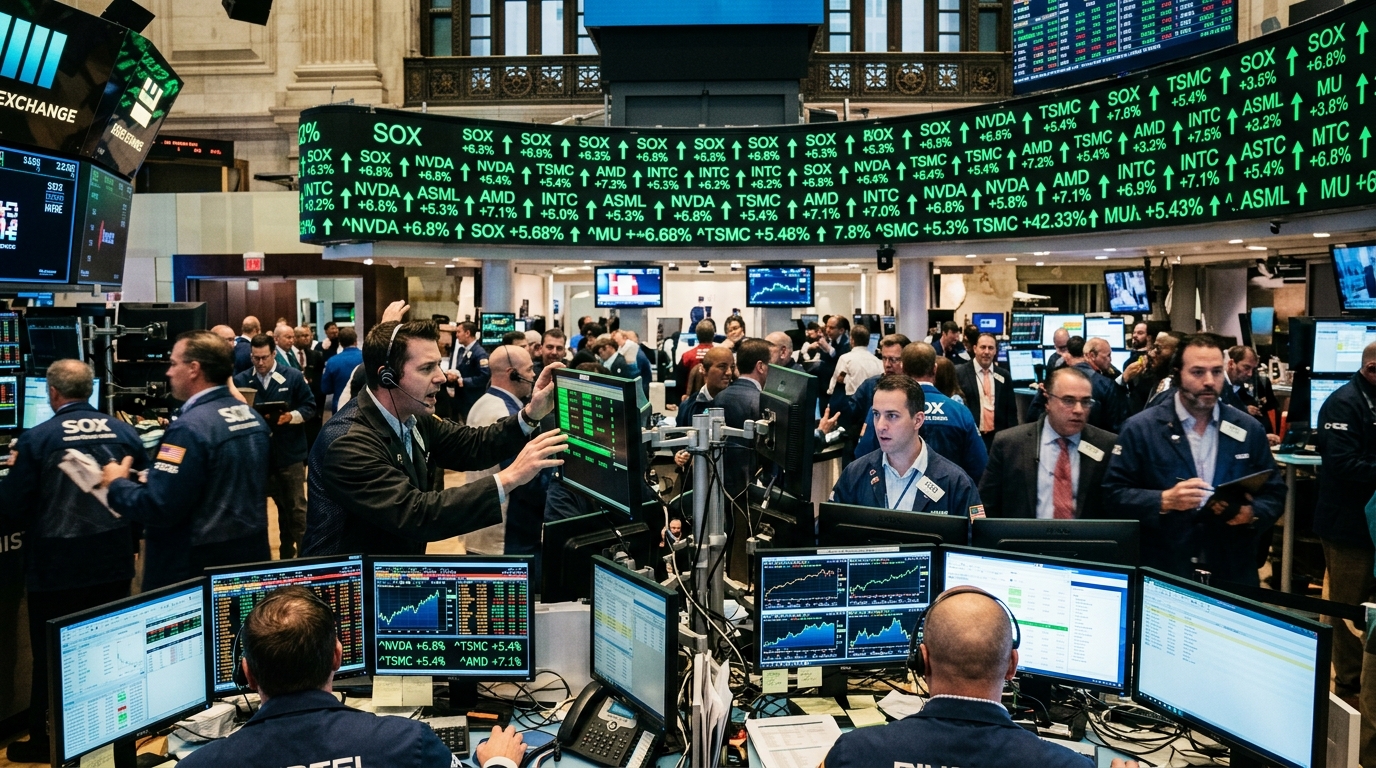
July 6, 2026, will likely be recorded as the day Wall Street confirmed that the Artificial Intelligence cycle was not a fleeting bubble, but a structural restructuring of the global capital market. As indices closed with significant gains, attention turned once again to the architects of the digital age: semiconductor manufacturers. The revival of the so-called 'AI Trade' comes after a period of intense volatility and skepticism, proving that the demand for computing power remains the driving force of the modern economy.
Market Maturation: From Promise to Reality
Unlike the exuberance of previous years, the 2026 rally is characterized by a deeper understanding of fundamentals. Katerina Simonetti of Morgan Stanley PWM, speaking on Bloomberg, noted that investors are no longer just buying the 'hope' of AI, but the actual revenue generated by its infrastructure. Semiconductor companies have evolved from mere component suppliers into strategic partners for nations and software giants.
The current surge is fueled by three main pillars: the widespread adoption of Generative AI at the enterprise level, the need to upgrade data centers with next-generation chips (2nm and below), and the explosion of Edge AI—artificial intelligence that runs locally on devices without the need for the cloud. This transition from 'training' (model development) to 'inference' (model execution) is expanding the market for companies like NVIDIA, AMD, and Broadcom, as well as new players specializing in energy-efficient processors.
Geopolitics and Sovereign AI
A critical factor discussed extensively is the concept of Sovereign AI. Nations worldwide, from the European Union to the Gulf states, are investing billions to create their own domestic AI infrastructures. This creates an 'artificial' yet stable demand for semiconductors, independent of consumer trends. Semiconductors are now the 'new oil,' and the stocks of companies controlling the supply chain are considered safe havens in an uncertain geopolitical environment.
- The shift toward onshoring in the US and Europe is boosting capital expenditures significantly.
- China continues to invest in legacy chips, putting price pressure on lower segments of the market.
- TSMC remains the irreplaceable link, with its valuation reflecting its role as a global high-tech monopoly.
The Role of Interest Rates and BlackRock’s Strategy
Russ Brownback of BlackRock offered a different perspective, linking the semiconductor rally to the macroeconomic landscape. With inflation showing signs of stabilization and central banks adopting a more predictable stance, capital is returning to high-growth sectors. AI stocks act as a hedge against traditional economic slowdowns, as the automation provided by AI is seen as the key to maintaining corporate profit margins during downturns.
"We are not just seeing a stock market move; we are seeing the pricing of a new industrial revolution that is now reaching full speed," Brownback noted.
Challenges and the Energy Bottleneck
Despite the optimism, there are shadows on the horizon. The massive energy consumption of AI data centers is the biggest hurdle to further growth. Investors are starting to look not just at who makes the fastest chip, but who makes the most efficient one. This paves the way for companies involved in ARM architecture and new cooling technologies, which also saw their shares strengthen at the close of July 6th. The sustainability of the AI trade will ultimately depend on the industry's ability to solve the energy puzzle.