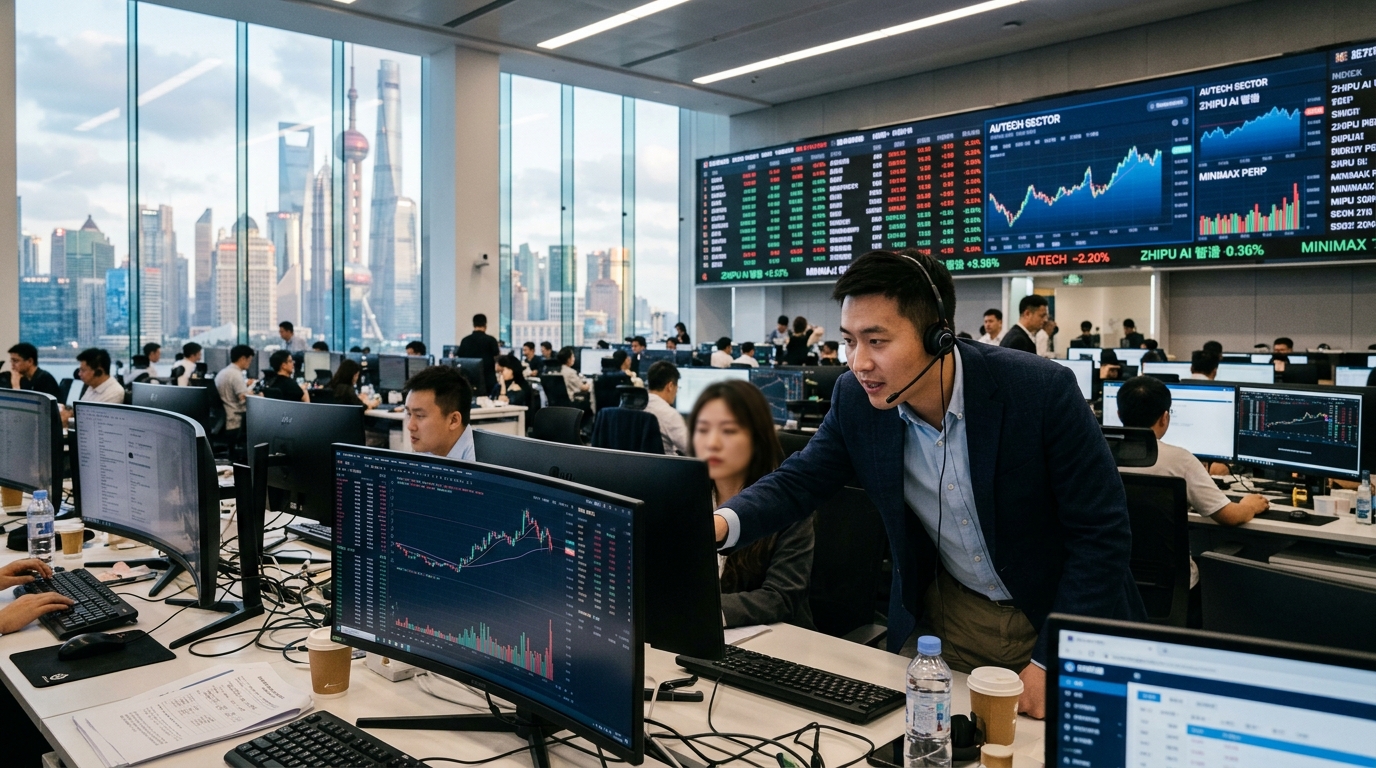
In a move that underscores the intensifying convergence between crypto-asset markets and the Artificial Intelligence (AI) industry, Bitget exchange has announced the introduction of stock perpetual contracts for two of the most significant players in the Chinese AI ecosystem: Zhipu AI and MiniMax. This addition allows investors to gain exposure to the valuations of these companies with leverage reaching up to 20x, signaling a new era in speculative access to private or restricted-access tech entities.
The New 'Tigers' of Chinese Artificial Intelligence
Zhipu AI and MiniMax are not just any names in the tech world. They are considered part of China's 'six new tigers' in the field of Generative AI. Zhipu AI, an offshoot of the prestigious Tsinghua University, has already secured funding from giants such as Alibaba, Tencent, and Meituan, with its valuation soaring past $3 billion. Its flagship model, GLM-4, is widely regarded as the most formidable Chinese-language competitor to OpenAI's GPT-4.
On the other hand, MiniMax, backed by HongShan (formerly Sequoia China), has focused on social interaction and content creation through AI, developing sophisticated text, voice, and video models. Bitget’s strategy to offer derivatives on these companies enables global traders to bet on the success of China’s national AI strategy, bypassing the traditional hurdles of legacy stock exchanges and cross-border investment restrictions.
The Mechanics of Stock Perpetuals and High Leverage
Stock perpetuals are a hybrid financial product. Unlike traditional stocks, they do not grant ownership in the company but rather track the stock price or the estimated market value of the entity. The 20x leverage feature means a trader can open a position worth $20,000 with just $1,000 of capital. While this multiplies potential gains, it exponentially increases the risk of liquidation, especially in a sector as volatile and news-driven as Artificial Intelligence.
Bitget appears to be targeting a high-risk, high-reward demographic, blending the speed of crypto trading with the narrative of the AI revolution. This move also reflects a broader trend: cryptocurrency exchanges are evolving into multi-asset financial service platforms, directly challenging the dominance of traditional brokers by offering synthetic access to equity markets.
Geopolitics and Investment Risk
The inclusion of Chinese AI firms on a platform like Bitget carries significant geopolitical weight. As the United States imposes strict export controls on high-end chips (such as those from Nvidia) to China, the ability of firms like Zhipu AI to innovate under pressure remains a central question for investors. Traders opting for these contracts are essentially wagering on China's ability to achieve technological self-sufficiency and overcome Western sanctions.
However, the risks are substantial. The lack of transparency in the financial statements of private 'unicorns' and the regulatory gray areas surrounding crypto derivatives in various jurisdictions make these investments highly speculative. Bitget, nevertheless, continues to expand its portfolio, betting that the global appetite for AI exposure will outweigh concerns regarding market volatility or the opacity of private valuations.
Conclusion: A New Digital Wall Street?
Bitget’s decision to list Zhipu AI and MiniMax is more than just an asset expansion. It is a statement on the future of investing: global, digital, highly leveraged, and intimately tied to cutting-edge technological shifts. For the modern investor, the ability to trade the value of a Chinese startup via a smartphone using stablecoins represents the ultimate expression of financial globalization—along with all the systemic risks it entails.