

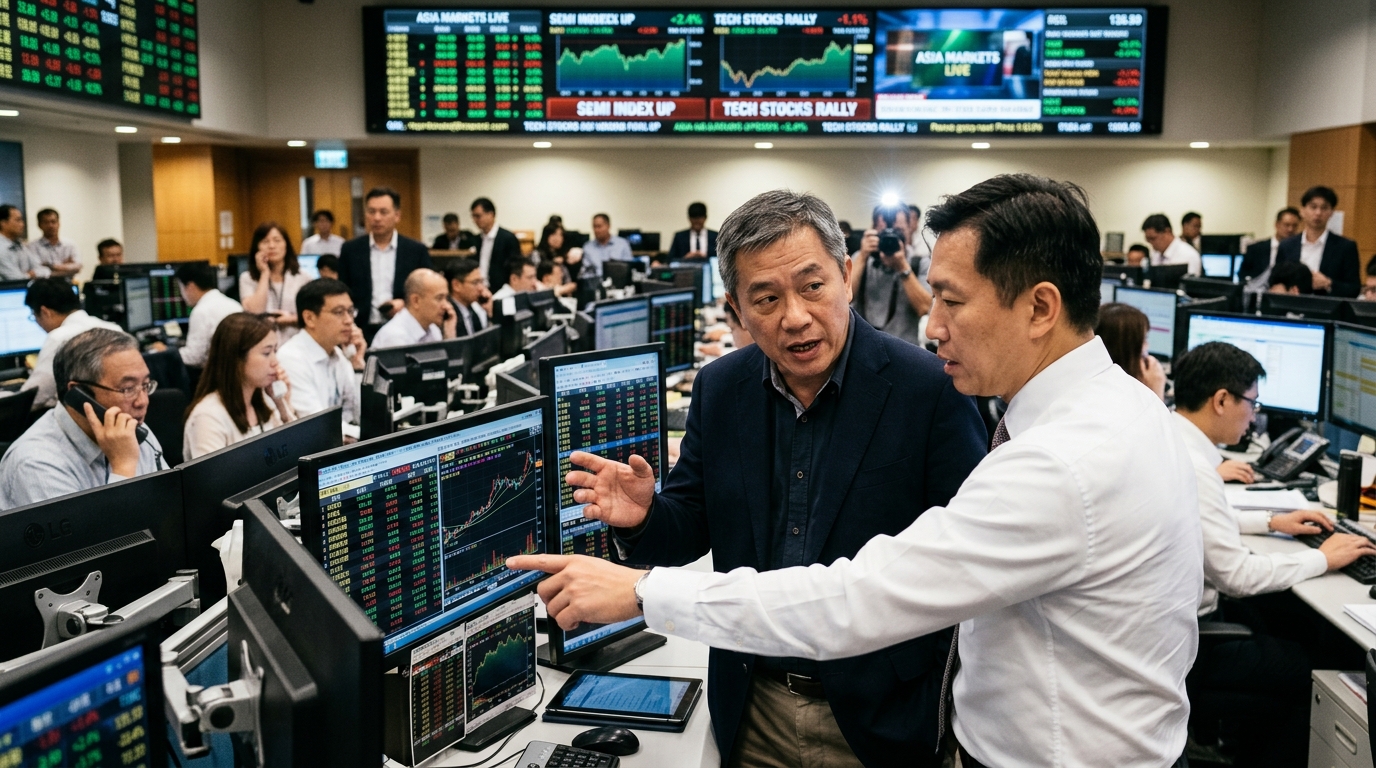
The global Artificial Intelligence landscape is undergoing a seismic shift. While the past three years saw interest almost exclusively focused on OpenAI and Nvidia, the summer of 2026 finds the world's leading investors turning their gaze eastward. South Korea and Japan are no longer mere component suppliers; they have emerged as the new protagonists promising to break the Western monopoly on AI hardware and software.
Korea’s National Champion: The Rebellions-Sapeon Merger
At the heart of this investment frenzy is Rebellions, the South Korean AI chip design firm that recently finalized its strategic merger with Sapeon Korea, a subsidiary of SK Telecom. This move was not just a business deal but a state-backed effort by Seoul to create a "national champion" capable of challenging Nvidia's supremacy. Investors, including giants like Pavilion Capital and Shinhan Venture Investment, are betting on Rebellions' ability to produce Neural Processing Units (NPUs) that are significantly more power-efficient and specialized for Large Language Models (LLMs) than traditional GPUs.
The strategic importance of Rebellions lies in its vertical integration with SK Hynix, the global leader in High Bandwidth Memory (HBM). Proximity to memory production gives Korean startups a supply chain advantage that no Silicon Valley firm can directly replicate. This symbiosis of compute and memory is driving valuations to unprecedented heights, with Rebellions now approaching decacorn status as it eyes a major global IPO.
Sakana AI: Tokyo Redefines Intelligence
Simultaneously, across the Sea of Japan, Sakana AI has become the primary target for Wall Street capital. Founded by former Google researchers—including Llion Jones, one of the authors of the seminal "Attention Is All You Need" paper—Sakana is not trying to build the largest model, but the smartest one. Utilizing techniques inspired by nature and biological evolution, the company develops small, agile models that can run locally on devices without the need for massive, energy-hungry data centers.
Nvidia’s recent investment in Sakana AI is an ironic but strategic move: the market leader itself recognizes that the future may not belong solely to its own chips, but to new software architectures being born in Tokyo. The Japanese government, through aggressive subsidies and tax breaks, has fostered an ecosystem where Sakana and other startups, such as Preferred Networks, can flourish, positioning Japan as the premier hub for the burgeoning "Edge AI" market.
Why Investors are Pivoting Away from Silicon Valley
The shift toward Asia is driven by more than just technological prowess. Three key factors are guiding this trend:
- Geopolitical Stability: With US-China tensions remaining at a fever pitch, South Korea and Japan are viewed as "safe harbors" for technology transfer and capital deployment.
- Cost and Manufacturing Efficiency: Asian hardware firms have demonstrated they can produce specialized chips (ASICs) at a fraction of the cost of US startups, thanks to direct access to Samsung and TSMC foundries.
- The Rise of Sovereign AI: Nations are increasingly seeking their own AI infrastructure to avoid total dependence on US cloud services. Asian hardware providers are offering the building blocks for this "national AI" movement.
"We aren't just seeing an investment in companies; we are seeing an investment in a new geography of power," says a senior analyst at SoftBank. "The era where innovation began and ended in Palo Alto is officially over."
Challenges and the Road Ahead
Despite the optimism, the path is not without hurdles. The dominance of Nvidia’s CUDA software ecosystem remains the most significant barrier for new entrants. However, Rebellions and Sakana AI are not trying to beat Nvidia at its own game. Instead, they are creating new arenas: Edge AI, energy-efficient data centers, and biologically-inspired intelligence. As we move deeper into 2026, the question is no longer whether Asia can compete with the West, but how the West will manage to keep pace with the East's relentless momentum.





