

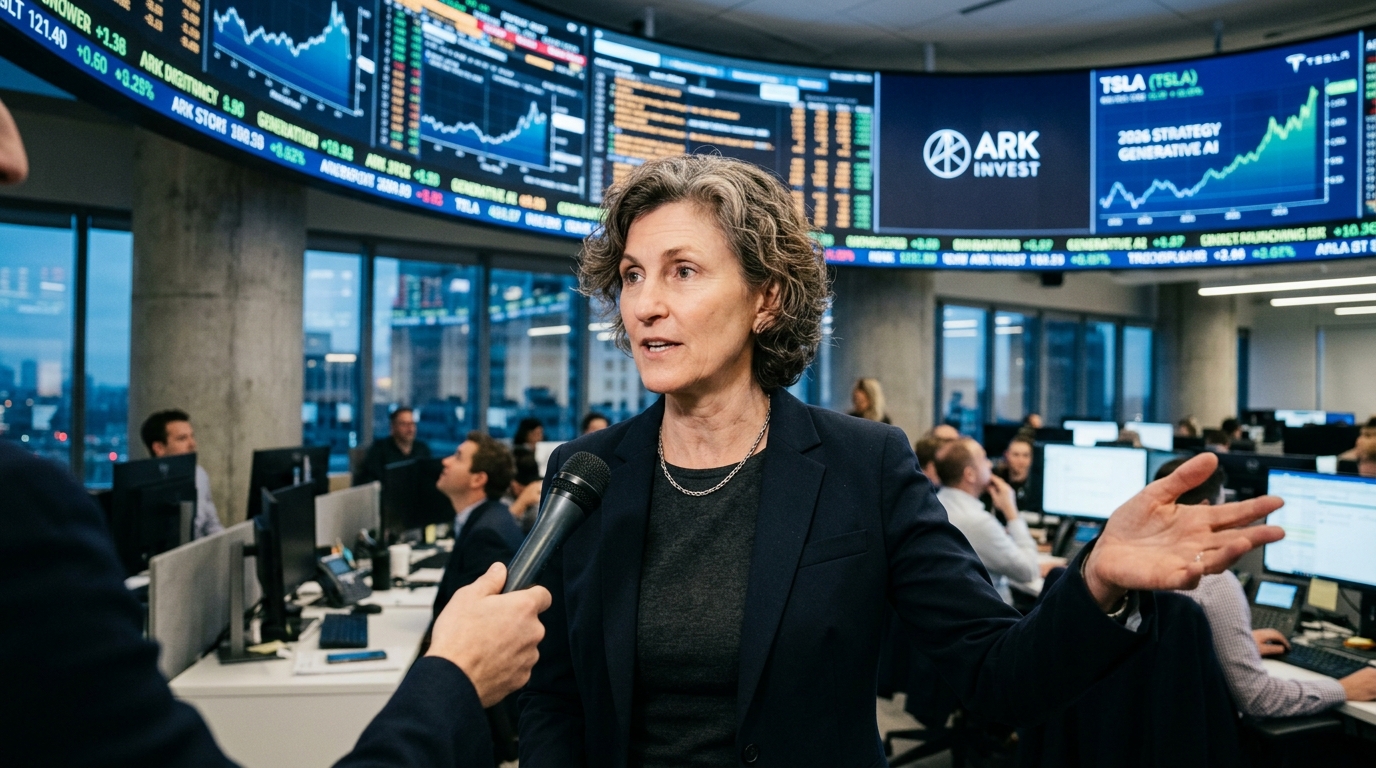
In the volatile investment landscape of June 2026, Cathie Wood and ARK Invest continue to defy Wall Street norms with moves that signal an unwavering faith in technological convergence. The recent rebalancing of ARK's flagship ETFs, centered on aggressive Tesla purchases and a simultaneous reduction in Roku exposure, is not merely a tactical shift but a definitive statement on where value will be generated in the coming decade: AI applied to the physical world.
Tesla as the Ultimate AI Play
For ARK, Tesla has never been just a car company. In their 2026 analysis, Wood and her team argue that Tesla is the world's largest artificial intelligence project. With Full Self-Driving (FSD) approaching reliability levels that surpass human capabilities across multiple regions, ARK views recent price dips as a generational buying opportunity. The conviction is that Tesla’s Robotaxi network, projected to dominate urban transit by 2030, will pivot the company from a low-margin hardware manufacturer to a software-centric platform with SaaS-like margins.
Furthermore, the progress of the Optimus humanoid robot has added a new dimension to ARK's investment thesis. According to company reports, Tesla’s ability to train neural networks on massive real-world datasets gives it an unfair advantage over competitors relying solely on simulation.
"We aren't buying a car company; we are buying the infrastructure of the next industrial revolution," Wood recently stated in a media briefing.
The Retreat from Roku and Streaming Maturity
While Tesla is being bolstered, Roku is seeing its weight in ARK's portfolio diminish. This move reflects a broader shift in Wood's 2026 philosophy. Roku, once considered the "gatekeeper" of TV advertising in the streaming era, now faces market saturation and fierce competition from tech giants like Amazon and Google, who are integrating AI directly into their operating systems. ARK appears to believe that "disruptive innovation" in the streaming space has peaked, and capital must be reallocated to sectors with higher exponential potential.
- Declining ad revenue due to AI-optimized search and discovery.
- Increasing competition from TV hardware manufacturers.
- The need for liquidity to position in emerging AI startups.
The Grand AI Bet of 2026
Artificial Intelligence is no longer a future promise for ARK; it is the central nervous system of every investment. Wood has shifted focus toward companies developing "Sovereign AI" and specialized models for healthcare and biotechnology. Investing in AI in 2026 is no longer just about Nvidia chips; it’s about companies that possess proprietary data to train their own models.
ARK’s strategy now heavily features names like Palantir and Teradyne—companies bridging the gap between digital intelligence and physical execution. ARK’s analysis suggests that firms managing to lower production costs via AI will see their valuations skyrocket, while those clinging to traditional operational models will face an existential crisis.
Economic Implications and Risks
Naturally, Wood’s strategy is not without its critics. Many analysts point out that concentrating a portfolio on a few "winners" drastically increases volatility risks. However, Wood remains undeterred, arguing that in times of rapid technological shifts, safety lies in innovation, not tradition. Buying Tesla at these levels is a litmus test for ARK, as the market waits to see if the Robotaxi promises will materialize this year or remain a distant dream that depletes investor capital.





