

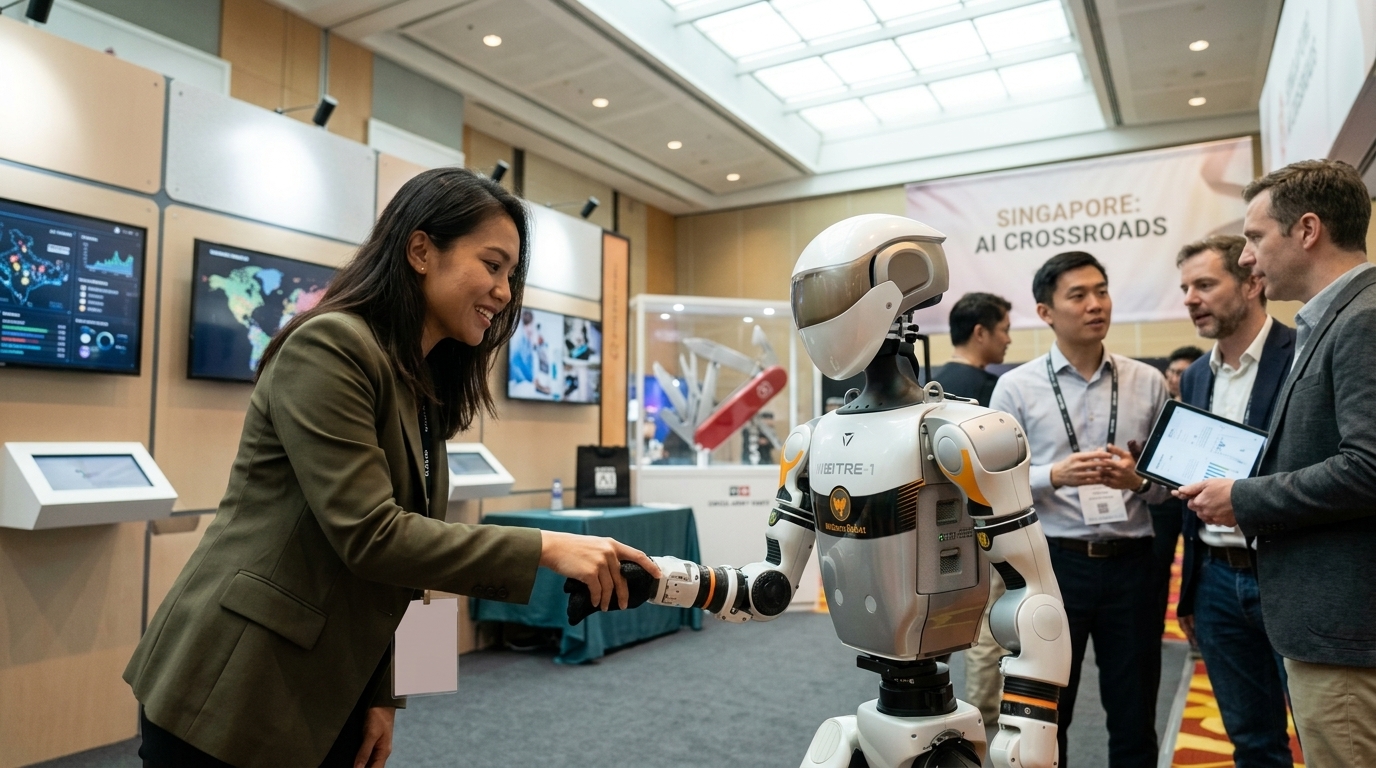
In the geopolitical chessboard of the 21st century, Singapore is no longer just a financial harbor; it has become the digital sanctuary where the two superpowers of Artificial Intelligence—the United States and China—are forced to coexist. As of June 2026, the trend that began a few years ago has solidified: Singapore is emerging as Asia’s de facto 'neutral hub' for AI, offering a rare environment where Google and Microsoft share the same neighborhood with Alibaba and ByteDance.
The Convergence of Giants on a 'Smart Island'
The strategic choice of AI titans to set up shop in Singapore is far from accidental. While Washington and Beijing raise ever-higher digital walls, Singapore has invested billions into its National AI Strategy 2.0 (NAIS 2.0). The result is an infrastructure that offers not just tax incentives, but a critical mass of talent and compute power. According to recent data, investments in data centers and AI research hubs in the country have surged by 40% compared to the previous year.
For American firms, Singapore serves as the gateway to the Southeast Asian (ASEAN) market, a region of 670 million people with a rapidly expanding digital economy. For Chinese firms, the country offers an 'out' from US-led restrictions, allowing them to operate in an environment that remains friendly to international collaboration, avoiding—at least for now—the stigma of direct state influence from Beijing.
Algorithmic Diplomacy and Regulatory Excellence
Singapore’s true 'product' is not just hardware, but trust. The government has developed one of the most sophisticated AI governance frameworks in the world, the Model AI Governance Framework. This framework acts as a 'common language' that allows Western and Eastern systems to operate under clear ethical and safety guidelines.
"Singapore doesn't choose sides; it chooses standards,"says a regional technology analyst. This stance allows entities like OpenAI to collaborate with local universities while Tencent simultaneously expands its cloud operations in the same city.
- Boosting local compute power with new low-carbon data centers.
- Attracting top-tier researchers through the AI Singapore program.
- Creating 'sandboxes' for testing generative AI in public services.
The Challenges of Neutrality and the Specter of Sanctions
However, maintaining this balance is becoming increasingly difficult. The US is exerting pressure to limit China's access to advanced Nvidia chips, and Singapore, as a transshipment and tech development hub, is under the microscope. There is a lingering fear that if Singapore is perceived as a 'backdoor' for bypassing US sanctions, Washington could impose restrictions that would cripple its economy.
Furthermore, the country’s limited physical size poses natural hurdles. AI requires massive amounts of energy and water for server cooling. Despite efforts toward 'Green AI,' Singapore must decide how much of its energy grid it will sacrifice at the altar of digital sovereignty. The recent shift toward importing renewable energy from neighboring Malaysia and Indonesia is a survival move to maintain its status as an AI hub.
The Future: A Bridge in a Fragmented World
Ultimately, Singapore’s success will depend on whether it can remain indispensable to both sides. If AI becomes the new 'nuclear arms race,' Singapore aspires to be the Geneva of this era. Its ability to host AI safety summits where scientists from both sides of the Pacific participate is perhaps its greatest contribution to global stability. In a world heading toward a 'splinternet' (a fractured internet), Singapore remains the last place where code knows no nationality.





