

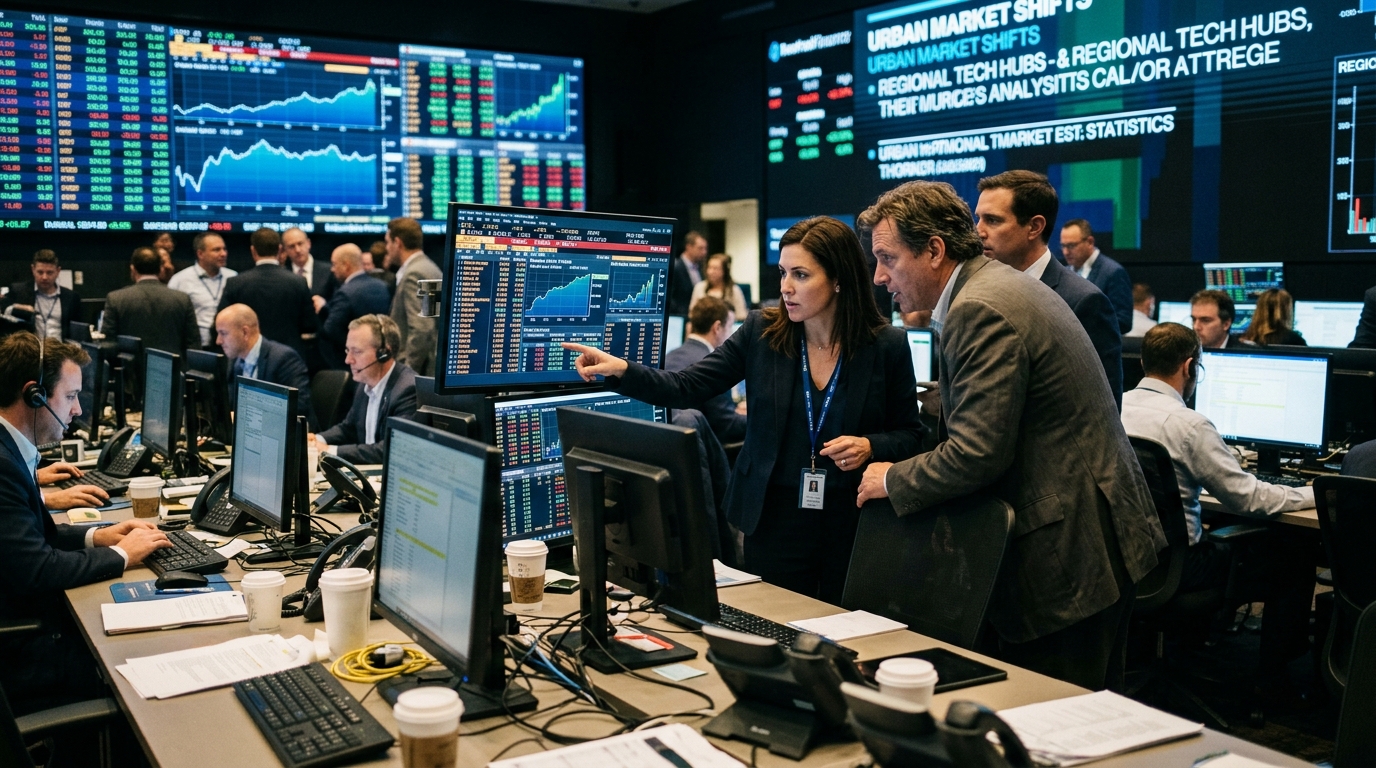
The haunting images of vacant office towers in major urban centers—a lingering ghost of the pandemic era and the subsequent rise of remote work—are finally beginning to fade. However, the catalyst for this transformation is not a simple return to the status quo, but rather the explosive growth of Artificial Intelligence. According to recent market data as of July 2026, the demand for office space from AI-focused firms is no longer confined to the traditional tech bastions of San Francisco and New York City; it is rapidly spilling over into new geographic frontiers.
This trend signals a significant maturation of the AI sector. Firms are no longer merely seeking a prestigious zip code; they are hunting for talent density, specialized infrastructure, and, crucially, a collaborative friction that only physical proximity can provide at this stage of the technological race. Despite its inherently digital nature, AI development is proving to be an intensely physical endeavor, requiring deep, face-to-face interaction between hardware engineers, software researchers, and strategic leadership.
The Saturation of the Tech Meccas
For years, San Francisco was the undisputed epicenter of the AI revolution. With industry titans like OpenAI and Anthropic anchoring the city, the Bay Area experienced a post-2020 renaissance. Yet, the cost of entry has become prohibitively high. Rents for Class A office spaces have reached astronomical levels, and the competition for local talent has hit a saturation point where poaching is the only way to grow. Similarly, in New York, the dominance of Fintech AI has consumed much of the available high-end real estate, leaving little room for emerging players who require expansive, flexible footprints.
This pressure is forcing firms to cast a wider net, looking toward cities like Seattle, Austin, Boston, and Chicago in the United States, as well as European hubs like Berlin, Paris, and London. This shift is not merely a cost-cutting exercise; it is a strategic repositioning. Boston offers unparalleled proximity to biotech research and healthcare AI, while Austin is rapidly becoming the foundry for the specialized hardware and semiconductors that power the next generation of neural networks.
The Necessity of Innovation Clusters
AI does not evolve in a vacuum. It requires robust ecosystems. The new destinations favored by AI firms are characterized by their proximity to world-class research universities and an existing industrial base. The search for office space in these secondary hubs follows a "cluster" model. Companies want to be near their peers, not just for competition, but to benefit from the continuous flow of ideas, specialized vendors, and a shared labor pool.
Furthermore, the physical requirements of these offices have evolved. We are no longer looking at rows of cubicles and laptops. Modern AI firms require spaces that can accommodate localized edge computing clusters, robotics laboratories, and massive communal areas designed for high-intensity brainstorming. This necessitates buildings with exceptional power density and advanced cooling systems—features that are often lacking in the aging skyscraper stock of traditional financial districts.
Economic Implications and the Real Estate Outlook
This geographic expansion is a much-needed lifeline for the Commercial Real Estate (CRE) sector. After years of volatility and concerns over a "death spiral" for office buildings, the steady, high-value demand from the AI sector provides investors with a renewed sense of stability. Analysts suggest that cities successful in attracting these firms will see a holistic upgrade in their infrastructure and a significant boost in high-wage employment.
However, there are socio-economic risks. The rapid influx of AI companies into mid-sized cities can trigger intense gentrification, driving up housing costs for existing residents and placing a strain on local services. It is a delicate balance that municipal governments must navigate with foresight. What remains clear is that the map of global innovation is being redrawn, and Artificial Intelligence is the pen defining its new borders.





