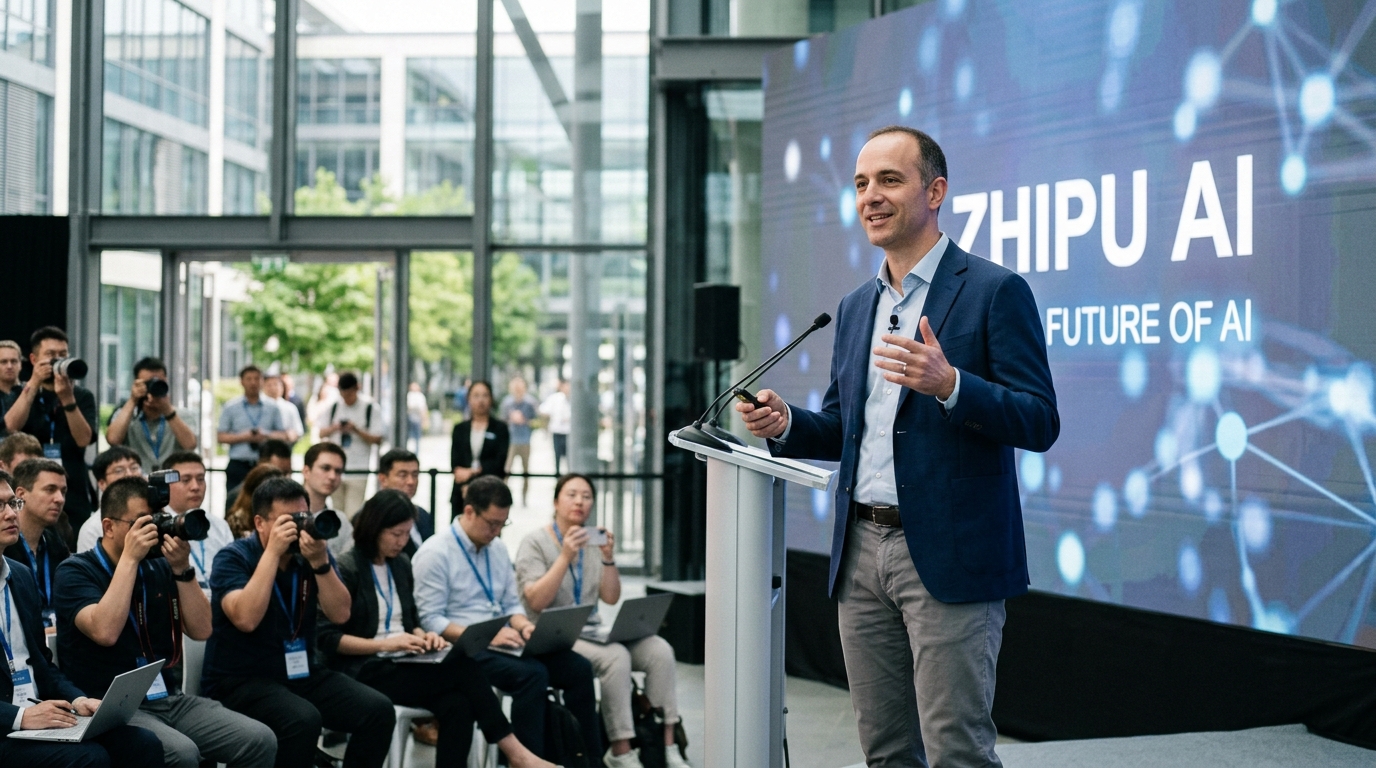
In a rare display of market resilience that defies traditional financial trends, Chinese AI powerhouse Zhipu AI saw its share value climb significantly immediately following its lockup expiry. While the expiration of such periods typically triggers a sell-off as early investors look to liquidate gains, the Zhipu case suggests a deeper, strategic commitment from Chinese capital toward domestic technological autonomy.
Zhipu AI, which emerged from the prestigious Knowledge Engineering Group (KEG) at Tsinghua University, stands at the forefront of China’s push to develop Large Language Models (LLMs) capable of rivaling OpenAI’s GPT-4 and Anthropic’s Claude. This recent market movement is not merely financial news; it is a political and technological signal to the West: China is consolidating its investor front around its national champions.
A Vote of Confidence from the Titans
The share price jump was fueled by the fact that major investors, including Alibaba, Tencent, Meituan, and the state-linked HongShan (formerly Sequoia China), chose not only to maintain their positions but, in some cases, to increase them. This rallying of Chinese tech giants around a single platform is unprecedented. Despite their fierce competition in other sectors, the necessity for a robust, domestic AI infrastructure transcends individual commercial rivalries.
Analysts note that Zhipu AI has successfully built an 'ecosystem' rather than just a product. With its GLM (General Language Model) series, the company provides solutions ranging from simple conversational AI to specialized industrial applications and coding assistants. Its ability to train high-performance models despite US-imposed restrictions on high-end chip imports has bestowed upon the company an aura of 'technological resistance.'
Academic Heritage and Technical Superiority
The secret to Zhipu’s success lies in its roots at Tsinghua University. Unlike many startups that prioritize marketing and rapid user acquisition, Zhipu maintains a rigorous academic approach to research. Its models, such as ChatGLM, are renowned for their efficiency in processing the Chinese language and cultural nuances—areas where Western models often falter due to a lack of appropriate training data.
Furthermore, the company has invested heavily in 'open science,' releasing versions of its models to the developer community. This strategy has cultivated an army of developers building applications on Zhipu’s infrastructure, making it a de facto standard for the Chinese market. The post-lockup investor support reflects a conviction that Zhipu is not just a software company, but the foundation of China’s next digital era.
Geopolitics and the Need for 'Sovereign' AI
One cannot analyze Zhipu AI’s trajectory without considering the geopolitical context. As the US continually tightens export controls on high-end semiconductors from Nvidia and AMD, China is in a race for computational self-sufficiency. Zhipu has demonstrated that it can optimize its algorithms to run efficiently even on less powerful hardware or domestic chips from the likes of Huawei and Biren Technology.
This 'algorithmic resilience' is what attracts investors. In an environment where access to raw compute power is uncertain, the intelligence of the code becomes the most valuable asset. Zhipu AI is now viewed as a 'national champion,' an entity that the Chinese state and domestic market cannot afford to let fail.
The Future: From Training to Profitability
Despite the optimism, challenges remain. Zhipu AI, like all companies in the sector, faces the question of sustainable profitability. Training next-generation models requires billions of dollars in investment, while revenues from subscriptions and enterprise licenses are still in their infancy. However, the market reaction post-lockup indicates that investors are willing to wait, viewing Zhipu as a long-term strategic placement rather than a quick-flip opportunity.
In conclusion, Zhipu AI symbolizes the new phase of global competition in artificial intelligence. It is no longer just about who has the best chatbot, but about who controls the infrastructure of cognition at a national level. With the backing of its investors, Zhipu seems poised to lead China into this new, uncertain, but exhilarating era.