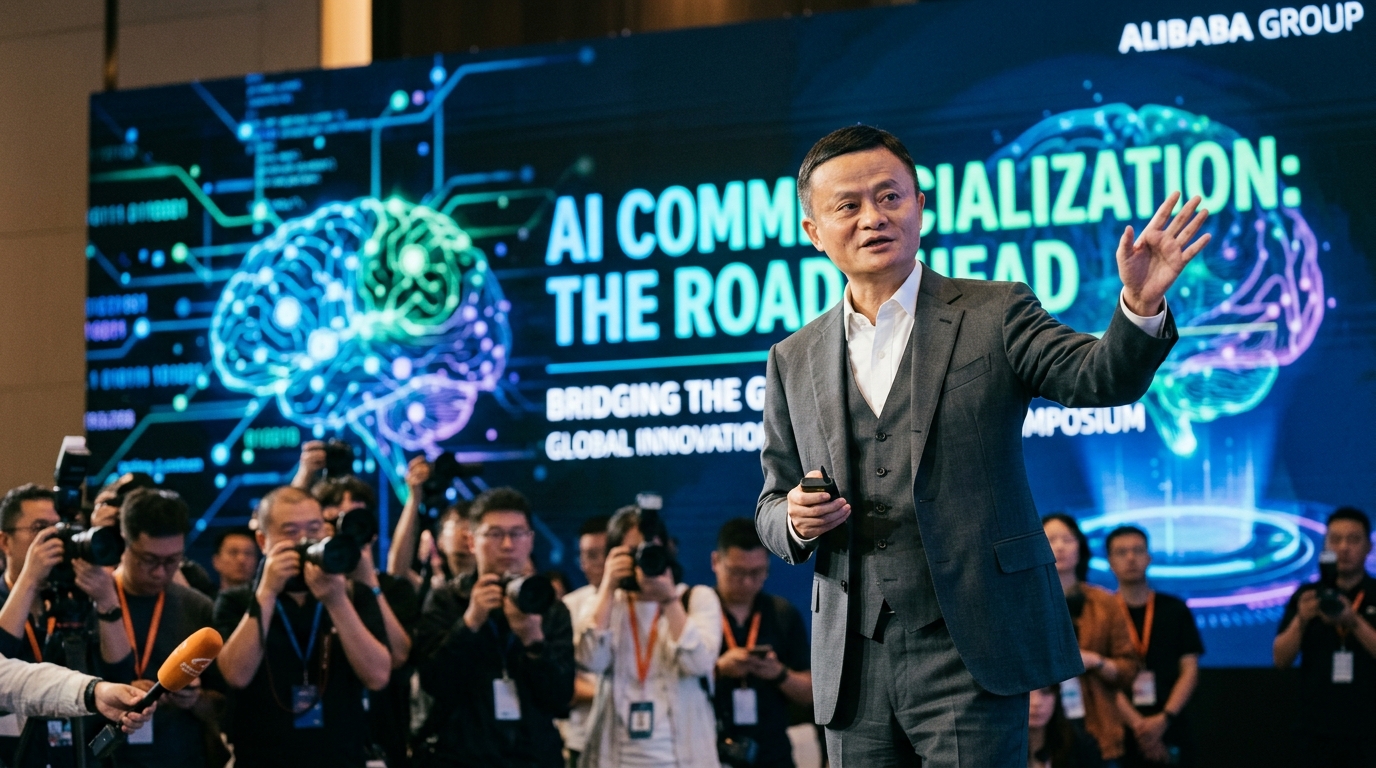
The recent stock market explosion of Alibaba, with a surge exceeding 10% in a single trading session, was not merely a random market fluctuation. It was the moment of the "expectation gap correction." For nearly two years, investors watched with skepticism as the Chinese giant attempted to reorganize under the new leadership of Eddie Wu, doubting whether Alibaba Cloud could turn the hype surrounding Artificial Intelligence (AI) into tangible revenue. The answer arrived emphatically, confirming that the commercialization of AI in China is no longer a distant dream but a present economic force.
The Expectation Gap and Market Reality
The so-called "expectation gap" arose from the distance between the promises of the Generative AI revolution and the actual financial results displayed by Chinese tech firms. While American giants like Microsoft and NVIDIA saw their valuations skyrocket, Alibaba struggled with internal restructuring and Beijing's strict regulatory environment. However, the strategic focus on "AI-driven, Public Cloud-first" has begun to bear fruit.
Alibaba Cloud managed to bridge this gap by proving that its infrastructure is indispensable for 80% of Chinese tech companies and the vast majority of domestic Large Language Models (LLMs). The market realized that Alibaba is not just a storage provider but the "operating system" of the Chinese AI economy. The increase in revenue from AI-related products, which is recording double-digit growth every quarter, was the catalyst that forced analysts to revise their forecasts.
Tongyi Qianwen: The Engine of Commercialization
At the heart of this success lies the Tongyi Qianwen (Qwen) model family. Alibaba's decision to adopt an open-source strategy for many of its models proved to be a stroke of genius. By offering powerful tools for free or at very low prices, the company created a massive ecosystem of developers who depend on Cloud infrastructure to train and run their applications.
- Market Penetration: Over 2.2 million enterprise customers now use Alibaba Cloud's AI services.
- Cost Reduction: Aggressive price cuts in cloud services allowed startups to adopt AI without the fear of exorbitant costs, while simultaneously increasing the volume of data flowing through Alibaba.
- Ecosystem Integration: Integrating AI into the Taobao and Tmall e-commerce platforms improved sales conversion, demonstrating the practical value of the technology.
This approach is not just about technological superiority but also about economic scale. Alibaba Cloud leverages its size to offer computing power at prices that smaller competitors cannot match, creating a "moat" around its operations.
Geopolitics and the Semiconductor Challenge
Despite internal success, Alibaba Cloud operates in a minefield of geopolitical tensions. US restrictions on the export of advanced AI chips, such as those from NVIDIA, pose a constant threat. However, Alibaba has invested significantly in its own processors, like the Yitian 710, and in software optimization techniques that allow for maximum performance even from less advanced hardware.
"Alibaba's ability to innovate despite constraints is a message to the West: Chinese technology will not stop; it will adapt," say Hong Kong market analysts.
The company's strategy to focus on "Public Cloud" rather than "Private Cloud" (which state-owned enterprises prefer) gives it greater flexibility and higher profit margins. While Huawei and Tencent are formidable rivals, Alibaba maintains the lead in the commercial application of AI, turning geopolitical difficulties into a motive for domestic self-sufficiency.
Conclusion: A New Starting Point
The 10% surge is only the beginning of a long-term revaluation. Alibaba Cloud is no longer seen as a "sideline" to e-commerce but as the group's primary growth engine. The correction of the expectation gap means that investors now view Alibaba as a pure-play AI company. As commercialization accelerates, the challenge will be to maintain this momentum and further penetrate international markets despite political headwinds. 2026 finds Alibaba in a position of strength that many had predicted it would have lost.