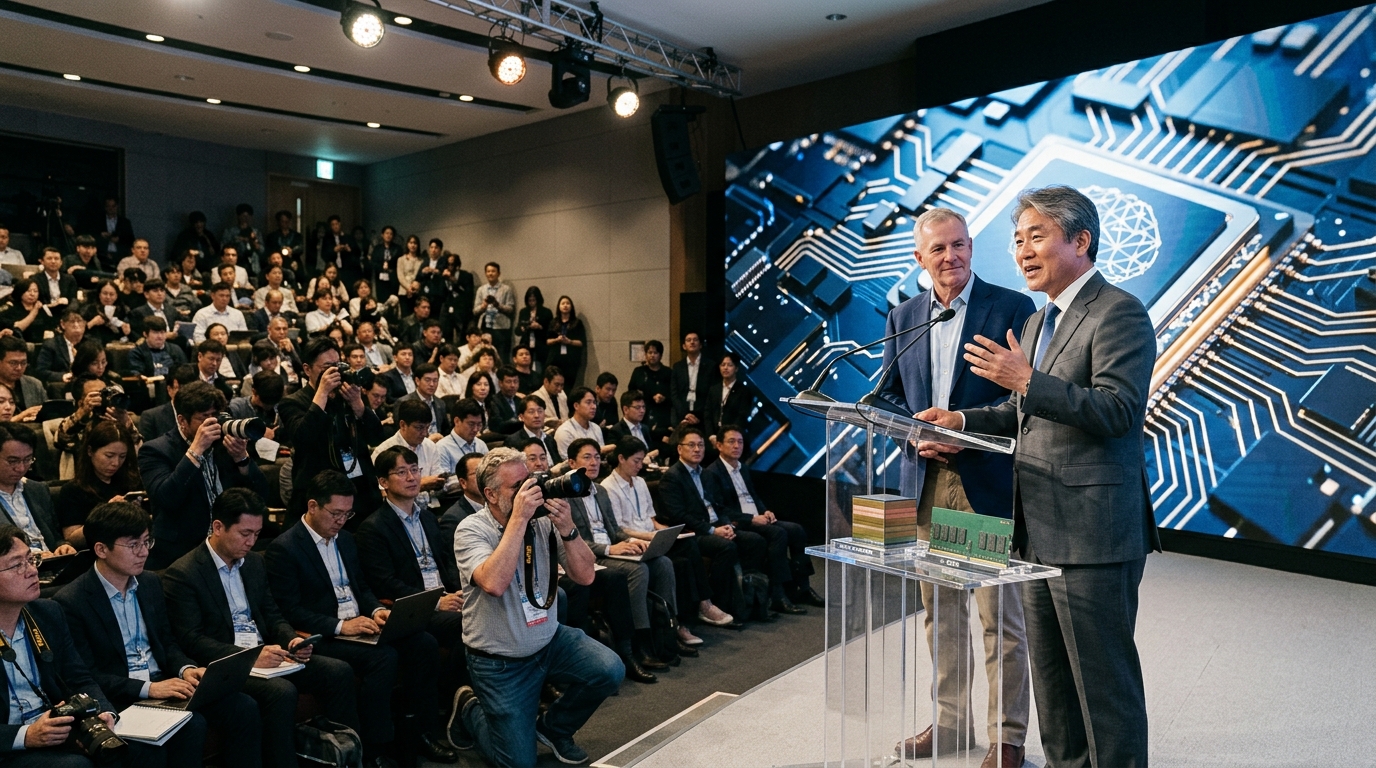
As we move through June 2026, the global semiconductor landscape is witnessing a seismic shift. While previous years saw the spotlight shine almost exclusively on Nvidia’s Graphics Processing Units (GPUs), this week has confirmed that the true heartbeat of Artificial Intelligence lies in data storage and transit speeds. Back-to-back announcements from South Korea’s SK Hynix Inc. and the US-based Micron Technology Inc. have left no room for doubt: High Bandwidth Memory (HBM) is now the most coveted commodity on the planet.
The HBM Empire and the 'Memory Wall'
For decades, DRAM memory was viewed as a simple commodity—low margins, cyclical, and predictable. However, the rise of Large Language Models (LLMs) changed the calculus. Training models with trillions of parameters requires data to move from memory to processor at speeds that traditional architectures simply cannot sustain. This phenomenon, known as the 'memory wall,' has made HBM technology an absolute necessity for any serious AI endeavor.
SK Hynix, a pioneer in HBM3E development, announced earnings that shattered expectations, noting that its production capacity for the entirety of 2026 is already sold out. Its tight-knit partnership with Nvidia has placed it at the apex of the hardware pyramid, making it the de facto primary supplier for Blackwell systems and future AI architectures. The company’s ability to maintain high yields in an incredibly complex manufacturing process gives it a strategic moat over Samsung, which is still struggling to stabilize its HBM production lines.
Micron: The American Counter-Strike and Geopolitical Stakes
Across the Pacific, Micron Technology is making its own giant leap. Bolstered by subsidies from the US CHIPS Act, Micron is no longer just a fast follower but an innovator leading the charge in energy efficiency. Micron claims its HBM3E chips consume 30% less power than competing products—a vital advantage for data centers grappling with massive cooling requirements and soaring electricity costs.
Micron’s ascent also carries heavy political weight. Washington views the company as a national champion capable of securing the AI supply chain on American soil. As tensions with China persist, the ability to manufacture critical memory components in Idaho and New York is seen as a matter of national security. Micron has announced multi-billion dollar investments for new 'megafabs,' betting that the AI demand is not a transient bubble but a permanent structural shift in the global economy.
Economic Implications and the Road Ahead
The financial health of these companies is reflected in their profit margins, which now resemble software companies more than traditional hardware manufacturers. The pricing power held by SK Hynix and Micron is unprecedented. Customers like Microsoft, Google, and Meta are willing to pay premium prices to secure the memory they need, fearing that shortages will stall their own AI service rollouts.
However, risks remain. The history of semiconductors is littered with periods of oversupply followed by sharp price crashes. If the demand for AI applications slows down, or if Samsung finally manages to flood the market with its own high-quality chips, the current profit party could end abruptly. For now, however, analysts are looking toward the next frontier: HBM4. This next generation is expected to bring even tighter integration between memory and the processor, fundamentally altering how computers are designed.
Conclusion
SK Hynix and Micron have proven that in the AI era, the 'brain' (CPU/GPU) is only as good as the 'nervous system' (Memory) supporting it. The transformation of memory from a secondary component to the star of the show marks a new epoch for technology, where physical data proximity and access speeds determine who will dominate the digital economy of the future.