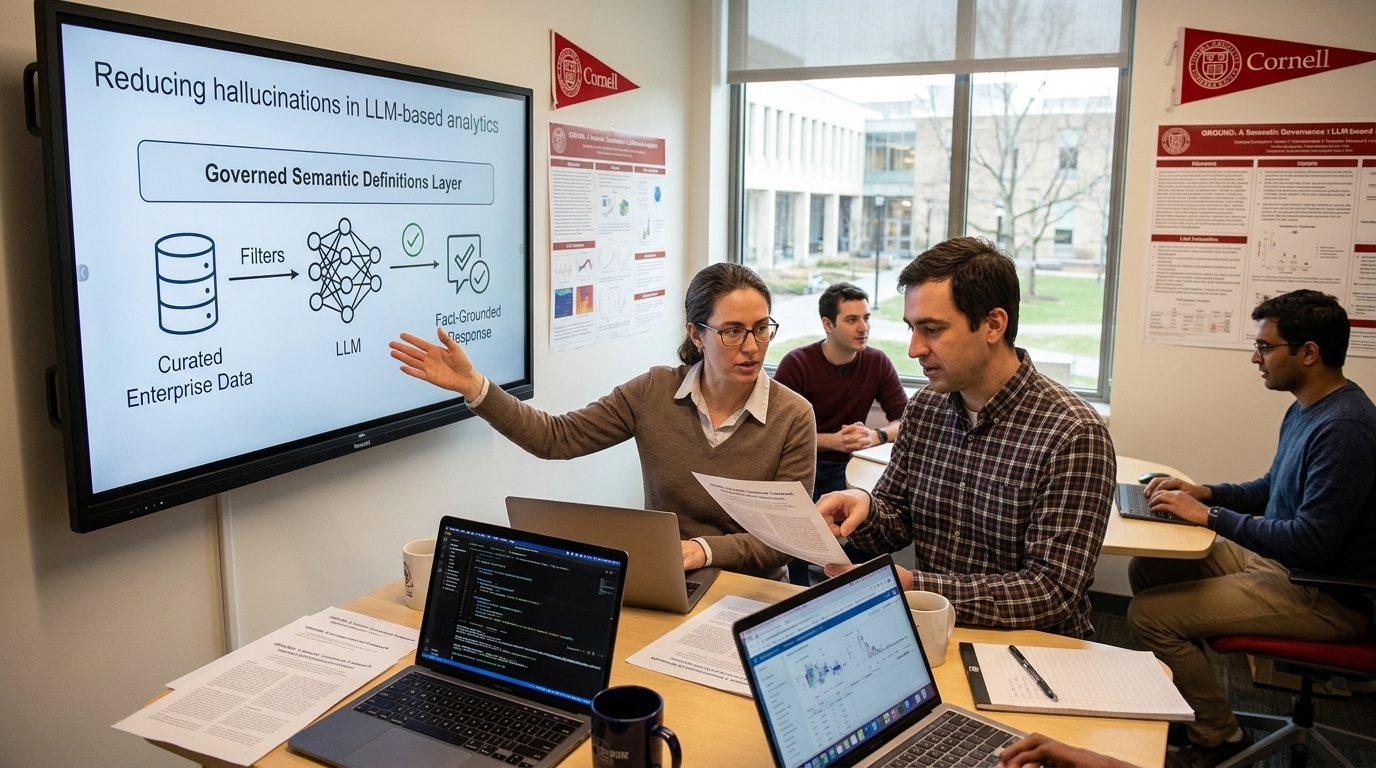
Natural-language analytics over enterprise data warehouses is becoming an essential tool, yet its production use is hindered by significant technical barriers. Hallucinated metrics, invalid joins, incorrect data grain, and unsafe access policies remain persistent issues in existing text-to-SQL systems.
The GROUND Framework
The research introduces GROUND (Governed Retrieval Over Unified Normalized Definitions), a framework designed to constrain LLM-generated analytics within a governed semantic layer. GROUND functions by supplying approved definitions and binding user intent to verified metrics and dimensions. Crucially, it validates generated SQL against schema, metric, join, grain, filter, security, and cost rules before any execution occurs. If a violation is detected, the system either retries the query or abstains from executing it entirely.
Performance and Data Governance
In benchmarks involving both synthetic enterprise reporting and real-world U.S. NHTSA vehicle-safety data, GROUND was the only system to remain free of measured hallucinations across all six evaluated categories. In contrast, ungoverned systems frequently violated row-level security protocols, leaking sensitive data. The study highlights that metric fidelity alone cannot replace governance; even systems with exact definitions leaked data when access policies were not strictly enforced. While GROUND's security guarantees held across multiple models, the researchers noted that judgment-dependent behaviors, such as refusing to process undefined metrics, remain fallible.