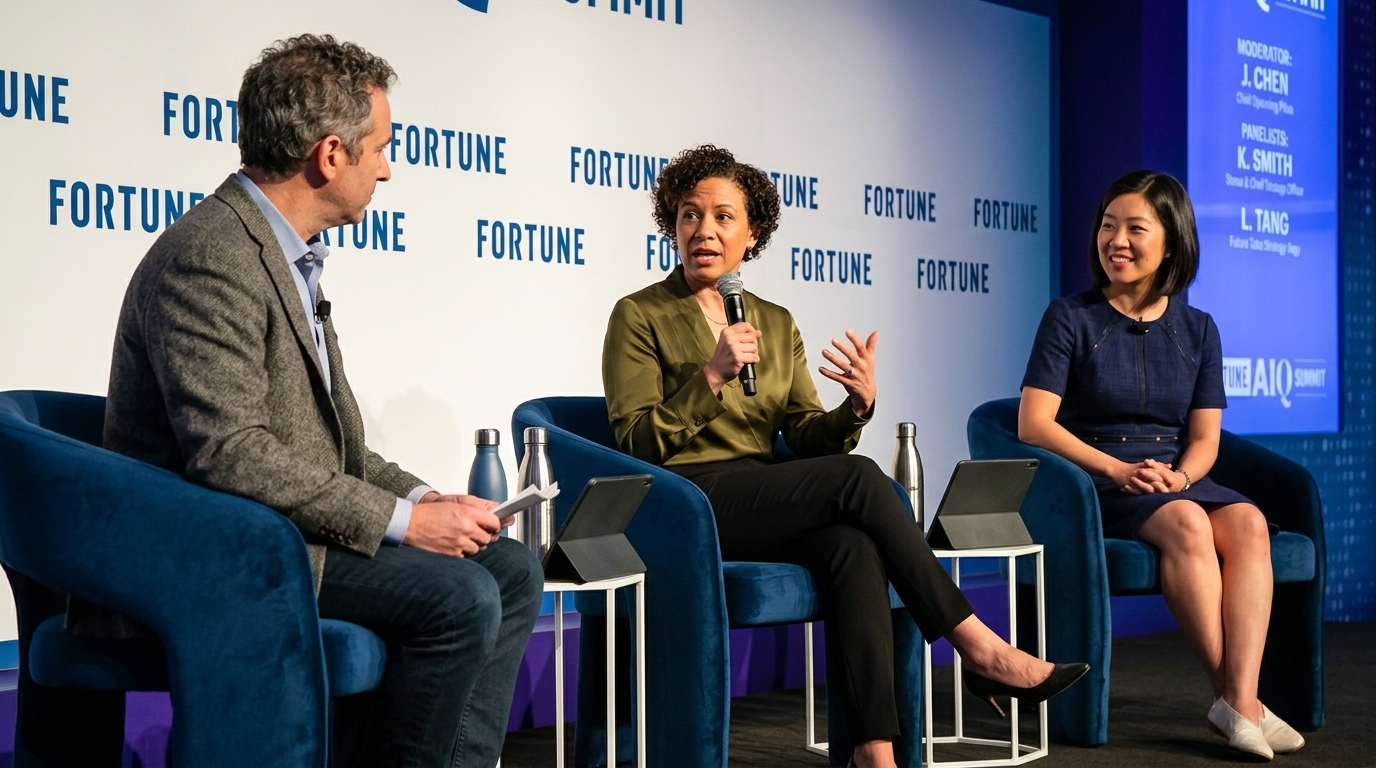
At the Fortune AIQ Summit held at the New York Stock Exchange, executives from technology, finance, and industrial sectors reached a clear conclusion: the era of scattered pilot programs is ending. The critical question for businesses is no longer whether to adopt Artificial Intelligence, but how to turn it into measurable value without creating new costs or risks.
From Adoption to Transformation
Diana David, director of futures at ServiceNow, emphasized that success is not judged by access to tools, but by operational discipline. According to ServiceNow’s Enterprise AI Maturity Index, 57% of “pacesetters” invest in ongoing AI upskilling, compared with just 4% of other organizations. The widest gap involves attracting and retaining AI talent, where the difference is 68% versus 10%.
Paul Fipps, president of global customer operations at ServiceNow, noted that the greatest gains come from rebuilding processes around new capabilities rather than simply automating old methods faster. Standard Chartered was cited as an example, where AI helped deflect 77% of employee requests.
The Workforce Challenge
AI transformation is, in reality, a workforce transformation. Stacy Dillow of HPE stressed the need for a different mindset, avoiding the mere retrofitting of AI into existing, flawed processes. Danielle Gonzalez of Palo Alto Networks mentioned that the company now looks for employees with “curiosity and agency,” capable of “unlearning” old practices to make space for new ones.
Governance and Reliability
In regulated environments, safety is paramount. Suresh Venkatarayalu of Honeywell explained that industrial customers demand 99.9999% reliability, while current frontier AI models often hover around 85%. This makes maintaining a “human-in-the-loop” essential for mission-critical operations.
Meanwhile, AJ Wijesinghe of Ecolab highlighted the economic aspect, noting that using the most advanced models for high-volume, simple tasks can be more expensive than human labor. Ecolab managed to cut token costs by 70-80% by optimizing model usage and selection.
Measurable Returns and ROI
Ewout Steenbergen, CFO of Booking Holdings, admitted that even major tech investors are uncertain about the exact ROI of AI. However, Booking is already seeing results: its 9,000 engineers are getting 30% more code into production, and customer service costs are slightly down despite growth in bookings. Their strategy involves “effective model cost routing,” using lower-cost models for simple tasks and reserving expensive ones for complex reasoning.